Pittsburgh trails competitors in industrial jobs, but leaders see bright spots ahead
Published in Business News
Pennsylvania is trailing its neighbors in recovering industrial jobs lost during the pandemic — and the Pittsburgh region is worse off than most others across the state, according to a new report from the economic development group Pittsburgh Works.
The numbers are “sobering,” said Colliers real estate firm principal John Bilyak on Thursday morning while moderating a panel discussion about the region’s industrial jobs market during NAIOP Pittsburgh’s February chapter meeting. The association represents developers, brokers and other commercial and industrial real estate professionals.
But the report does not account for some major bright spots in the market — including huge investments in shovel-ready sites and new manufacturing facilities, as well as permitting reforms that could fast-track future projects, panelists said.
Despite Pittsburgh’s current standing, “the future looks bright,” said Ken Zapinski, director of research for Pittsburgh Works and author of the new report.
‘Not a good place to be’
Per the report, Pittsburgh still does not have as many of the jobs economists classify as “goods-producing” as it did before the pandemic, while neighboring states have made a full recovery.
The category includes jobs in factories, construction, oil and gas drilling, and agriculture — all of which pay about 33% more than service-sector jobs in Pennsylvania, according to the report based on Bureau of Labor Statistics data.
Right now, Pennsylvania has 98% of the goods-producing jobs that it had in 2019, whereas Ohio and West Virginia have both surpassed their pre-pandemic jobs numbers, the report said.
The Pittsburgh region is struggling more than most and getting “clobbered” by its Ohio counterparts, according to the report.
Today, the region has just 92% of its pre-COVID-19 jobs in those sectors — far less than Philadelphia, Erie and competitors in Ohio such as Columbus, where goods-producing jobs are up 14% since 2019. Even Ohio’s worst-performing market, Cleveland, has surpassed Pittsburgh, the report shows.
Of all goods-producing jobs, construction is seen as a critical field because it acts as a harbinger for what’s to come, panelists said on Thursday. An uptick in construction jobs indicates there are facilities being built that could add permanent jobs soon.
Since the pandemic, Pennsylvania has added some construction jobs but still trails neighboring states. And Pittsburgh is lagging far behind its competitors in-state and beyond: Construction jobs are down 12% since 2019 here.
“That’s not a good place to be,” Mr. Zapinski said on Thursday.
How did Pennsylvania fall behind?
Panelists on Thursday pointed to a number of factors that could explain the region and state’s struggle to compete. Among them: a sharp increase in construction costs as tariffs drive up the price of key materials.
“We’ve had projects that were domestic and were planning to move forward and are slowing down … because that equipment is a lot more expensive,” said Eric Bitar, managing director the state’s business development agency, Business PA.
Beyond that, Pennsylvania’s weather and hilly topography often deter developers, panelists said. And the state has lost out on investment in the past because of its lengthy permitting process.
But Gov. Josh Shapiro’s expansive permitting reform effort, a centerpiece of his administration, has already cut wait times and is expected to continue speeding up development, panelists said.
Locally, Mayor Corey O’Connor made permitting a day-one priority, starting a 60-day countdown for different agencies to recommend reforms that will end in early March.
“Timing and assurances [are] a big factor,” Mr. Zapinski said.
Still, construction work in Pittsburgh is also heavily unionized — a factor that “scares certain companies away,” said Tracy Hyatt Bosman, managing director of the site selection firm Biggins Lacy Shapiro & Co. Union wages are typically higher than nonunion, a difficult standard to meet as building costs rise.
‘Considerable headwinds’
Despite those headwinds, “we’re making progress in areas and levels that we had never seen previously,” Mr. Zapinski said.
The report, which accounts for all jobs as of December 2025, does not include positions that several recent investments in new manufacturing facilities across the state are expected to create.
A multibillion-dollar data center is proposed at the site of the shuttered Bruce Mansfield coal-fired power plant in Beaver County. And statewide, Amazon has announced plans to spend at least $20 billion developing data center campuses.
U.S. Sen. Dave McCormick, R-Pa., in July announced that billions more in energy and infrastructure investments were coming to the state, with the prospect of creating thousands of jobs.
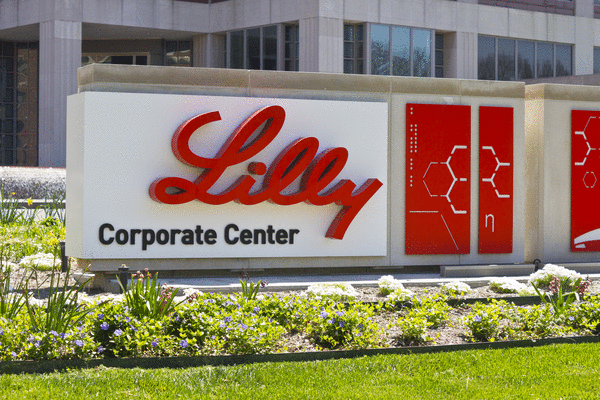
And in Eastern Pennsylvania, the pharmaceutical giants Eli Lilly and Johnson & Johnson have each committed to building new facilities.
These projects underscore Pennsylvania’s strengths, panelists said. Manufacturing, in particular, is a bright spot for the state — it boasts less manufacturing job loss since COVID-19 than its neighbors, according to the report.
Mr. Shapiro’s PA SITES program has also invested millions of dollars in creating shovel-ready land for future business development.
With big, regional projects such as renovations within Pittsburgh International Airport wrapping up, Pittsburgh has a large labor supply available for future projects on that land, panelists said. And thanks to a high degree of unionization and apprenticeship programs statewide, workers are more likely to be upskilled here than in many other places — a selling point for the region, they added.
“I often hear from developers that they would prefer to use union contractors because they know it’s going to get done right,” Mr. Bilyak said.
“We can create any training program out there — it doesn’t matter what it is,” added local carpenters union representative Steve Mazza at Thursday’s meeting.
If Pittsburgh can secure deals, it can staff projects, Mr. Zapinski said — a possible solution to the region’s current industrial jobs performance.
“We have considerable headwinds in this region, some of our own making, some we can't do anything about,” Mr. Zapinski said.
“Everything we touch — every department, every economic development agency, every union, every contractor — we have to be better than everybody else,” he added. “We just have to raise our game and be better.”
©2026 PG Publishing Co. Visit at post-gazette.com. Distributed by Tribune Content Agency, LLC.










Comments