Aaron Brown: Positive trends defy trope of decline in greater Minnesota
Published in Business News
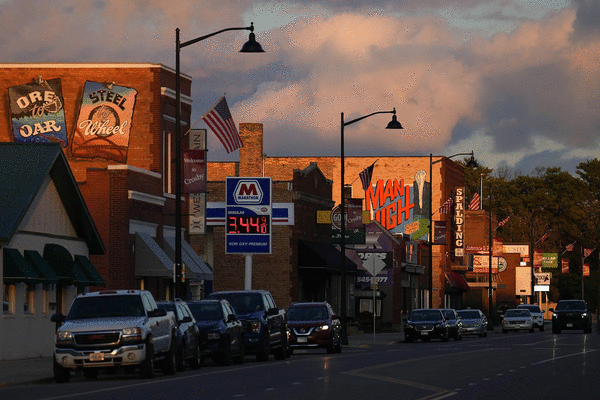
MINNEAPOLIS — New research shows rural counties across Minnesota growing for a change. The timing gives greater Minnesota a one-time opportunity to capitalize on overlooked resources — many of them human — to prepare for a rapidly changing future.
This month, the Center for Rural Policy and Development released its annual report, “The State of Rural 2026.” It shows that from 2020-2024 most rural counties posted a modest increase in population after decades of decline. In addition, rural counties saw the highest percentage of self-employed people and the fastest growth in median wages.
Analysis shows many hazards ahead, including declining birthrates and an aging population. Over time, rural areas will see slower growth, along with the state as a whole. But for now, rural areas find themselves boosted by a new generation of workers, leaders and entrepreneurs.
“We need to set aside this narrative that rural is dying, because it’s not,” said Marnie Werner, co-author of the study, when I spoke to her last week.
Two groups seem to be fueling the swing: early and midcareer professionals returning to their roots and seniors retiring to the lakes and woods of rural Minnesota.
Holly Miller came home in 2019. A native of Hibbing, Minn., she spent the first half of her career working in academic administration across Minnesota and Wisconsin. Things were going well, and she saw the possibility of being a college president in her future. But her family was back home, and she and her husband wanted something different.
“You start to realize that you’re building community somewhere where you don’t have roots,” said Miller. “And that’s not a bad thing, but in my case, I was just going to keep continually moving every several years for growth professionally, and that wasn’t bringing me joy.”
Her husband, Steve, is from the Rochester area. Now he’s an equipment operator for the city of Hibbing, availing himself of opportunities to hunt and fish in northern Minnesota. Holly was planning a statewide seminar when I called, such work being a part of her job with the St. Paul-based Minnesota State Colleges and Universities system. She works from their home on the rural edge of Hibbing, where she and Steve raise their two children.
In Miller’s case, high-speed internet was key to her relocation. Werner said the improvement of high-speed networks across rural Minnesota contributed to successful rural in-migration that started during the COVID-19 pandemic, a trend that has held.
Health and education services, followed by government, remain the largest employers in rural areas, but these areas also have the highest proportion of self-employed individuals.
“The entrepreneurship in rural areas has really gone up,” said Werner. “Back before the [2008-09] recession there was such a focus on attracting businesses, trying to attract those large employers. And then slowly the thinking turned, and they started thinking let’s just attract people and entrepreneurs and support people in starting their own business.”
One such couple is Drs. Colton and Hannah Hudelson of Hibbing. They met their first year of dental school at the University of Minnesota in the Twin Cities. Colton was from Hibbing; Hannah hails from southern Minnesota.
After they got married in 2020, they wanted to start a shared practice somewhere rural, deciding on Colton’s hometown. Now they have two boys, ages 4 and 2, with another child on the way.
Colton said he was “blind” to his hometown growing up, but grew to appreciate it more when he left, especially its proximity to nature.
“I have easy access to share my love of the outdoors with my children,” said Hudelson. “Babies don’t have a lot of patience, so it’s good to be able to go really quick and not take a whole day right outside of town.”
The Hudelsons are also an example of another reason rural populations grew recently. Not only are young professionals coming home, but they’re bringing a spouse and children, too.
When I spoke with Miller, she rattled off dozens of people from her high school class who had returned to the area: teachers, doctors, diesel shop managers, bankers and businesspeople. She’s reconnected with them as they volunteer for school and community activities.
But getting people to move to rural Minnesota takes more than just a homesick expatriate.
“If we want towns to be able to take in these new people coming in, then they’re going to need some help,” said Werner.
Werner suggested affordable housing options and upgrades to aging water infrastructure as two areas where the state and federal governments could help greater Minnesota communities. These issues prove costly and work against one of rural Minnesota’s best attributes: a low cost of living relative to wages, according to the State of Rural report.
So, yes, rural school budgets are reeling from declining enrollment. Most small towns have taken a knock or two since their heyday. No region in our state may avoid the social problems and political divisions of our times.
But hope endures. An optimistic report like this shows only what you can see for yourself when you visit rural Minnesota. You meet moms and dads, teachers and coaches, new business owners, along with skilled professionals at hospitals and legacy companies. Instead of being stuck in the past, they’re investing time, energy and resources into their changing communities.
Hard times lie ahead, no doubt. But if a new generation can rebuild and reinspire our rural communities, the challenges ahead will be surmountable.
©2026 The Minnesota Star Tribune. Visit at startribune.com. Distributed by Tribune Content Agency, LLC.








Comments