Residents, elected leaders protest proposal to move the White Sox
Published in Business News
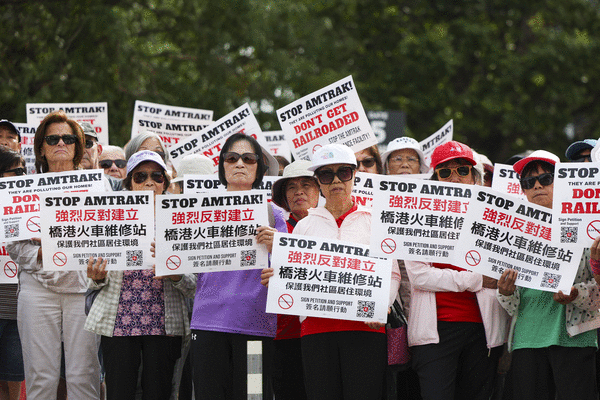
CHICAGO — Hundreds of residents from Bridgeport, Chinatown and Armour Square gathered at Rate Field Tuesday morning to protest plans by Amtrak and billionaire Justin Ishbia to establish a giant railroad maintenance facility nearby and possibly move the White Sox out of the team’s longtime home on the South Side.
Ald. Nicole Lee, 11th, said residents were blindsided by the proposal, announced in August, and don’t want to lose the White Sox or see the railroad move into Bridgeport.
“We’re obviously seriously alarmed, that yard is going to be right over your shoulder,” Lee told the crowd at 35th Street and Shields Avenue. “Our community feels pretty disrespected. If it’s approved, it would drive a knife through the heart of this community.”
Amtrak’s $900 million plan would open up enough land for Ishbia, a minority owner of the White Sox, to plant a new riverfront stadium for the team at 14th Street, and force South Side residents to deal with pollution caused by chugging Amtrak trains, Lee said.
“No 24-hour maintenance facility belongs in a residential area,” Lee said.
Amtrak did not respond to a request for comment.
Lee was joined by community activists and several politicians representing the area, including Cook County Commissioner John Daley, along with several mayoral contenders. All spoke out against Amtrak’s plan.
“We’re stating in no uncertain terms our vehement opposition,” 24th District state Rep. Theresa Mah said.
U.S. Rep. Mike Quigley, a declared candidate for next year’s mayoral election, said he agreed Amtrak needed a new, more modern facility, but criticized what he called the railroad’s rush to build in Bridgeport just north of Rate Field.
“You do need a new maintenance facility, but not here,” he said.
Quigley and others, including Illinois Comptroller Susana Mendoza, another mayoral hopeful, said a full environmental review should be conducted. Amtrak’s plan calls for a new, four-story maintenance facility along a railroad viaduct just north of 35th Street. The property is currently used by the Union Pacific railroad.
“(The community) deserves full transparency now, not after the decision has been made,” Mendoza said.
Reinsdorf in 2024 proposed moving the White Sox from Rate Field to a new stadium at The 78, the South Loop site where developer Related Midwest is building the Fire stadium. That proposal fell apart because it required massive public subsidies, and was strongly opposed in Springfield.
Ishbia unveiled his proposal for the development at 14th Street on Saturday morning. Called The Railyards, renderings show a new White Sox ballpark on Amtrak’s current maintenance site near the Chicago River, along with a new mixed-use campus, largely dedicated to healthcare and occupied by Northwestern Medicine.
The billionaire purchased a minority stake in the White Sox five years ago. He has the option to purchase a controlling stake in the ballclub after 2034 from longtime owner Jerry Reinsdorf. The team’s lease at Rate Field runs out in 2029.
Ishbia would purchase Amtrak’s 47-acre facility on 14th Street once the railroad took control of the railyard near Rate Field. He said the new White Sox stadium would be privately financed.
Ishbia is also deeply involved in Amtrak’s Bridgeport plan. Canal Edge, his development firm, would develop the site, and Ishbia has said he will invest $125 million into the new facility.
Crain’s Chicago Business first reported the latest White Sox stadium plan.
The team’s current ownership said the pair of proposals, to move Amtrak and then replace its facility with a new stadium, is not a done deal.
“The White Sox were completely unaware of the extent of Amtrak’s plans, including the scope and scale, prior to their public announcement,” a team spokesperson said in an email.
“Justin Ishbia approached us about his vision for the Canal Edge development as a possible future site for the next White Sox ballpark once our lease at the state-owned Rate Field ends,” the spokesperson added. “He agreed to conduct a multi month study and evaluation of the site and to present those findings to the White Sox for consideration. If the site proves viable, it would be added to the locations up for consideration for a new ballpark, along with The 78 and other options.”
For his part, Mayor Brandon Johnson carefully struck a neutral tone when questioned about Ishbia’s plan Tuesday. He called the proposal “just a concept” when asked if he supports the new stadium.
“No official decision has been made here,” Johnson said during an unrelated Little Village news conference. “I think it’s important that we center the voices of the community around any type of economic development.”
While he avoided taking a stance on the stadium and the potential use of tax increment financing dollars to facilitate construction, Johnson cast Ishbia’s announcement as “further evidence of the confidence that businesses have in growing in Chicago.” He did not directly refer to Lee and Daley’s opposition, despite repeating that “community voice has to be centered in all of this.”
“If anything were to move forward, the process of course will adhere to local, state and federal regulations around it,” he said. “This is just that much more proof that people have confidence in my administration.”
Amtrak announced in August that it will receive nearly $700 million in federal funds to acquire the Union Pacific site near Rate Field, develop the new Amtrak facility and make improvements to local infrastructure.
Interim Amtrak President Byl Herrmann said modern facilities were essential to providing customers with timely service.
“For years, Amtrak’s Midwest and national rail customers and state partners have been desiring improved on-time performance,” Herrmann said in an August statement. “Investments in maintenance facilities will achieve that outcome. With these grants, Amtrak is able to accelerate those goals by more than a decade while improving conditions to deliver a safe, reliable, and efficient passenger rail service for years to come.”
An Amtrak spokesperson also said in August that the railroad had received from the Trump administration an exemption from a federal environmental review.
Lee called the exemption a “red flag,” but she’s not sure how much power city officials have to halt Amtrak’s current plan. With its federal exemption, the railroad might be able to bypass city zoning officials and the buildings department, Lee said.
“We still have not seen a site plan for this, and they want to put shovels in the ground in a matter of months,” she said.
Ald. Pat Dowell, 3rd, attended Tuesday’s protest and said city officials and surrounding communities such as Wentworth Gardens were being left in the dark by Amtrak.
“No formal plan has been submitted to the city of Chicago that I’m aware of,” she said. “Normally when you do a project of this scale, you do a lot of community engagement. It doesn’t seem like this is a Chicago process. It looks like a Washington, D.C.-led effort.”
©2026 Chicago Tribune. Visit at chicagotribune.com. Distributed by Tribune Content Agency, LLC.









Comments