Pacific Northwest power crunch starts with AI. The bigger challenge may come after
Published in Business News
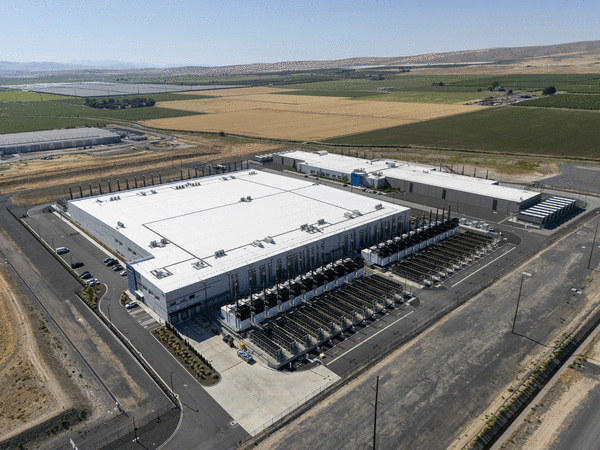
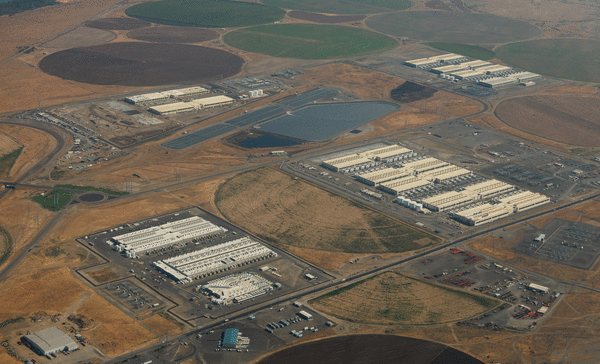


The Northwest is preparing for its largest grid build-out in decades to meet a historic surge in electricity demand, expected to cost billions of dollars.
The problem is, nobody really knows how big it needs to be.
The region could need between 40% and 100% more electricity in the next two decades, according to the Northwest Power and Conservation Council, a power-planning body for Washington, Oregon, Idaho and Montana, which published a draft plan last month for the region’s power build-out.
It's a huge range, more than 10 times wider than Seattle’s average electricity use.
“The level of uncertainty associated with the load forecast in this plan is much greater than it’s ever been,” said KC Golden, a Washington representative on the council.
Data centers are the biggest driver of uncertainty. They could be the largest or the smallest of the region’s new major loads, and they’re expected to arrive first, which some worry could allow them first dibs on scarce grid infrastructure.
But the bigger grid challenge may come after, as the region electrifies vehicles and buildings. Their arrival is slower and more predictable, but they need energy in concentrated bursts, a challenge that grid operators haven’t yet figured out how they’ll handle.
Utilities won’t have the luxury of waiting for those questions to be answered before they start building. And they face huge consequences if they get it wrong.
Build too little and risk outages. Build too much and waste ratepayers’ money at a time affordability concerns are spiking. Build the wrong kind and you could have both problems.
“We are at another junction in history when some very expensive and potentially controversial decisions are going to be made on the public’s behalf and on the public’s dime,” Golden said.
First dibs
New data centers in the Northwest may end up using only about as much power on average as Seattle does, or they may consume five times that by 2046, according to the council’s forecast.
“Planning for the growth in these large loads is one of the biggest challenges facing the region,” the council wrote in its draft plan.
One reason for the uncertainty is that data center companies often shop multiple locations and submit requests for projects that may be duplicates or never materialize. Utility regulators are considering requiring developers to show more evidence that they’re serious — or put more money down — when they apply for utility service.
Regardless of how many arrive, data centers are expected to connect earlier than other loads as tech companies race to meet demand for artificial intelligence. Electric vehicles and buildings will demand power more gradually, ramping up only as fast as consumers buy cars, heat pumps or induction stoves.
Golden said the risk is that data centers could claim grid capacity before electric vehicles or heat pumps arrive in full force.
“Are they getting to the cheap renewables first? Are they getting to the available transmission pathways first? Are they siting in the places where siting is going to be easiest first?” Golden said.
Many clean energy projects are backlogged on available transmission — the high voltage lines that transfer power from where it’s generated to where it’s consumed, which remains “the most critical limiting factor for clean energy development in Washington,” according to state analysis.
Even requiring data centers to bring their own power would not necessarily solve the problem, Golden said, since they would still compete for a limited pool of lines, equipment, workers and easily developed sites.
State lawmakers and utility regulators are working to shield other customers from data-center costs, but neither effort has looked at reserving grid capacity for future electrification.
Both regulators and lawmakers, however, have talked about requiring data centers to reduce their electricity use at certain times, which could leave room on the grid for the more complicated loads arriving later.
Peak, not average
When utilities build out the grid, all the wires, generators and equipment they use have to be able to accommodate not just average electricity use but peak demand.
While data centers are relatively stable in their electricity use, EV charging is concentrated in the hours that people get home from work and heat pumps use much more electricity at extremely cold temperatures, causing both to have higher peak demands.
Heat pumps, in particular, are going to be very 'peaky,' ” said Arne Olson, a senior partner at energy consulting firm E3. He said they will be especially difficult to serve because their winter peaks coincide with times that wind and solar can produce less power. Because of that, Olson said heat pumps — more than data centers and EVs — will drive the need for new gas “peakers,” power plants that only run when needed.
It's possible that EV and heat-pump-related peaks could be cut significantly, and doing so would reduce the need for costly new infrastructure. But that comes with its own trade-offs.
An E3 study commissioned by Washington state found that better-performing heat pumps and insulation could cut the extra peak demand from building electrification by 25% to 50% and hybrid heat pumps that switch to gas on the coldest days could cut it even further. But that would come at a higher upfront cost for homeowners or prolong the region's reliance on fossil fuels.
The peakiness of EVs could be even more manageable.
Left alone, most EV owners have been found to charge their vehicles as soon as they get home from work. But the more that charging can be spread out, the less the grid needs to be built out, saving ratepayers money. Utilities could incentivize owners to do that by setting electricity prices higher in the evenings and lower overnight.
Going further, a recent study of Washington EVs found that utilities taking direct control of EV charging (with the option to opt out) reduced peaks by up to 50% and could defer some grid upgrades by as much as a decade. But it’s unclear how widely utilities will adopt this.
If customers sense a risk their car might not be charged when they need it, “that’s a no-go. It’s a nonstarter for almost everybody,” Olson said. Utilities are still figuring out what consumers' appetite is for moving their electricity use, which has huge ramifications for the grid build-out.
“The road is still kind of unrolling before us,” Olson said.
Keeping options open
Despite the uncertainty, the region still needs a road map.
Last month, the council published a draft plan calling for 9 gigawatts of new renewable energy, 5 gigawatts of battery storage and 2 gigawatts of natural gas generation over the next six years — a pace of construction the Northwest hasn’t seen in decades.
The council is aiming for a “sweet spot” between the low and high forecasts to prevent both underbuilding and overbuilding, said Jennifer Light, its director of power planning. Every year, the council plans to reassess power supply and demand and adjust course as needed, although “dialing back is probably easier than dialing up,” Light said.
One of the easier ways to dial up if demand comes in higher is energy efficiency, Light said. Although the simplest savings like efficient light bulbs have already been taken, utilities can still cut demand by helping customers install more efficient water heaters, heating and cooling systems, pumps, and fans, she said.
Or demand might fall if supply can't keep up. Golden said that if the region can’t build out its grid fast enough, some proposed data centers may never get built — what he called a “self-leveling” effect.
If data-center growth comes in lower, Light said, batteries would likely be the part of the build-out most affected. When the council modeled lower data-center demand, it still found a need for roughly the same amount of renewable energy but with less backup capacity needed.
Politics could also change the final grid build-out. Light said the council has heard arguments that the draft plan calls for too much gas — or, from others, that it doesn't call for enough — with similar disagreements over other resources in the plan.
The council is accepting public comments on the draft through Oct. 16 and plans to finalize the Ninth Power Plan by the end of the year.
Editor's note: Photographs taken for this report were supported in part by EcoFlight, a nonprofit using small aircraft to provide an aerial perspective with a mission to educate and advocate for wild lands, watersheds and culturally important landscapes.
©2026 The Seattle Times. Visit seattletimes.com. Distributed by Tribune Content Agency, LLC.










Comments