News organizations publish Florida's secret examination of insurer profits
Published in Business News
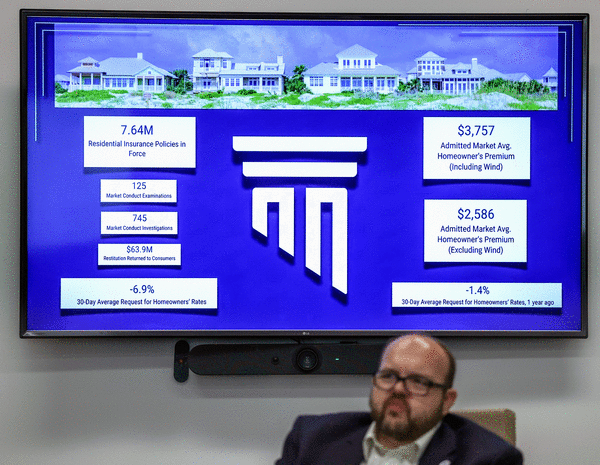
Ten days ago, the Florida Senate demanded that the Orlando Sentinel and South Florida Sun Sentinel destroy a long-hidden state report detailing property insurers’ payments of millions to sibling companies whose profits remained secret.
Now the news organizations are publishing the complete report.
The existence of the 2022 “Affiliated Fee Analysis” of insurer profits and losses, performed for the state Office of Insurance Regulation by Risk & Regulatory Consulting, LLC, has been publicly known since early 2025, drawing widespread interest and some criticism even though relatively few people have ever seen it. The analysis explored payments and practices that might obscure insurers’ true financial health, undermining the work of regulators while generating higher premiums for policyholders.
Florida Insurance Commissioner Michael Yaworsky told a House committee in 2025 the analysis was never released because it was an unfinished draft. In more recent statements, his office branded the report as an “incredibly flawed and outdated” product that “should never be relied upon as accurate.”
Consumer advocates and industry watchdogs, though, have accused Gov. Ron DeSantis’ administration of deliberately burying the consultant’s analysis four years ago as lawmakers approved sweeping legal and financial reforms that benefited — and some say saved — the insurance industry.
“The people of Florida who paid for this report deserve to see the truth — what’s happening to their money once the insurance company takes it out of their pocket and then comes back later crying poverty and needing to raise premiums,” said Doug Quinn, executive director of the American Policyholder Association.
The analysis, which cost the state about $150,000, was obtained by the news organizations through a public records request to the state Senate. The Senate’s general counsel, Tom Thomas, later said its release was inadvertent and that it contained “sensitive, proprietary trade secrets” as he demanded its destruction and threatened “civil or criminal legal implications.”
The Sentinel and Sun Sentinel published a story on those threats last weekend along with a summary of the analysis. The full report is now available through the news organizations’ websites, part of the launch of “Uncovered,” a joint investigation of Florida’s property insurance crisis.
“This report was obtained legally through a public records request and has information that’s important for everyone making homeowners insurance decisions,” Roger Simmons, executive editor of the Orlando Sentinel, and Gretchen Day-Bryant, executive editor of the Sun Sentinel, said in a joint statement. “Instead of destroying it or hiding it, as the Florida Senate requested, we believe it’s in the best interest of our readers — and Florida residents — that the report be made public so everyone can have access to its information.”
Though some of its data is nearly a decade old, the report remains the deepest exploration in recent years of key financial issues that have been at the center of the homeowners insurance debate in Tallahassee. The consultant examined records for 53 companies from 2017 to 2019, a pivotal time for property insurers that preceded a multi-year market meltdown brought on by hurricanes Irma and Michael. In 2021 and 2022 alone, seven Florida-focused insurers went insolvent.
The use of affiliates is legal and has long been a standard practice in the insurance business. These sibling companies, which share ownership with the primary insurer, perform services like underwriting, claims handling, accounting and information technology.
But Florida law requires payments between insurers and affiliates to be “fair and reasonable,” even though no state statute clearly defines what that is. That’s been the source of much scrutiny from industry watchdogs who say the use of affiliates can hurt consumers if the companies reap inflated fees that deplete the primary insurer’s ability to pay claims.
Overall, excluding several outliers, the insurers in the study claimed $432 million in losses from 2017 to 2019, while paying fees to their affiliates that generated $1.3 billion in net income, according to the news organizations’ review of the consultant’s numbers.
In the consultant’s opinion, 20 insurers were paying affiliates at a rate that was presumed to not be fair and reasonable, based on a comparison of the company’s net income with that of its affiliates. In some cases not enough information was provided by insurers to make a determination, according to the report, and the consultant urged the state to scrutinize those insurers more closely. Often the state lacked up-to-date information from insurers explaining the rates, and again the consultant urged closer attention.
The news organizations counted at least 17 companies in the analysis, individually or as part of an insurance group, which publicly reported operating losses while also paying their affiliated companies more than they claimed to have lost. Insurers regularly stamped that affiliate income as a “trade secret.”
For instance, the report says, Security First Insurance reported about $27 million in losses while affiliates receiving 30% of the insurer’s gross written premiums earned over $50 million in net income. PURE Insurance, a “reciprocal exchange” insurer geared toward high net worth homeowners, claimed $9 million in losses while paying 22% of gross premiums to affiliates that earned $176 million, according to the report.
In contrast, Homeowners Choice Property & Casualty Insurance Co. reported $28.7 million in net profit for its insurance operation but $85 million in net income for its affiliates, which received 28.5% of the insurer’s gross written premium, the report said.
Based on those comparisons, the Risk & Regulatory consultant deemed the insurers’ affiliate payments “presumed not to be fair and reasonable” in all three cases.
In advance of publication, the Sentinel and Sun Sentinel reached out to executives at insurance companies flagged by the consultant for affiliate fees that were presumed to not be “fair and reasonable,” summarizing the report’s analysis of their company’s operations. Most did not respond, but several did.
Those industry representatives objected both to the report’s methodology and its premise, calling the affiliate structure a standard framework that is highly scrutinized by state insurance regulators. They noted that affiliates often give money back to insurers as capital contributions to bolster the companies’ finances, a practice also noted in the consultant’s report, and objected to any notion their fees are not fair and reasonable.
Security First Insurance CEO Locke Burt said his company’s affiliated agreements are in line with what the services would cost on the open market, and the report doesn’t capture the total picture of Security First Insurance’s finances. He said his company lost about $150 million from 2017 to 2022, requiring the owners to contribute about $25 million and borrow over $100 million to keep the business afloat.
“The narrative that the subsidiaries and MGAs are a clever way to hide money is absolute nonsense,” he said, referring to a managing general agent, a type of affiliate given authority to underwrite and price risk on behalf of insurers.
Paresh Patel, CEO of HCI Group, which includes Homeowners Choice and TypTap Insurance, said in a statement the consultant’s “arbitrary standard of what is deemed fair and reasonable” used limited data and wasn’t applied consistently among companies.
“Overall, we think the analysis was biased against the single state carriers that supported Florida in a time of crisis,” Patel said.
PURE also objected to any implication that its fees are not fair and reasonable.
“A presumption in an unfinished draft is not a finding. … PURE’s reciprocal structure is a key reason behind PURE’s exceptional service record, and PURE disputes any characterization of its attorney-in-fact arrangement as other than fair and reasonable,” said Kristin Piccini, a company spokeswoman. Piccini said the consultant also overlooked that PURE’s key affiliate, referred to as an attorney-in-fact in its “member-owned” reciprocal structure, “provides substantial and explicit capital support to the reciprocal insurer.”
The newly released documents underpin an executive summary of the consultant’s report that was first made public by the Miami Herald and the Tampa Bay Times in early 2025. That revelation led to hearings in the Florida House and efforts to boost state oversight of affiliate transactions.
The Senate’s recent demands to squelch the report have sparked renewed, bipartisan calls for greater consumer transparency in the future.
In a social media post, Republican candidate for governor Byron Donalds blasted efforts to hide insurer finances as “unacceptable,” vowing to “create a first-of-its-kind Insurer Scorecard and reform regulations so that insurance companies cannot secretly overcharge consumers.”
Gwen Graham, the running mate of Donalds’ Democratic opponent David Jolly, weighed in too on social media: “It is time for change in Tallahassee. Time to put Floridians first,” she wrote.
Not a new issue
The use of affiliates has been a recurring debate in Florida’s insurance market.
Florida, like other states, controls the rates insurers may charge their customers. In rate-setting, regulators typically use a profitability benchmark of about 4.5% for the primary insurer. But they do not directly limit or cap the profits of the insurers’ affiliates, which consumer advocates say can create an incentive for companies to make higher returns with that part of their business.
State regulators review contracts with affiliates and evaluate how much is being charged to the insurer, said Jane Nelson, the Office of Insurance Regulation’s deputy commissioner of property and casualty. State lawmakers provided insurance regulators in 2021 with expanded authority to examine the finances of affiliates.
“We’ve found contracts before that we’ve said, ‘This is not reasonable. This is completely unreasonable,’ and we’ve made them unwind the contract, affiliates pay back money to the company and then to start over with a contract that we did deem to be fair and reasonable,” she said.
Such regulatory actions are confidential, state officials said in declining to give examples.
Jeff Brandes, chairman of Patriot Select Property & Casualty Insurance Co. and a former state senator, said affiliate structures are a “feature” not a “flaw,” candidly acknowledging they allow insurers to boost overall profits.
“Nobody would run any insurance business in Florida for a 4.5% return,” said Brandes, whose company launched in 2025 after he left the Senate and was not part of the study. “You can’t make money, and you can’t have investors to do that. You would never get a nickel in your company.”
That, he said, would be bad for consumers. As new insurers enter the market and seek customers, increased competition brings down premiums, he argued.
But the use of affiliates has also drawn scrutiny — in part because it is difficult for consumers to know if companies are paying a market rate for the services they are getting, or perhaps paying much more.
Publicly available financial data show that many of the issues identified in the consultant’s study with affiliate payments continue today in Florida.
A Sentinel/Sun Sentinel review indicates that payments to affiliates by key Florida insurers in 2025 fell in a range from 20% to 35% of direct premium, about the same range the consultant found from 2017 to 2019. The news organizations did not have access to affiliate profit numbers, which are not generally public.
Florida should be doing more to crack down on excessive payments to affiliates, said Birny Birnbaum, director of the Center for Economic Justice and a former chief economist at the Texas Department of Insurance.
“The problem has been identified, certainly remains today and if anything, it is worse,” he said.
Pressed in 2025 by state lawmakers in a hearing, Jan Moenck, one of the individuals who worked on the consulting firm’s report, said it wasn’t within the scope of the review to decide if the Office of Insurance Regulation failed to enforce the law on affiliate fees. She answered “no” when asked if she found any financial practices potentially in violation of state insurance regulations.
In the wake of those hearings, the Florida House voted 106-3 earlier this year for legislation to give regulators more authority to scrutinize insurers’ affiliate transactions. But the measure died in the Senate.
The House would have required insurers to submit more information to regulators detailing affiliate payments and would have set standards for evaluating whether they are fair and reasonable. The factors included the relative financial condition of the insurer and the affiliate, the amount and purpose of dividends and whether affiliate agreements are in the best interest of policyholders.
House members also promised last year to undertake their own, updated “forensic audit” of affiliate payments, a project that appears to have been abandoned.
The report’s history
Initial work on the analysis of affiliate fees started in late 2020 as part of a broader contract and focused on a sample of 16 insurers deemed to be at the highest risk of insolvency, Moenck said in her testimony to lawmakers.
An initial report was delivered to the state’s director of property and casualty financial oversight on March 31, 2021, for the first batch of companies, conducted by Wayne Johnson, a Risk & Regulatory consultant who had previously worked as a Florida state insurance regulator. Moenck said the consulting firm was engaged on Oct. 14, 2021, by the Office of Insurance to analyze all the remaining Florida insurers, and the expanded report was provided to state officials in April 2022.
Yaworsky, who became insurance commissioner in March 2023, told legislators he became aware of the report in 2024, and that many of the recommendations in the report had been “organically” implemented internally.
But Yaworsky and the Office of Insurance Regulation have stepped up their criticism of many aspects of the report.
State regulators said they found validation issues with the net income of affiliates and inconsistencies between data points in the draft report and financial statements and holding company filings, among other issues. Officials have declined to identify any specific inaccuracies in response to a request from the Sentinel and Sun Sentinel, however, saying that doing so would likely require the use and disclosure of protected information.
The examination didn’t consider economic factors insurers faced at the time, such as surging reinsurance costs and the “efforts companies made to adapt to a quickly deteriorating legal environment and years of multiple-event storm seasons,” according to the agency’s statement.
Risk & Regulatory Consulting did not respond to a request for comment on Florida’s objections to its work. But in her April 2025 testimony to lawmakers, Moenck, the consultant, said she viewed the report as complete, and state regulators did not request changes or express concerns with the report’s methodology or conclusions.
(Data reporter Haiyi Bi contributed to this article.)
©2026 Orlando Sentinel. Visit at orlandosentinel.com. Distributed by Tribune Content Agency, LLC.








Comments