Gautam Mukunda: The incentives for entrepreneurs have become warped
Published in Business News
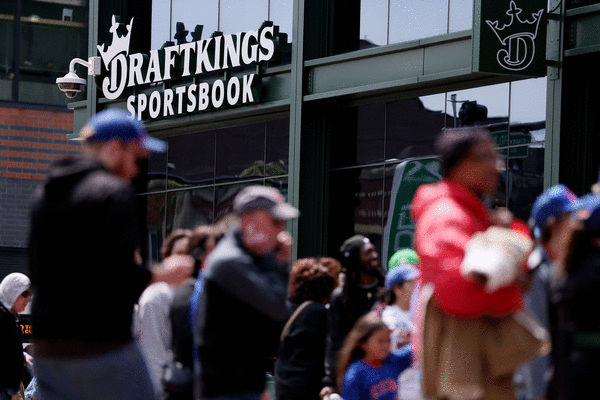
A recent New York Times investigation found that sports betting company DraftKings Inc. built a machine-learning model that scored customers by how much they would lose for each free bet or bonus they received. The data analyst assigned to test the model began to worry that many of the customers ranked highest were prone to addiction. By financial logic, the analyst said, “the best investment would be a problem gambler.”
One might call that predatory capitalism, profiting by either deliberately or negligently harming customers in deals that cost them more than you gain. Lori Kalani, DraftKings’s chief responsible gaming officer, told the paper that the company’s business depended on “customers who are betting within their means, are betting for entertainment and betting for fun.” Nevertheless, Brett Hollenbeck, an associate professor of marketing at the University of California, Los Angeles, and two co-authors found that when states that already had in-person betting added online betting, average credit scores fell by about 12 points, and bankruptcies, debt collections and missed payments all increased.
If you’re a gambling company, targeting addicts can juice your profits. And finding clever ways to maximize profits is a pretty good description of successful entrepreneurship. In a 1990 paper, the late New York University economist William Baumol defined entrepreneurs as people “ingenious and creative in finding ways that add to their own wealth, power, and prestige.” Baumol described how medieval barons innovated via technologies like the stirrup, then used them to seize wealth by force. The net effect, he wrote, may be “not merely a transfer but a net reduction in social income and wealth.”
Entrepreneurs can innovate to create wealth for the many or to reallocate it into their own pockets. The rules determine which one they pick, and right now, the rules make reallocation far too easy and rewarding. Consider memecoins. Between January 2024 and March 2025 users launched about 7 million tokens on Pump.fun, a platform that lets anyone create one. Solidus Labs, which sells fraud-detection tools to crypto companies, found that 98.6% showed signs of being pump-and-dump schemes. There's no better example of who wins and who loses than President Donald Trump's own memecoin. By May 2025, Chainalysis found that 58 wallets had made more than $10 million apiece from it while 764,000 had lost money. Yet the Securities and Exchange Commission's staff said in February 2025 that typical memecoins aren’t securities, leaving buyers without federal securities-law protection.
Or how about fire trucks? Starting in 2008, the private equity firm American Industrial Partners bought four fire truck makers and consolidated them into what became REV Group Inc. (now part of Terex Corp.). Independent manufacturers had only about a fifth of the U.S. market as of 2023, according to Democratic Senator Elizabeth Warren and Republican Senator Jim Banks.
The senators claimed REV permanently shut plants and cut its capacity by a third even as demand rose, while the cost of a pumper truck had risen from $500,000 in 2013 to almost $1 million. REV has said the companies it bought were in financial distress and that a 43% jump in orders from 2022 to 2023 strained its fire division. But Chief Executive Officer Mark Skonieczny told investors in December 2024 that REV’s backlog “is largely backed by municipal tax receipts, and offers significant value accretion opportunity.” Rolling up fire truck manufacturers and jacking up prices is an innovation of a sort. So is combining veterinary clinics, where private equity did more than $45 billion in U.S. deals from 2017 to 2022. Joseph Schumpeter, the economist who coined the term creative destruction, even counted “the creation of a monopoly position” as a form of innovation. But they skip the “creative” part.
At its best, capitalism is aspirational. In 1983, Steve Jobs famously lured John Sculley, then Pepsi’s president, to Apple Inc. by asking, “Do you want to spend the rest of your life selling sugared water, or do you want a chance to change the world?” For Jobs, selling sugared water was something to be ashamed of, but it’s a lot better than squeezing the last penny out of a gambling addict or a town trying to fight fires.
Regulations against this sort of predatory capitalism wouldn’t just restrain bad companies. They’d protect good ones, which find it hard to compete with their more ruthless rivals. George Akerlof explained in his 1970 paper on “lemons,” which helped get him a share of the Nobel prize in economics, that “dishonest dealings tend to drive honest dealings out of the market.” Because private and social returns differ in such markets, he wrote, “in some cases, governmental intervention may increase the welfare of all parties.”
In their 2015 book "Phishing for Phools," Akerlof and fellow Nobel laureate Robert Shiller went further. Where there is money in exploiting customers’ weaknesses, they wrote, “even firms guided by those with real moral integrity will usually have to do so in order to compete and survive.” Even if that’s too strong, regulation is the honest executive’s friend, not foe.
It’s not that more regulation is always better. It’s that good regulations can steer entrepreneurs’ talents in socially beneficial directions. Before 1624, English monarchs handed court favorites control of trades. That year, Parliament’s Statute of Monopolies declared such grants void, with the exception of patents for “the true and first inventor” of something new, and even that was barred if it was “mischievous to the State, by raising prices of commodities at home.” Baumol noted that the law is said to have sharply reduced rent-seeking and may have pushed entrepreneurs toward farming and industry.
A good place to start would be to crack down on the industries where ruining lives is the easiest way to make a buck. At DraftKings, a model meant to spot gamblers heading for trouble never got its meeting. The right rule would make that meeting something no CEO would consider missing.
____
This column reflects the personal views of the author and does not necessarily reflect the opinion of the editorial board or Bloomberg LP and its owners.
Gautam Mukunda writes about corporate management and innovation. He teaches leadership at the Yale School of Management and is the author of "Indispensable: When Leaders Really Matter."
©2026 Bloomberg L.P. Visit bloomberg.com/opinion. Distributed by Tribune Content Agency, LLC.






Comments