Harvard fund hits record $68 billion after 27% annual return
Published in Business News
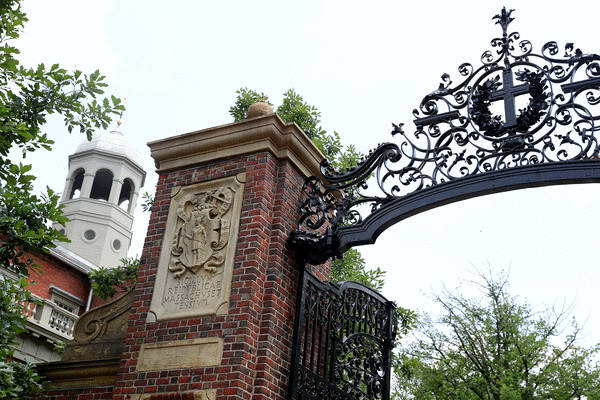
Harvard University’s endowment jumped to a record $68 billion as successful bets on equities and venture capital including SpaceX holdings helped the richest U.S. college weather an unprecedented pressure campaign from President Donald Trump.
The fund returned 27% and donations rose to $1.5 billion, Harvard said Thursday in a financial report for the fiscal year ending in June. The endowment, which added a total of $11 billion during the period, benefited from broad gains in the stock market and its hedge fund portfolio.
Harvard handily beat the 19% median return before fees for large U.S. college endowments and posted its best year since 2021, when the markets rebounded from a Covid-induced plunge. It came as N.P. “Narv” Narvekar, chief executive officer of Harvard Management Co., said he still plans to retire after almost a decade at the helm, a period in which the fund faced criticism for mediocre performance, dragged down by investments in private equity.
The endowment gains provided a boost as Harvard contends with uncertainty around future government research funding amid a confrontation with Trump over higher education policy and control. During the fiscal year, the school froze employee pay, shouldered hundreds of millions of dollars in research costs and funded ongoing legal expenses as it battled the administration in court.
“We have risen as a community to meet this moment with intensity and resolve, working to ensure that we will be a stronger and more resilient institution than ever before,” Harvard President Alan Garber said in the report.
The university’s $100 million surplus contrasted with last year’s similarly sized deficit, as the school revamped operations and reduced costs. Harvard pared its workforce through a hiring freeze, attrition and restructuring, and total salaries fell 3.8%, or $104 million.
“Without those interventions, we would have ended the year in deficit,” Executive Vice President Meredith Weenick and Chief Financial Officer Ritu Kalra said in a statement accompanying the financial report.
The robust results don’t resolve Harvard’s underlying financial challenges as doubts swirl about future government research funding. The Trump administration has made the Cambridge, Massachusetts-based school a major target of its campaign to reshape higher education, seeking to freeze billions of dollars in federal research money and curb international students.
Harvard filed lawsuits in opposition to those moves and has won federal court rulings in both cases. Appeals are pending. Meanwhile, the government continues to launch new investigations of the school, including a probe last week into a foreign exchange visa program.
During Harvard’s latest fiscal year, federally sponsored research money declined by 20%. The university sustained over $1.2 billion in research activity, with $500 million coming from federal funding, $300 million from non-federal sponsors and $400 million from the school’s own resources. Harvard is working to diversify its external sponsors by deepening engagement with foundations and industry.
Aid boost
The university said it provided more than $775 million in financial aid, including stepped-up assistance for Harvard College families earning $200,000 or less.
Harvard also spent $969 million in capital expenditures, including maintenance and strategic investments in space on its centuries-old campus in Cambridge, as well as continued development across the river in Boston’s Allston neighborhood, where the Enterprise Research Campus opened early this year.
About 40% of the university’s operating revenue comes from the endowment.
Tapping its network of donors, Harvard raised more money, with its $1.5 billion haul increasing by about $200 million from the previous year. Gifts for “current uses” that can be spent now climbed to a record $640 million.
“These resources will allow us to absorb disruption and protect critical priorities,” said Kalra and Harvard Treasurer Timothy Barakett. “They cannot indefinitely replace the revenue needed to support ongoing teaching and research.”
Within the endowment portfolio, the asset allocation for private equity grew to 46%. While that asset class is illiquid, the university maintains significant liquid assets and credit lines to ensure financial flexibility.
Tax increase
Harvard and a handful of other rich private schools face an increased tax on their endowments as the levy on net investment income rises next year to 8% from 1.4%.
While the burden will depend on when gains are realized, Harvard said it expects to pay an estimated $300 million annually. The amount “would be several times larger” in a year with advances as large as its latest investment gains.
Harvard held $2 billion in Space Exploration Technologies Corp. shares as of June 30. Additional SpaceX stock received after July 1 would pay the higher tax when gains are realized.
Early investments in SpaceX have fueled a bonanza at a handful of other endowments, with the University of North Carolina and Washington University posting returns of more than 35% in the most recent fiscal year.
Strong performers also included Stanford University, with a 32% return, and the University of Pennsylvania, at a little more than 27%. Other wealthy peers are expected to release gains over the coming weeks. Endowments with assets of more than $500 million posted a median return of about 19% before fees, according to the Wilshire Trust Universe Comparison Service.
Harvard’s gain helped boost the endowment’s long-term performance under Narvekar. Its 10-year annualized return is about 11%, according to data compiled by Bloomberg.
Narvekar, who joined Harvard from Columbia University in 2016, reiterated plans for his “eventual retirement” in the report. Looking ahead, he cautioned that Harvard can’t count on investment gains as high as the endowment’s most recent performance.
“Outsized returns can sometimes portend subdued, or even negative, returns in the near term,” Narvekar wrote. “This is in no way a market prediction; it is a simple acknowledgement of historical market patterns that we must bear in mind when assessing the risk level and composition of the portfolio.”
©2026 Bloomberg L.P. Visit bloomberg.com. Distributed by Tribune Content Agency, LLC.








Comments