Teacher, nurse, police officer: What traditional middle-class jobs pay in Minnesota
Published in Business News
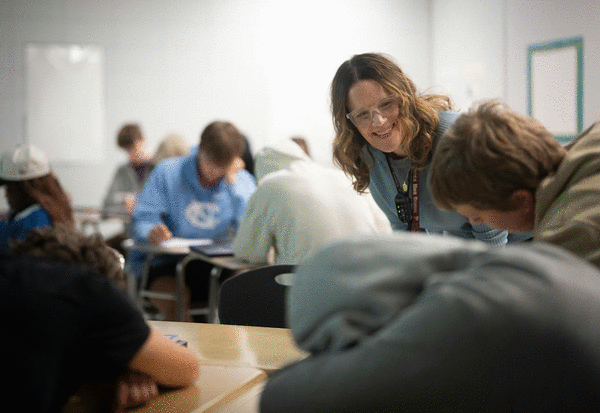
Ask a child what they want to be when they grow up and the answers are often familiar: teacher, firefighter, veterinarian, nurse.
For generations, Americans have counted on jobs like these to help them reach, and stay in, the middle-class. Careers in fields like education, health care, manufacturing and the trades have paid enough to support a family, buy a house and a car and afford the occasional vacation or dinner out.
But amid historically high levels of student debt, soaring real estate costs and AI threatening to upend entire professions, many Minnesotans are questioning whether these traditional career paths can still deliver, and what actually makes a good job.
Donna Bastemeyer always wanted to be a teacher, in part because her grandmother, a widow, had raised three children on a teacher’s salary. It seemed like a good, middle-class job.
But Bastemeyer, a social studies teacher in Marshall, Minnesota, is struggling. After getting divorced a few years ago, the bills fall to her alone. Rising prices, especially a health insurance premium that has jumped fivefold in two years, quickly eat up her $58,000 salary.
At 45, she said, her finances feel as tenuous as they did when she was in her 20s. Bastemeyer is on the hunt for a cheaper apartment, and can’t imagine being able to support children, as her grandmother did in the 1960s.
“I realize that I’m middle-class, by whatever standards we use to determine that. But I definitely feel like the concept of being middle-class — it should be more comfortable,” Bastemeyer said. “I feel like middle-class should be, you don’t have to worry when you go to fill up your gas tank.”
Pew Research Center defines “middle-income” using a range between two-thirds and double the area median income. In Minnesota, that’s between about $58,000 and $174,000 annually per household.
Most jobs still fall in that range, and wages have outpaced inflation over the long-term. Yet many Minnesotans say mounting costs — from gas and groceries to health care and school loans — make them feel like they are starting to slip behind. This has fueled the pervasive feeling for many that life is increasingly unaffordable.
Five years ago, “I was pretty satisfied with how things (were) going,” said Jen Secor Nelson, 52, an English teacher in Blaine, Minnesota.
Since then, the combination of a recent divorce and rising prices has changed her retirement plans. And she has had to cut out small joys — getting her nails done, buying new clothes.
“I’m living paycheck to paycheck,” Secor Nelson said. “It’s just not how I thought things would be.”
Historically, many of the jobs that provided a solid, middle-class living were union jobs — and often still are today, even as union membership has declined nationwide.
“Many good middle-class jobs became good middle-class jobs because of unions,” said Elise Gould, senior economist at the Economic Policy Institute, a left-leaning think tank. “They set standards not only for union shops, but for nonunion shops alike.”
Restoring union membership in the U.S. to 1950s levels would result in a 14.5% raise for the median worker, or more than $7,700 a year, EPI reported this summer.
Chris Rubesch, a registered nurse at Essentia Duluth and president of the Minnesota Nurses Association, was raised by parents who were public school teachers and had “excellent” benefits, including pensions.
But when Rubesch thinks about his 4-year-old son’s future, he said he wouldn’t recommend his son pursue teaching, or nursing, for that matter.
Though health care has been a bright spot in a slowing labor market, the industry is facing widespread financial challenges. In September, even high-demand nursing jobs declined.
Rubesch said he believes he and his wife, who also is a nurse, have a middle-class life in large part because they were able to buy a house in 2019, when mortgage rates were lower.
“I really wonder whether or not nursing will continue to be a middle-class profession,” Rubesch said. “I look at some of the younger nurses I work with today, and their economic situation is far different than mine.”
The skilled trades, jobs like a carpenter or electrician, have been heralded in recent years as the workaround to budget-busting student loan debt. These careers often lead to good-paying jobs without the cost of a four-year degree, and appear more resilient to AI disruption.
But these jobs are also exposed when the economy is unstable and work dries up, said Brian Winkelaar, business agent for International Brotherhood of Electrical Workers Local 110.
Unemployment among apprentices in the electricians’ union is currently around 30%, Winkelaar said.
“Construction is definitely cyclical, right? And for us recently, it is starting to slow,” he said. “We’ve seen that with tariffs, with the data center (moratoriums), our work cycle is down because material is hard to get, and then the uncertainty.”
An electrician since 1999, Winkelaar has become familiar with the boom-and-bust cycle. During the 2008 recession, he said, unemployment among electricians was 50%.
He still considers it a middle-class job.
“It is not more than that,” he said. “But as a skilled trade, we definitely think we’re middle-class — when we’re working, right?”
©2026 The Minnesota Star Tribune. Visit at startribune.com. Distributed by Tribune Content Agency, LLC.








Comments