Boeing won't increase Max production rate again this year, Ortberg says
Published in Business News
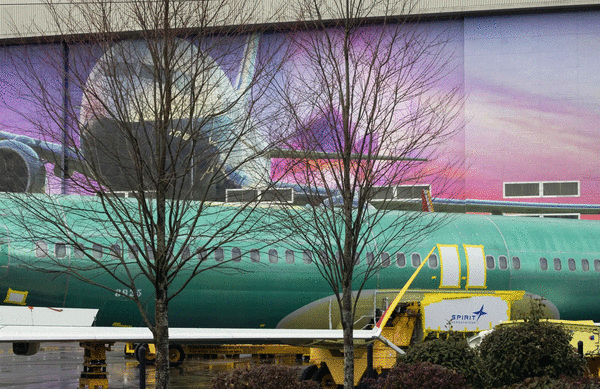
Boeing lost $116 million in the third quarter this year, as it celebrated certification milestones for two new Max variants but slowed its progress on increasing monthly Max production.
Boeing is working to increase its monthly Max production rates from 42 planes per month to 47 but expects that stabilization period" will last into early next year, CEO Kelly Ortberg said Tuesday morning in an interview with CNBC. Ortberg acknowledged that, "Everybody wants us to go faster, but we're going to do it right."
Still, Boeing secured certification from the Federal Aviation Administration to begin delivering its long-delayed 737 Max 7 and 10 variants and got its North Line in Everett, the fourth Max production line, up and running. Boeing rolled out its first fully assembled aircraft on the North Line on Monday. The 737 Max 10 is slated for delivery to WestJet next year, Ortberg said.
"The uncertainty in our financial performance is narrowing," Ortberg said on CNBC, pointing to Boeing's commercial aircraft backlog that shows demand has remained strong. "We're definitely reducing the risk going forward."
In the third quarter last year, Boeing lost more than $5.3 billion and $7.14 per share, compared with a loss of $0.26 per share in the three months from July to September this year.
Boeing’s third-quarter 2025 earnings reflected a $4.9 billion charge associated with its long-delayed 777X family, something the plane-maker is still working through one year later.
Boeing's revenue in the third quarter this year hit $24.2 billion, a 4% increase year over year, driven by higher defense production and "less favorable commercial delivery mix," the company said Tuesday.
Boeing's free cash flow for the third quarter increased year over year from about $200 million to $500 million. This year's free cash flow reflects the company's investments in its St. Louis, Mo., and Charleston, S.C., factories, as well as about $700 million in payments to the Department of Justice related to two fatal 737 Max crashes in 2018 and 2019.
Boeing still expects to reach about $2 billion in free cash flow for the year, the company said Tuesday.
To employees, Ortberg wrote in a note Tuesday that the company "delivered another meaningful quarter."
"Looking ahead, expectations are rising, and they should. We have a stronger foundation than a year ago, but we also have more work to do to deliver on our backlog, strengthen our culture, and improve how we work every day," Ortberg wrote.
That means "productivity and efficiency improvements in our day-to-day, Ortberg continued, while maintaining a commitment to quality and safety.
Boeing delivered 161 commercial aircraft in the third quarter this year, nearly identical to the 160 it delivered in the same period a year ago. Revenue from its commercial aircraft division decreased 3% year over year, from about $11 billion in the third quarter last year to $10.7 billion this year.
Boeing said Tuesday it expects higher costs associated with its supply chain and future production rate increases.
In the first three quarters of this year, Boeing delivered 475 aircraft, an 8% increase from the same period a year ago. It broke its record for the highest number of Max deliveries from January through the end of September for the second year in a row, with 363 Max aircraft delivered in this period.
The company is still working to certify its 777X family, which includes two passenger variants and one freighter. In September, Ortberg said the certification program could drag into 2027 as it continues to navigate an engine issue.
On the defense side, Boeing won a lucrative contract in September to produce the Navy’s next fighter jet, known as the F/A-XX. That win comes after Boeing last year won a contract for the Air Force’s stealth F-47 fighter jet.
Revenue from Boeing's defense and space business increased 15% year over year, from $6.9 billion to $7.9 billion. Boeing’s defense results include a $252 million gain from its July sale of HRL Laboratories, a quantum computing research company Boeing jointly owned with General Motors.
Boeing's global services division also saw revenue increase 4%, from $5.4 billion to nearly $5.6 billion.
In the third quarter, Boeing also reached contract agreements with members of the Society of Professional Engineering Employees in Aerospace, or SPEEA, the union that represents 17,000 engineers, technicians, planners, analysts and other white-collar workers in Boeing's factories. After union members rejected Boeing’s first contract offer and authorized a strike in August, workers voted to accept the company’s second deal and averted a strike before the contract expired in October.
A work stoppage would have further delayed 777X certification and slowed monthly Max production.
Analysts were initially pleased with Boeing’s third quarter results, with Matthew Akers of BNP Paribas Equity Research writing in an investor note Tuesday morning that the quarter “importantly had no new surprises.”
©2026 The Seattle Times. Visit seattletimes.com. Distributed by Tribune Content Agency, LLC.









Comments