Trump affordability pitch heads to a Davos focused on Greenland
Published in News & Features
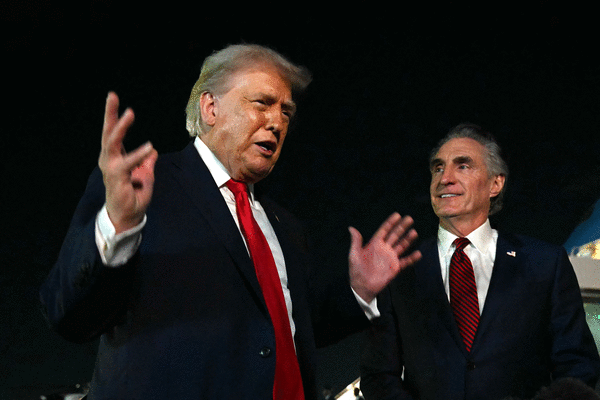
President Donald Trump pitched his populist economic platform to autoworkers and supporters at a casino in battleground states in recent weeks. Now he’s targeting a different audience: the global elite gathered in the Swiss ski village of Davos.
Trump has vowed to unveil details of a sprawling affordability pitch — which has landed Wall Street banks, technology companies and home builders in his crosshairs — during a Wednesday speech at the World Economic Forum.
If he follows through on that pledge, it will come after a weekend in which he put Europe on edge over his increasingly aggressive rhetoric about winning control of Greenland — and his threat to use tariffs against a host of NATO allies backing the island’s ties to Denmark.
On Monday, with Europeans planning a separate meeting to respond to Trump and Danish officials skipping Davos, the president appeared to be trying to get affordability back on peoples’ minds with social media posts about mortgage rates and his economic agenda.
Affordability was an issue Trump mocked as a Democratic “hoax” as recently as late last year, but he’s aiming to show action on the issue after Republicans lost several key elections in November and polls revealed voters souring on his economic management.
Parts of that agenda are already emerging. National Economic Council Director Kevin Hassett said Trump will unveil a proposal to let savers in 401(k) retirement plans use some of their money for down payments on a home purchase. The president is also expected to elaborate on his plans to ban institutional investors from buying single-family homes, cap credit card rates at 10% for a year and intervene in the market for mortgage-backed securities.
Those moves come alongside proposals to promote a new health-care plan — after Republicans allowed Obamacare subsidies to expire — and get tech giants to foot the bill for surging power costs.
The range of initiatives is a sign that Trump is seeking to “demonstrate a level of seriousness on his part that he hopes will break through with voters,” GOP strategist Jim Merrill said.
And even if the Davos audience — packed with CEOs and financiers bouncing from seminars on geopolitics to ski slopes and cocktail parties — isn’t fretting about how to make their next rent payment, they have much riding on understanding Trump’s next moves. That includes gauging if Republicans can keep hold of Congress in November’s midterm elections and trying to understand where the Greenland saga will go next.
“There is a lot of apprehension on Wall Street right now,” said Ed Mills, Washington policy analyst at Raymond James. “The number-one question I’m getting is, ‘What’s next?’ Or, ‘What can he surprise me with?’ And the fact that people are trying to figure out what you’d be surprised with allows the imagination to run wild.”
And while Trump’s backers don’t agree on all of the specifics of his economic agenda, a focus on pocketbook issues is what GOP leaders in Congress have been waiting for. Republicans “are glad that Trump is finally doing something about affordability,” said Todd Belt, director of George Washington University’s Political Management Program.
Housing is a critical part of Trump’s agenda. Though the housing market is in a better position today than it was a year ago — mortgage rates have fallen, rents are down slightly and housing price growth has leveled off — the costs, most Americans’ largest monthly expense, are still elevated.
Home prices were up 54% from before the pandemic as of Oct. 31, the latest reading of the Case-Shiller National Home Price Index. Rents increased by 35% over that period, according to Zillow, eating up more of the money renters need to save if they want to buy a home. The median age of first-time home buyers has risen to a record 40 years old, according to the National Association of Realtors.
“President Trump is committed to making it easier and more affordable to achieve the American Dream of homeownership by eliminating unnecessary red tape, increasing supply, and lowering costs,” said Davis Ingle, a White House spokesperson.
The president hasn’t provided details about his proposal to have Fannie Mae and Freddie Mac, the government-sponsored enterprises underpinning the mortgage market, buy an additional $200 billion in mortgage bonds in an attempt to push rates down. Nor has he said how he’ll block institutional investors from buying rental homes, an announcement that hit companies from Blackstone Inc. to Toll Brothers Inc.
Treasury Secretary Scott Bessent on Tuesday sought to offer some clarity, saying the administration was looking to provide guidance to separate larger institutional firms from smaller real estate investors.
“We are going to give guidance at some point to see what is a ‘mom and pop,’ that someone, maybe your parents for their retirement, have bought five, 10, 12 homes. So we don’t want to push the mom and pops out. We just want to push everyone else out,” Bessent said in an interview with Fox Business.
Analysts warn that many of Trump’s favored approaches to addressing housing issues would be difficult to enact and would have limited impact on an affordability crunch that’s been years in the making – and some could even backfire.
‘Kitchen sink’
A 50-year mortgage proposal lost momentum after industry analysts panned it. The vow to restrict institutional investors from the rental market could reduce liquidity without helping consumers.
“There is a little bit of everything in the kitchen sink kind of being thrown in right now, and I think some of it will resonate with voters,” said Merrill, the Republican strategist. “Others will get washed out because they just don’t have time to germinate and stand on their own two legs.”
Housing isn’t the only cost weighing Americans down. Consumers are piling on credit card debt, which hit $1.23 trillion in the third quarter of 2025, as interest rates on cards hover around 20%. But capping rates, as Trump urged, would be a mixed bag: While a 10% cap could save consumers about $100 billion a year, it would no longer be profitable for banks to extend credit to people with credit scores under FICO 780, according to research published by Vanderbilt.
Banks are vowing to fight the measure: Citigroup Inc. Chief Financial Officer Mark Mason warned last week that a “cap would likely result in a significant slowdown in the economy.”
2025 speech
Trump said banks that failed to bring rates down by Jan. 20 would be “in violation of the law,” but it would almost certainly require congressional action to cap rates, and House Speaker Mike Johnson has already downplayed the idea.
Those kind of proposals are exactly what will keep Davos participants on the edge of their seat when Trump speaks on Wednesday, about a year after he rattled attendees with a virtual speech to the forum on just the third full day of his second term.
Those remarks came before the tumultuous introduction of “liberation day” tariffs, the Oval Office rebuke of Ukraine President Volodymyr Zelenskyy, the DOGE-led gutting of many federal agencies and the threats to take Greenland or make Canada the 51st state.
After last year’s presentation, in which Trump announced a broad plan for tariffs and name-checked JPMorgan Chase & Co. CEO Jamie Dimon and Bank of America Corp.’s Brian Moynihan for allegedly limiting business with conservative clients, one of the key participants at the annual confab called for calm.
“Please let’s not hyperventilate,” World Trade Organization Director-General Ngozi Okonjo-Iweala said at the time. “Could we chill?”
---------
—With assistance from Josh Wingrove, Skylar Woodhouse and Meghashyam Mali.
©2026 Bloomberg L.P. Visit bloomberg.com. Distributed by Tribune Content Agency, LLC.





Comments