New Maryland House rural caucus aims to boost rural voices in Annapolis
Published in News & Features
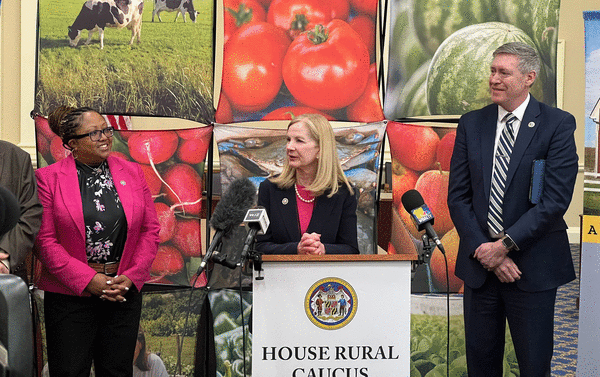
The newly formed Maryland House Rural Caucus aims to give rural communities a stronger voice in legislative leadership and policymaking, House Speaker Joseline Peña-Melnyk said Tuesday at the group’s first news briefing, weeks after she announced its creation late last month.
Peña-Melnyk said the caucus will focus on “elevating” views and concerns from rural areas across the state, from Western Maryland to the Eastern Shore and Southern Maryland, which she said are often overlooked in Annapolis. She emphasized the group is not meant to be performative and urged members to develop legislation ahead of this session’s Friday’s bill-filing deadline.
“This is not a caucus that is symbolic. I really mean that. I don’t have time for that. I want it to be a caucus that you do work and you come together and you collaborate and you try to find solutions to issues,” Peña-Melnyk said, adding that she expects members to continue meeting outside the regular legislative session as well.
Earlier Tuesday morning, the caucus virtually held its first meeting, outlining a weekly schedule and a slate of policy discussions that members said would shape their legislative agenda. The caucus plans to meet every Tuesday at 8 a.m., with time reserved for public comment.
The caucus is co-chaired by Del. Natalie Ziegler, a Democrat representing Howard and Montgomery counties, and Del. Jeff Ghrist, a Republican representing Kent, Queen Anne’s, Cecil and Caroline counties. Ghrist said rural lawmakers are at a disadvantage in Annapolis, noting that rural jurisdictions comprise a minority of the state’s population.
“Rural communities make up less than a third of the population,” Ghrist said at the meeting. “That’s a political reality, but it doesn’t mean rural issues should be sidelined.”
At the meeting, representatives from state agencies and advocacy groups flagged several early priorities, including rural health care access, food insecurity, agriculture preservation, land-use authority, energy infrastructure and economic development tied to farming, fishing and tourism.
Maryland Agricultural Secretary of Kevin Atticks said his department and others would partner with the caucus, noting that agriculture remains the state’s “No. 1 industry” and that rural areas often face the same challenges as urban and suburban communities but require different solutions – a sentiment he later echoed at the news briefing, adding that the caucus’ early discussions appear to align with priorities of the Moore-Miller administration.
Local government leaders also emphasized opposition to unfunded state mandates and efforts that override county land-use authority. Kevin Kinnally, a leader with the Maryland Association of Counties’ Rural County Coalition, said rural counties are closely monitoring legislation that could weaken local zoning control.
“As a group, we stand for … county autonomy,” Kinnally said. “One size does not fit all.”
Ghrist emphasized the caucus is nonpartisan and focused on “practical” challenges facing rural communities, including access to health care, transportation, workforce shortages, agricultural sustainability, public safety, affordable energy and the ability of local governments to comply with state mandates despite limited resources.
Industry representatives raised concerns about land loss, agricultural preservation funding and proposed fishing regulations that could have significant economic consequences for rural communities, particularly on the Eastern Shore.
Rural communities “don’t exist in isolation,” Ghrist said at the briefing, adding that the caucus intends to work with stakeholders, local governments and residents to “identify concerns early, address their concerns and promote solutions that are workable and fair.”
“Decisions made for one part of the state often have a ripple effect in other parts of the state,” he said. “The rural caucus is not asking for special consideration or special treatment. We’re asking for thoughtful consideration, meaningful representation and policies that recognize our unique circumstances and contributions to Maryland.
The caucus also includes delegates from Western Maryland, the Eastern Shore, Southern Maryland and rural portions of central Maryland, including Republican Dels. H. Kevin Anderson, Terry Baker and Kevin Hornberger as well as Democratic Dels. Andre Johnson, Steve Johnson and Sheree Sample-Hughes.
The caucus plans to hear from stakeholders on housing, tourism, rural health care, energy and environmental preservation over the coming weeks before shifting its focus to tracking and weighing in on legislation affecting rural Maryland, Ghrist and Ziegler said.
_________
©2026 The Baltimore Sun. Visit at baltimoresun.com. Distributed by Tribune Content Agency, LLC.




Comments