Disabled Delaware immigrant ordered back to Ecuador at climactic hearing on Tuesday
Published in News & Features
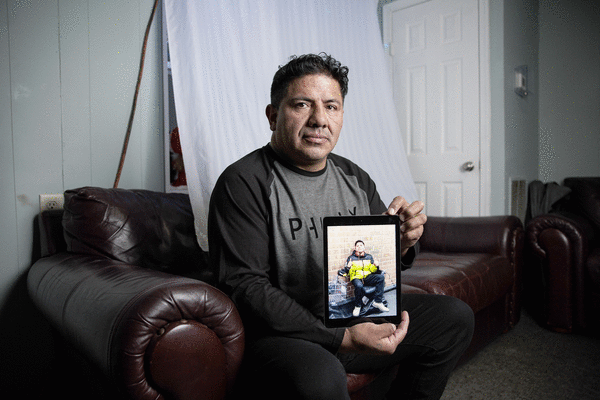
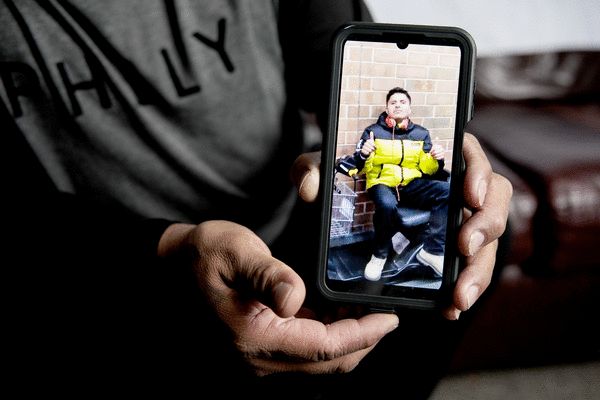
PHILADELPHIA — A disabled Ecuadoran immigrant who was arrested and detained by ICE after he flagged down an officer in September was ordered back to his homeland on Tuesday.
Victor Acurio Suarez, who is 52 but childlike and unable to live on his own, was issued an order of voluntary departure by Immigration Judge Dennis Ryan.
That is not the same as an order of deportation, but for migrants in detention it has the same practical effect. If Acurio Suarez were to refuse to leave voluntarily, the order would convert to a deportation order, which carries consequences including fines and a bar on reentry.
“It’s not good news,” his attorney, Kaley Miller-Schaeffer, said shortly after the video hearing concluded.
She plans to quickly appeal to the Board of Immigration Appeals, which can review decisions by immigration judges. It is uncertain if an appeal would be successful.
The judge denied her client’s request for asylum, which can be granted to migrants who could face persecution in their home countries because of their race, religion, nationality, politics, or membership in a particular social group. Acurio Suarez was beaten by gangs who preyed upon his disabilities, his attorney said.
Miller-Schaeffer said she was not able to speak with her client after the ruling. His brother, Lenin Acurio Suarez, was still processing the decision, she said.
Victor Acurio Suarez’s case drew support from Delaware Gov. Matt Meyer, who wrote to the judge that it would be “cruel” and “egregious” to deliver the Seaford resident to gang violence. Meyer also advocated for Acurio Suarez in social media posts, calling his arrest and detention “deeply disturbing” and arguing that with no criminal history, not even a traffic violation, Acurio Suarez “poses no threat to public safety.”
The governor’s office did not immediately reply to a request for comment on Tuesday.
Acurio Suarez has long been cared for by his brother, Lenin Acurio Suarez, who said in an interview last month that Victor Acurio Suarez did not realize he was in immigration custody when he was taken to the Moshannon Valley Processing Center in Pennsylvania. He thought he was on vacation, provided with three free meals a day and allowed to buy snacks and kick a soccer ball.
He was arrested on Sept. 22 in a Lowe’s parking lot near the brothers’ home in Seaford when he tried to flag down a U.S. Immigration and Customs Enforcement agent, apparently thinking the officer could help him find work.
In the past, someone with Acurio Suarez’s profile might have been allowed to live at home as the case moved forward in immigration court. That has changed as President Donald Trump has pressed his mass-deportation agenda, and mandatory detention policies have swelled the number of people in custody.
His case, Miller-Schaeffer said earlier, is a prime example of how Trump administration policy shifts have encouraged ICE to detain even the most vulnerable and to treat potential discretionary relief as irrelevant in a bid to boost deportations. Her Sept. 30 request to have Acurio Suarez released to the care of his brother while his immigration case went forward was denied.
A medical assessment submitted for his asylum application said Acurio Suarez has autism and aphasia, a language disorder that affects his ability to produce or understand speech.
David W. Baron, the doctor who did the assessment, said Acurio Suarez cannot safely live on his own. He requires supervision to perform daily hygiene activities or cook and has a hard time communicating his needs to others, a condition made worse by being in an unfamiliar setting while in detention, where he does not have access to the support needed for his neurocognitive disabilities.
At an earlier court hearing, Miller-Schaeffer said, she watched as Acurio Suarez struggled to answer basic questions. He told the judge he didn’t know if he had an attorney or know what an attorney does.
His ability to testify was so limited, she said, that the judge allowed his brother to take the stand to explain his sibling’s experience and situation.
Acurio Suarez can recall big events in his life, she said. He remembers being beaten by gangs, but he couldn’t tell you exactly when that occurred.
He worked at odd jobs in Ecuador before coming to this country.
Records show that on Aug. 2, 2021, the brothers were stopped by the U.S. Border Patrol as they tried to enter the United States near Eagle Pass, Texas.
Lenin Acurio Suarez was issued a notice to appear in court and released, and his immigration case was later dismissed.
Victor Acurio Suarez was ordered deported and subsequently returned to Ecuador on Sept. 24. Three days later, for reasons that are unclear, the deportation order was found to have been issued incorrectly, and Acurio Suarez was brought back by authorities to the U.S.
In October 2021, he was granted temporary permission to stay in the country. He had filed his asylum case by the time that permission expired a year later.
Last year, according to an ICE report, on Sept. 22 an ICE team was conducting operations in Seaford, a southern Delaware city of 9,000 where 13% of the population is foreign-born.
The ICE officer wrote that he was looking for a place to park in the Lowe’s lot when a man in paint-stained clothing, Acurio Suarez, approached him. Acurio Suarez waved his hand, signaling the officer to come to him, according to the ICE report.
The officer kept going, then stopped his car and watched Acurio Suarez from another lot. Acurio Suarez tried to hail other cars, and could be seen talking to people who were loading lumber onto a trailer in the parking lot, he said.
It looked as if Acurio Suarez was trying to find daily work, which is why he tried to get the ICE officer to stop his vehicle, the report said.
It is common for undocumented immigrants seeking a day’s pay to wait in the parking lots of big home-improvement stores like Lowe’s and Home Depot, hoping to connect with building contractors who need laborers.
Lenin Acurio Suarez said his brother cannot hold a full-time job, and is able only to handle small tasks, provided someone is beside him giving directions.
A second ICE officer arrived, and both parked their cars near where Acurio Suarez had left his lunch box. Acurio Suarez walked back toward the officers, and one of the agents approached and questioned him.
Acurio Suarez told the agents he had no identification or immigration documents and was placed in handcuffs.
©2026 The Philadelphia Inquirer, LLC. Visit at inquirer.com. Distributed by Tribune Content Agency, LLC.






Comments