Trump backs off Greenland tariffs, citing 'framework' deal
Published in News & Features
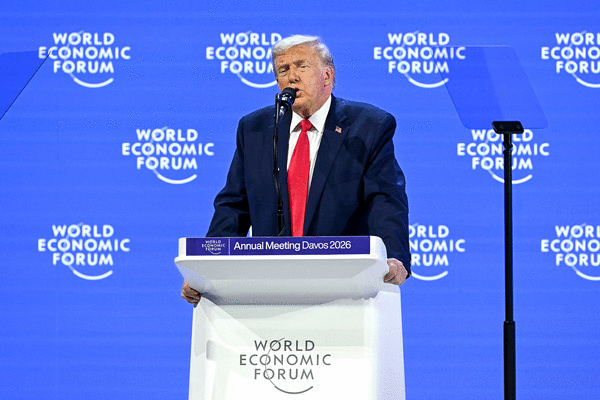
President Donald Trump said he would refrain from imposing tariffs on goods from European nations opposing his effort to take possession of Greenland, citing a “framework of a future deal” he said was reached regarding the island.
The decision, which Trump announced Wednesday on social media, marks a stark reversal for a president who has repeatedly attempted to coerce Europe over Greenland. It came after a meeting with NATO Secretary-General Mark Rutte at the World Economic Forum in Davos, Switzerland.
Still, Trump did not detail the parameters of the so-called “framework” and it was unclear what the agreement entails, especially since Denmark earlier Wednesday ruled out negotiations over ceding the semi-autonomous island to the U.S.
“We have formed the framework of a future deal with respect to Greenland and, in fact, the entire Arctic Region,” Trump posted. “This solution, if consummated, will be a great one for the United States of America, and all NATO Nations. Based upon this understanding, I will not be imposing the Tariffs that were scheduled to go into effect on February 1st.”
U.S. stocks jumped on the news that tariffs wouldn’t be implemented, with the S&P 500 and Nasdaq 100 rallying to session highs. Treasuries extended gains, and the Bloomberg Dollar Index rose to a daily high.
Danish Foreign Minister Lars Lokke Rasmussen welcomed the latest developments, saying in a Wednesday interview with local broadcaster DR that “the day ends better than it started.” Rasmussen, however, added that it’s obvious that Trump has not given up on his ambition to gain control of Greenland, which is still “a red line for the Kingdom of Denmark.”
Trump told reporters after his post that he would release the specifics of the agreement shortly. He declined to answer when asked if it grants U.S. ownership of Greenland, saying “it’s a long-term deal. It’s the ultimate long-term deal, and I think it puts everybody in a real good position.” He said it would last for an “infinite” period of time.
In an interview with CNBC, Trump said he had not spoken directly with officials in Denmark about his “concepts of a plan” for Greenland, but added that he assumed Rutte had briefed leaders there. He also said the U.S. would be “involved” in Greenland’s mineral rights, without elaborating.
The U.S. president said there would be additional discussions on the Golden Dome missile-defense system, which he cited in justifying his pursuit of Greenland. Vice President JD Vance, Secretary of State Marco Rubio, Special Envoy Steve Witkoff and “various others” will be responsible for negotiations, Trump added in his post.
“Negotiations between Denmark, Greenland, and the United States will go forward aimed at ensuring that Russia and China never gain a foothold — economically or militarily — in Greenland,” a NATO spokesperson said in a statement after the Trump-Rutte meeting, adding that discussions “will focus on ensuring Arctic security through the collective efforts of Allies, especially the seven Arctic Allies.”
Trump’s brinkmanship over Greenland touched off a diplomatic crisis with Europe and spooked financial markets. A day earlier, stocks and the dollar fell before the president’s climb-down.
The European Parliament froze ratification of the European Union’s trade agreement with the U.S. in response to Trump’s escalating threats. On Saturday, Trump said he would impose tariffs of 10% on goods from eight European countries on Feb. 1 unless a deal was reached for the purchase of Greenland, with the rate increasing to 25% on June 1 if an agreement was not made by then.
While the Greenland crisis may be defused for now, the famously mercurial president could spark tensions again in the future.
In a speech at Davos earlier Wednesday, Trump ruled out the use of military force to take control of the island. But he still used menacing language to describe what would happen if Europe did not meet his demands.
“You can say yes, and we will be very appreciative, or you can say no, and we will remember,” the president said.
He also bristled at earlier comments from Rasmussen, who said that his nation “will not enter into any negotiations on the basis of giving up fundamental principles.”
“If he wants to tell me, he’ll tell me that to my face,” Trump said of Rasmussen, when asked during a meeting with the NATO chief about the remarks.
Trump’s aggressive play for Greenland nonetheless may have inflicted lasting damage on ties between the U.S. and its traditional allies. It comes after a year in which he raised tariffs on longtime trading partners, reduced support for Ukraine in its defense against Russia and struck blows against international institutions.
Canadian Prime Minister Mark Carney declared during his Davos speech that recent events have shown the “rules-based international order” is effectively dead, and that other countries must forge new partnerships to withstand pressure tactics from great powers. French President Emmanuel Macron said Trump’s trade strategy is meant to “weaken and subordinate Europe.” Belgian Prime Minister Bart de Wever said he no longer considers the U.S. an ally.
Trump’s designs on Greenland cast a cloud over the annual gathering of the world’s business elite in Davos. Before his arrival, senior U.S. officials there talked down the chances of confrontation over the island.
Treasury Secretary Scott Bessent encouraged U.S. allies enraged by Trump’s threats to “sit back” and “take a deep breath,” avoiding retaliation. Commerce Secretary Howard Lutnick foreshadowed the retreat during a Davos panel, telling the assembled world leaders and business titans that the situation was “going to end in a reasonable manner.”
_____
With assistance from Derek Wallbank, Andrea Palasciano and Jennifer A. Dlouhy.
_____
©2026 Bloomberg L.P. Visit bloomberg.com. Distributed by Tribune Content Agency, LLC.



Comments