Six children-focused bills California lawmakers want to pass in 2026
Published in News & Features
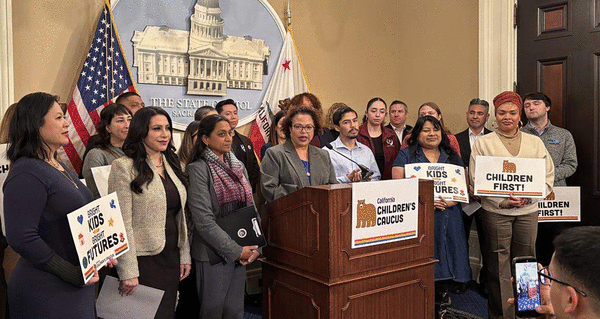
When Assemblymember Mia Bonta, D-Alameda, came to the Legislature after a long tenure at educational nonprofits, she realized she could no longer say she works with children.
“I work with adults who work with adults who work with adults who work with children,” she said Tuesday.
The mother of three said the state’s ballooning child poverty rate and worsening mental health outcomes for teens were driving forces in the creation of a new “Children’s Caucus,” a bicameral, bipartisan group of over thirty legislators. Bonta will be the chair of the caucus, which she said will meet in the coming weeks to coalesce support behind bills focused on children’s issues.
Several lawmakers joined Bonta during a rally Tuesday morning to announce the new effort, and spoke about bills they’re hoping to get across the finish line. Here were six proposals that stood out:
1) Age-gate social media apps: Assemblymember Josh Lowenthal, D-Long Beach, spoke about his new proposal, AB 1709, which would set a floor for how old you can be to make a social media account. Lowenthal has spoken highly of Australia’s similar ban, which went into effect in December and bans accounts for all children under 16 years old.
“We saw this implemented in Australia, effectively, 5 million accounts deactivated and counting. And we’ve seen 13 other countries announce that they’re doing the same,” Lowenthal said Tuesday. The lawmaker didn’t say Tuesday how old California’s minimum age should be.
He’ll have a powerful ally in Gov. Gavin Newsom, who urged legislators to bring him a proposal of the like during his State of the State address in January.
2) Ban weight loss and muscle-building supplements to children under 18: Lowenthal also discussed another bill Tuesday, which hasn’t yet received a number, which would prohibit the sale of certain supplements to people under 18. New York state passed a similar effort in 2023. The lawmaker spoke about the high proportion of eating disorders in the U.S.
He introduced his bills by talking about his daughters: “I’m not just informed by my girls when I come to work every day. They’re my compass. As a matter of fact, they’re a laboratory for the work that we need to do. And I see it right in front of me.”
3) Force cities to include planning for child care in their urban planning: Assemblymember Pilar Schiavo, D-Chatsworth, is the author of AB 1914, a bill that would require cities to consider access to child care when they do their city planning after 2028.
Schiavo, a single mother, pointed out that cities are required to plan for land use, housing, safety, and environmental justice. She argued child care should be part of that equation.
“Child care is not a luxury. It’s an essential piece of infrastructure,” Schiavo said during Tuesday’s news conference.
4) Ensure family members of foster youth are considered as guardians at any point in the process: Under current California law, it can be difficult to place children with a family member after the process has begun to place them elsewhere. Assemblymember Catherine Stefani, D-San Francisco, said her bill, AB 1846, would allow judges to place a child with a family member at any point during the foster care process.
“This bill is about reducing trauma for foster youth, strengthening families and honoring something every parent understands: that children belong with family whenever it is safe and possible,” she said.
5) Create a ‘line in the sand’ with child poverty: Chair Bonta seems to be taking a page out of the Office of Health Care Affordability with her latest proposal to set a statewide target to reduce child poverty. According to the national philanthropy Annie E. Casey Foundation, child poverty in California has more than doubled since 2021 — rising from 7.5% to 18.6% in 2024.
In addition to setting a target to reduce the poverty rate, AB 1996 would, in its current form, create a council to review policy decisions to determine whether they are improving or worsening the child poverty rate in the state.
“This is going to require our state agencies to lean in. It’s going to require our advocates and our legislators to lean in, and it’s going to require us all to draw a line in the sand,” Bonta said.
6) Allow adoptees to access their birth certificates: Assemblymbember Aisha Wahab, D-Hayward, often speaks of her experience as a foster child.
“As a former foster youth in Alameda County and a ward of the state of California, I can assure you that many of the vulnerable children that we are talking about are never in these rooms. They are never able to advocate for themselves, and they are not able to pay for lobbyists to advocate for policies that matter to other people,“ she said at the news conference Tuesday.
Wahab’s bill, SB 381, would allow people who are adopted in California to access their original birth certificates after they turn 18 beginning July 2028. It would also eliminate barriers for people who are the descendants of adoptees.
____
©2026 The Sacramento Bee. Visit at sacbee.com. Distributed by Tribune Content Agency, LLC.






Comments