Florida judges are releasing migrants from ICE custody, but a showdown is coming
Published in News & Features
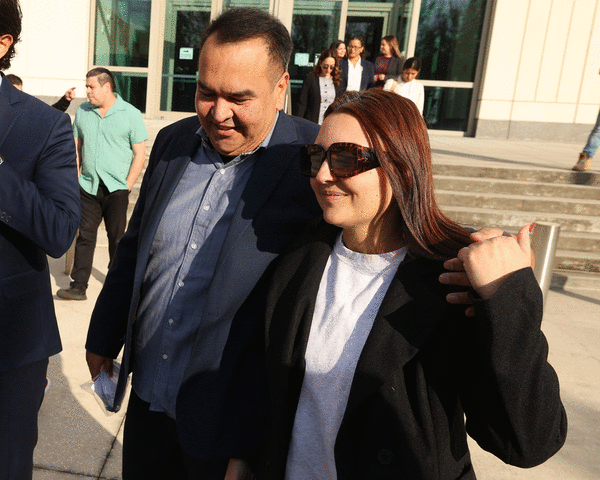
Reynel Bautista-Anzola, Angel Marquez-Perez and Francisco Delgado-Garcia entered the courtroom shackled on Feb. 9 and, walking in a line, were ushered in by federal officers to wait for their cases to be heard.
The hearing in federal court in Orlando, Florida, was to determine whether the three men, all migrants who’d been in ICE custody for weeks, should remain detained. U.S. Senior District Judge Gregory Presnell took less than an hour to order the men’s release, saying the delay in providing them bond hearings in immigration court left them wrongly languishing in detention.
“In our general jurisprudence, a reasonable time for a bond hearing would be 72 hours, not 17 days,” Presnell said of Delgado-Garcia’s case.
But the future for the three men — one from Colombia, two from Venezuela, none with a criminal record — is unclear, just as it is for thousands of other immigrants released after being swept up as part of the Trump administration’s mass deportation campaign.
Recent weeks have seen what amounts to a mass rejection by federal judges across the country of a relatively new practice by the Trump administration — indefinitely detaining immigrant non-citizens who are in the country lawfully and have committed no crime. That practice is at sharp odds with the administration’s rhetoric early in Trump’s second term, where officials insisted they were targeting only “the worst of the worst.”
But many Americans have gone along with the widening dragnet and some judges have too, with the U.S. Fifth Circuit Court of Appeals in Louisiana two weeks ago becoming the highest court so far to uphold the indefinite detentions. The 2-to-1 decision, experts say, re-interprets a federal provision that historically had applied only to people stopped at the border and makes it applicable to any undocumented immigrant, most of whom previously were considered to have due-process rights to challenge such detentions.
“If you’re going to take this interpretation … that it applies to individuals who are already in the United States, then what you’ve done is essentially made an endless, ever-present border,” said Fritz Scheller, a Central Florida attorney specializing in federal cases who recently began representing migrants petitioning for release.
The Fifth Circuit’s ruling does not apply to detainees held in Florida, and hundreds of federal judges, including several in Orlando, have rejected the government’s viewpoint.
But a similar question under consideration in the Atlanta-based 11th Circuit could have massive implications for detainees in Florida and elsewhere in the Southeast — and perhaps set up a legal battle at the Supreme Court.
Since January 2025, thousands of migrants, among them nearly 600 in the Middle District of Florida — which covers Central Florida — have filed so-called habeas corpus petitions to force the government to justify their prolonged detention, according to a case tracker by ProPublica.
Thousands, including at least 17 people in Orlando, have since secured their release.
With ICE reporting 68,000 detainees in its custody, a record-breaking figure, the deluge of petitions has clogged federal court dockets.
The intensifying clashes between federal judges and the Trump-backed U.S. attorneys stem from the interpretation of two different statutes, one focused on migrants stopped at the border or a port of entry and the other on migrants already living in the country, which says people already living in the country may be eligible for a bond hearing to consider their release. That latter statute is what many federal judges have cited when releasing detainees who’ve been held indefinitely without such a hearing.
In the Fifth Circuit case, however, the majority ruled that the 1996 law passed by Congress did not mean migrants already living here were entitled to bond hearings.
The government’s position, ultimately, is that any migrant, even those who have petitioned for asylum and have lived in the U.S. for years without issue, is subject to indefinite detention, said American Immigration Council senior litigation attorney Suchi Mathur.
“That’s what we would call a legal fiction, and in these cases, the majority of federal judges have said that doesn’t make sense,” Mathur said. “That’s not a plain text reading of the statute.”
Assistant U.S. attorneys in Orlando seemingly abandoned the argument for indefinite detention after facing admonitions in court in recent weeks. In Bautista-Anzola’s case, U.S. Attorney Gregory Kehoe conceded the right to a bond hearing — but then announced on a Sunday it would take place the following morning in Jacksonville, far from Orange County where Bautista-Anzola was arrested.
“Mr. Kehoe, you’ve been here a long time,” Presnell said before ordering Bautista-Anzola’s release. “You can’t possibly think it’s reasonable for you to schedule a bond hearing for that time.”
On Feb. 6, Attorney General Pam Bondi celebrated the decision by the Fifth Circuit as a “significant blow against activist judges” who are undermining the administration’s mass deportation efforts.
Presnell in open court called it “shocking for the Attorney General of the United States to pejoratively call me an activist judge,” adding that it was if she was calling all federal judges “traitors.”
Most detainees released by federal judges in Orlando have been represented by attorney Phillip Arroyo in an effort one judge described as “herculean.”
But with the growing number of detainees learning there is a chance for release, local attorneys are scrambling to fill the need.
The Orlando Center for Justice, founded in 2016 to provide legal services to people who cannot afford it, never before needed to defend detained migrants in federal courts, said Gisselle Martinez, a co-founder who spent more than a decade practicing immigration law.
“We have never seen anything like this, and we never expected things would be this bad,” she said. “We’re all trying to learn habeas, something that wasn’t remotely in our plans to start doing so, hopefully, we can protect our clients as much as possible.”
Families with loved ones at risk of being detained ought to prepare for a legal fight, saving money to hire an attorney whose practice in federal courts, she added.
Scheller, well-respected in Central Florida’s legal community, has been pulling together a team of attorneys willing to represent pro bono migrants detained locally. His team includes two former federal prosecutors, he said.
One such case is already being considered in Jacksonville.
“We’re not charging them any money,” he added. “We’re just doing this because it’s the right thing to do.”
But Arroyo has warned for weeks that bond hearings for his clients, though better that indefinite detention, are an “illusory” remedy as the Trump administration controls immigration courts, which are run by the Justice Department.
Even if migrants were given bond in immigration court, detainees would have to pay the full amount of the bond, which could be prohibitive. Criminal courts allow bond to be arranged for just 10% of the face amount.
In the last year, there is also a growing backlog in immigration courts, leaving people in ICE detention for days, even weeks, before an immigration judge would consider bond.
“If you had asked me a year ago, I would have said a lot of immigration judges are relatively neutral and having a bond hearing in front of them is a shot at due process,” Mathur said. “But since the administration has gutted the immigration courts, the people who are left are either scared that they’re going to lose their jobs so they do exactly what the administration tells them to do or they’re happy to go along with it.”
Days after Presnell ordered Bautista-Anzola, Marquez-Perez and Delgado-Garcia’s release, and in response to inaction by immigration courts, the judge banned the government from re-arresting the pair “until further order of the court.”
Bautista-Anzola said he fled his native Colombia in 2018, arriving in the United States on a tourist visa. He hoped a U.S. judge would hear his asylum case and allow him to stay.
“I came here because I needed protection,” he said outside the courthouse following his release. “I can’t go anywhere else. I can’t go back to my country.”
_____
©2026 Orlando Sentinel. Visit orlandosentinel.com. Distributed by Tribune Content Agency, LLC.






Comments