California rolled back Medi-Cal for undocumented people. Fresno legislator's bill seeks change
Published in News & Features
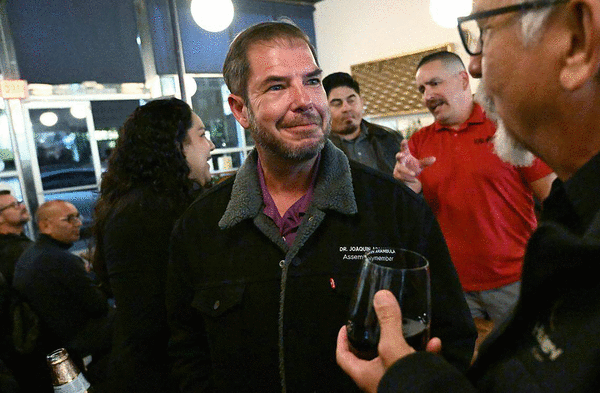
FRESNO, Calif. — A new California bill co-authored by a Fresno-area legislator intends to reopen Medi-Cal applications for undocumented adults who lost access to the program because of cuts made to the state’s budget last year.
The Medical Access Restoration Act, known as SB 1422, would end the Medi-Cal enrollment freeze that took effect Jan. 1 on undocumented people age 19 or older who otherwise financially qualify for the program. The bill was introduced last Friday by two Democrats, state Sen. Maria Elena Durazo of Los Angeles and Assembly member Joaquin Arambula of Fresno.
The state faced a deficit of more than $10 billion last year before it decided to roll back health insurance access for undocumented adults — which California had been expanding for several years — to help it pass a balanced 2025-2026 budget. California is again looking at a deficit of close to $3 billion as it looks to pass next year’s budget this summer.
But Arambula, who was previously an emergency room physician, says restricting health insurance access will be more costly to the state in the long run because people will still seek emergency care in hospitals after foregoing preventive care they cannot afford.
“The cost of that health care is much more expensive than what we’re proposing through SB 1422,” he said in a statement to The Fresno Bee. “Freezing enrollment may look like a budget solution, but it only shifts costs and escalates the financial problem.”
The bill is one of several recently introduced in California’s Legislature intending to protect Medi-Cal access following approval last summer by the U.S. Congress of the Trump administration’s H.R. 1, known as “The One Big Beautiful Bill Act,” which included cuts to the federal Medicaid program totaling nearly $1 trillion. Medicaid provides money for low income public health insurance programs in each state, including California’s Medi-Cal.
Health care experts have warned the cuts could be especially devastating in the San Joaquin Valley, where about half the population was covered by Medi-Cal in 2025.
“If we’re talking about the Central Valley and Fresno, those areas proudly feed the rest of the U.S.,” said Dr. Seciah Aquino, executive director of the Latino Coalition for a Healthy California. “We’re talking about farmworker communities, communities who need and deserve access to Medi-Cal.”
What’s in California legislators’ proposed Medical Access Restoration Act?
The Medi-Cal enrollment freeze that began Jan. 1 prevents the addition of new undocumented beneficiaries aged 19 or older. Those who were previously enrolled can retain their coverage but will have to pay $30 per month beginning July 1, 2027, if they are between the ages of 19-59. Undocumented children are still covered, as are pregnancy and emergency health care services.
The new bill’s text, as of Wednesday, would make undocumented people ages 19 and older who financially qualify once again “eligible for the full scope of Medi-Cal benefits subject to certain limitations.” Those between the ages of 19-59 would still have to pay a $30 monthly premium. Only emergency dental care would be covered for those who are 19 or older.
The bill is co-sponsored by 20 democratic California legislators, including Fresno-area State Sen. Anna Caballero.
Adocates say Medi-Cal cuts risk lives, local health care systems
Arambula said he believes restoring Medi-Cal enrollment for undocumented people is the fiscally responsible and “right thing to do” because of what he saw during his decade as an emergency room doctor in Fresno County. He said “too many” people with no health insurance would seek emergency room care as “a last act of desperation.”
“Their ailments could have been stopped or treated earlier,” Arambula said. “Instead, we tried our best to help patients whose health had deteriorated into chronic or life-threatening situations — and too often we couldn’t save them.”
Studies say California already spends about $3.5 billion annually on preventable emergency medical treatment. Aquino, of the Latino Coalition for a Healthy California, said the costs of higher emergency room attendance are often “punted to a different part of the system,” oftentimes county governments.
She said California is “shooting itself in the foot” by cutting access to health insurance for immigrants — a large percentage of them from the Latino and indigenous communities who work and pay taxes despite being undocumented. A study from the Institute on Taxation and Economic Policy showed undocumented people paid $8.5 billion in state and local taxes in 2022.
Said Aquino: “We provide industry folks with so many tax breaks, yet we are willing to let the most vulnerable bear the brunt of that economic burden.”
©2026 The Fresno Bee. Visit at fresnobee.com. Distributed by Tribune Content Agency, LLC.





Comments