Trump puts fate of world's top conflicts in the hands of two men
Published in News & Features
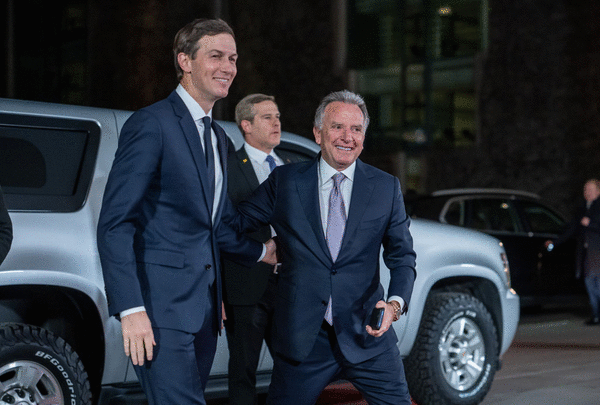
President Donald Trump put his son-in-law Jared Kushner and longtime friend Steve Witkoff in charge of resolving the war in Ukraine and a standoff with Iran. On Thursday, they juggled those momentous issues within hours of each other.
Dispatched to Geneva, Switzerland, Kushner and Witkoff met Iranian officials at the Omani ambassador’s residence in a bid to seal a deal over Tehran’s nuclear program and avoid what could be a massive strike by U.S. and Israeli forces.
Hours later, they shuttled across town to the Intercontinental Hotel to huddle with Ukrainian officials as the Russian invasion enters its fifth year. They then shifted to the Four Seasons to meet envoys from Russia and Ukraine on separate floors, before heading back to the Omani ambassador’s. They were expected to depart later Thursday to return to the U.S.
And that doesn’t count their participation less than a week ago in the inaugural meeting of the Board of Peace — the body that was created out of the ceasefire they helped reach to halt the fighting between Hamas and Israel in the Gaza Strip.
The pair’s frantic bid to quell conflicts that have the potential to further destabilize Europe and the Middle East was a stark illustration of the tension in Trump’s diplomatic strategy. His deployment of two envoys to secure peace — and U.S. economic interests — highlights his preference for relying on trusted associates for his most urgent priorities rather than the vast apparatus of the U.S. government.
But it also carries immense risks. No matter their strengths or acumen, the question is whether Kushner and Witkoff can possibly keep up with it all.
“It strains credulity to the breaking point to believe that two envoys — one the president’s best friend and the other the president’s son-in-law — can manage these three negotiations all at the same time,” said Aaron David Miller, a Carnegie Endowment for International Peace senior fellow who’s served as a State Department negotiator and adviser in Republican and Democratic administrations.
“We’re talking about three negotiations, each of which represent a universe of detail, each of which does not exist in a vacuum,” he said. “You could invite the best negotiator in the history of the world and these would still be a heavy lift.”
A White House official said the duo’s record of success speaks for itself, and that they manage their time efficiently while compartmentalizing the issues. Their business backgrounds aid in negotiations with world leaders, and Witkoff is regularly briefed by U.S. intelligence officers while both regularly communicate with the State Department and National Security Council, the official added.
Kushner rose to prominence during Trump’s first administration, when he held a central role in striking the Abraham Accords to normalize regional diplomatic relations with Israel. In 2024, he ruled out a return if Trump won a second term, saying he wanted to focus on his family and his investment business, Affinity Partners.
But he’s now deeply involved, and at the Gaza event in Washington last week, Trump said he planned to endow Kushner with the distinction of envoy, in line with Witkoff’s title.
Their participation is clouded by the major business interests they maintain. Kushner’s Affinity Partners manages billions of dollars of assets, including some from Qatar’s sovereign wealth fund. Witkoff has a stake in the World Liberty Financial crypto company, which is engaging in deals in the Middle East, including with funds linked to the Abu Dhabi government.
Witkoff and Kirill Dmitriev, one of Russia’s negotiators who also heads the country’s sovereign wealth fund, have discussed economic post-war agreements including around energy, rare earths and data centers. The U.S., Europe and Ukraine are also negotiating a post-war reconstruction deal on infrastructure and investment.
“Kushner and Witkoff are very accomplished business people,” Sen. Thom Tillis, a North Carolina Republican, said at a Council on Foreign Relations event this week. “I’m sure they’re good negotiators, but they’re not subject to Senate confirmation and they’re not subject to oversight.”
Ukrainian officials welcomed the duo on Thursday in a push to set up the next trilateral discussions with Russian officials in early March. That’s in turn meant to pave the way for a leaders’ meeting with Russian President Vladimir Putin, Ukraine’s leader Volodymyr Zelenskyy said Wednesday.
Olga Stefanishyna, Ukraine’s ambassador to the U.S., told reporters this week that Kyiv was “happy and proud” to work with Witkoff and Kushner, noting the importance of their direct line of communication to Trump. Three or four months ago, “we had disrupted chains of communications at different levels and we had mixed signals from both sides and now this has been structured and well-established,” she said.
Kurt Volker, who was special envoy for Ukraine talks in Trump’s first term, also noted that the pair’s ability to “speak with authority” on what Trump wants and to communicate directly with him is surely positive.
“On the negative side, they don’t have a deep understanding of the issues and the sensitivities,” Volker said.
(Alberto Nardelli contributed to this story.)
©2026 Bloomberg L.P. Visit bloomberg.com. Distributed by Tribune Content Agency, LLC.





Comments