Cape Cod business leader wants to bury electrical grid, demands state support after blizzard
Published in News & Features
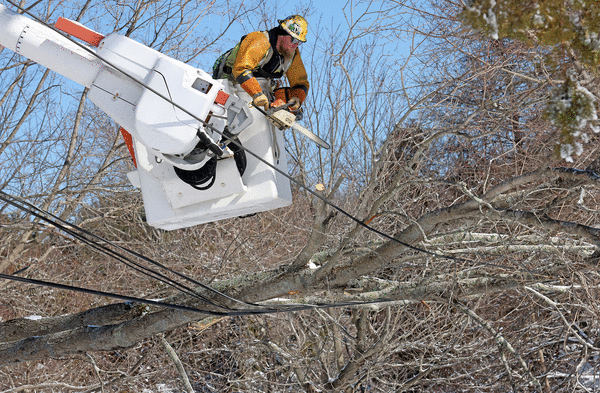
A Cape Cod business leader says it’s no surprise that the Blizzard of ’26 left the region without power for days because of trees and a lack of economic support from the state, and he called for parts of the electrical grid to be buried underground.
Cape Cod Chamber of Commerce CEO Paul Neidzwiecki is sounding off on how last Monday’s mammoth nor’easter caused 80% of the regional economy to go dark, which he blames on “predictable tree damage.”
“If you look at the outage map, nearly every dark neighborhood traces back to downed limbs and overhead lines,” Neidzwiecki stated in a chamber blog post on Thursday, as the region desperately searched for light. “In a forested, wind-exposed, coastal region with sandy soil, that isn’t surprising. It’s predictable.”
To better prepare the region in responding to future storms, the chamber leader is calling for a regional grid resilience task force, a phased undergrounding strategy for “priority areas,” and “serious engagement from policymakers,” among other desired action items.
Neidzwiecki is pointing to “critical corridors, village centers, public safety routes and economic hubs” for a phased plan of strategically burying the electrical grid underground.
“We do not need perfection overnight,” he stated. “We need a direction.”
At the peak of the blizzard, 153,000 Cape Codders were without power, prompting towns to open six regional shelters and at least 14 local warming centers and charging locations, according to the Barnstable County Regional Emergency Committee.
“Hundreds of residents sheltered as outages stretched into multiple days,” the committee stated in a Facebook post on Friday night, after Eversource declared earlier in the evening it had “substantially completed power restoration” before the established restoration time of 11:59 p.m. Friday.
The energy company said a “small number of remaining outages” entering the weekend involved “difficult repairs” and “hard-to-access locations.” Crews, including those from out of state, addressed more than 175 broken utility poles, repairing or replacing “dozens of miles of downed or damaged electric lines.”
“Our crews worked through blocked roads, deep snow and buried equipment to restore service safely, during extremely difficult conditions.” Doug Foley, Eversource’s President of Electric Operations, said in a statement. “This was a complex, long-duration storm that tested every part of our operations.”
Neidzwiecki’s call for an underground electrical grid has sparked conversation across Cape Cod. Some residents say they’re on board with the chamber head’s idea, while others argue it’s not feasible, physically and financially.
David Churbuck, who has lived in Cotuit since 1991, highlighted how officials in 1998 estimated undergrounding 2,900 miles of electric lines would cost the region $2.2 billion.
More recently, Eversource provided Orleans with a quote of $3 million per mile as the lower-Cape town considered burying some of its utilities in 2015, Churbuck added.
“Given the insane inflation of utility bills due to tacked-on subsidies by the state,” he told The Boston Herald, “I find it hard to believe ratepayers will be keen to see another surcharge tacked onto their bills.”
Churbuck said a policy that mandates burying utilities whenever a road is ripped up for other infrastructure projects would make more sense as a first step, adding that the high risk of hurricanes and nor’easters is the reality of living on the Cape.
Hyannis resident Gina Stewart wonders what state leaders and lawmakers could have done beforehand to better prepare for the impending blizzard. She told the Herald that she was without power for three days, while her elderly mother and aunt, also on the Cape, were in the dark for four days.
“It was expected that trees would blow and affect the power lines, and that affects people living on properties that aren’t able to make it out,” Stewart said on Saturday. “As people age, like our parents, they get more set in their ways, and they don’t want to ask for help until it’s an emergency.”
State Sen. Julian Cyr, who represents the Cape and Islands, did not immediately respond to a Herald request for comment Saturday afternoon. Gov. Maura Healey, who visited the region in the immediate aftermath of the storm, lifted the state of emergency on Friday.
“The people of Massachusetts always come together to help each other in our time of need,” Healey said in a statement. “I’m deeply grateful to everyone who has worked around the clock for the past week to prepare for and respond to this storm.”
Speaking to the Herald on Saturday, Kelly Collopy, who leads communications for Barnstable’s Department of Public Works, said local officials started preparing for the storm a few days in advance.
By 7 a.m. Monday, the town started fielding reports of an “overwhelming number of downed trees and downed power lines,” Collopy said. That meant crews couldn’t perform snow removal in those areas.
By that afternoon, the town had concentrated solely on clearing main and collector roads. More than half of the 400-plus reports from plow drivers and residents were tree-related, Collopy said. Three crews worked the entirety of the storm, including the town’s tree warden, she added.
“Oftentimes,” Collopy said, “they’ll go out to clear a road and clear a tree, and they’ll come across four or five other unreported tree issues. … So, it was really this insane effort from pretty much Monday afternoon on.”
With his demand for undergrounding utilities, Neidzwiecki is calling on the state to look at the Cape’s electric grid as essential as the region’s bridges. He pointed to how the regional economy “generates $2.9 billion in annual visitor spending,” with tourism supporting over 14,000 jobs.
“Make no mistake: in February, Cape Cod is not an affluent resort community,” Neidzwiecki stated. “It is seniors on fixed incomes. It is year-round workers. It is families relying on medical equipment and food deliveries. When the power goes out for days, vulnerability is not theoretical.”
©2026 MediaNews Group, Inc. Visit at bostonherald.com. Distributed by Tribune Content Agency, LLC.






Comments