Iranians in the Twin Cities watch, hope and wonder -- what's next?
Published in News & Features
When a 22-year-old Kurdish-Iranian woman was arrested by Iran’s “morality police” for not wearing her head scarf in the manner required by the regime, human rights advocates were right to fear the worst. The Iranian government later claimed Mahsa (Zhina) Amini suffered a fatal heart attack, but witnesses alleged she was beaten unconscious after her detainment and later died — a state-sanctioned murder that would give rise to youth-led protests in the streets of Tehran.
The September 2022 “Woman, Life, Freedom” uprising against the Iranian government was short-lived, leading to the deaths of hundreds of protesters and the arrest of thousands more, followed by executions of some 1,400 detainees, according to Iran Human Rights. Additional uprisings against Iran’s so-called “Supreme Leader” Ayatollah Ali Khamenei spanned the Green Movement of 2009, the Bloody November protest of 2019 and the gruesome events of this past January, in which some human rights groups estimate more than 30,000 Iranians were killed.
“There were body bags, but the regime could not even bury them fast enough,” said Hamid Kashani, an Iranian-American architect who has lived in the Twin Cities since 1973. “It pushed Iranians over the edge with this regime and how far they can go butchering their own people. At this point, any outside help appears welcome to most of us.”
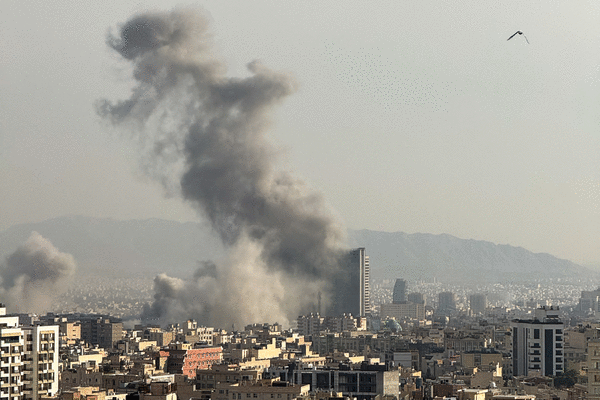
Still, even Kashani — a founding member of the Minnesota Committee in Support of a Democratic Iran — holds mixed feelings toward the Trump administration’s joint decision with Israel to bomb Iran. Khamenei was killed by a targeted Israeli missile strike in Tehran on Saturday, ending a 36-year rule that Iranian-Americans have described as a reign of terror.
Will Iran be any different?
Even those who celebrate his death recognize that elsewhere in the world, American efforts to topple autocratic regimes and hand-pick their successors have arguably set democracy backwards by creating ripe conditions for new authoritarians to assume power, notably Iranian-aligned leadership in Iraq and the Taliban in Afghanistan.
Will Iran be any different?
“It’s a million dollar question,” said Kashani, who lives in the western suburbs outside Minneapolis.
“We’re looking on with great hesitation and worry for the country and its people,” he said. “We all support getting rid of this barbaric leader, and hope for better days to come. The only concern is the ultimate outcome. Will we achieve the freedom and democracy that this whole thing is about, or will we replace one dictator with another?”
Regime change
Parham Alaei, a professor of medical physics at the University of Minnesota, shares the same mixed emotions.
“It is crucial to note that the people of Iran do not need, nor do they want, direct outside intervention; they are fighting against the regime on their own,” wrote Alaei, in a December 2022 opinion piece for the Pioneer Press regarding the “Woman, Life, Freedom” movement.
Fast-forward three years, and “direct outside intervention” has suddenly shaken Iran’s repressive government, killed its Supreme Leader and raised a host of new questions. The loss of life on the ground gives him pause.
“I didn’t want the war to start, but now that it’s started … the best outcome of the war would be to have a regime change,” said Alaei on Monday.
He doubts the U.S. will enter Iran with ground troops, given that the country of 93 million people is the size of Afghanistan and Iraq combined. Polling shows the attacks on Iran have proven unpopular so far with the American people, who are unsure about the Trump administration’s goals.
The government and the people
Do Khamenei’s death and U.S. and Israeli missile strikes open the door to new power structures that could help the Iranian people, or will they lead to fresh crackdowns under an equally oppressive successor?
“It may weaken the regime such that the next time people rise up as they did in January, the regime won’t have the full force of manpower and equipment to massacre the people,” said Alaei, who is praying for the former over the latter. “The best outcome would be when this war ends, people would be able to topple the government, we’d have a provisional government set in place, and people could choose their government.”
“The problem with Iraq and Afghanistan was the U.S. appointed their leader for them,” he added. “That was a ‘nation-building’ scheme.”
In the U.S., Kashani hopes that everyday Americans will come to understand that the war is with the Iranian government, and not with the people of Iran, many but not all of whom have longed for Khamenei’s overthrow.
“There is a clear distinction between Iranian people and the Islamic Republic of Iran,” Kashani said. “The government and the people are totally different sides of the table.”
_____
©2026 MediaNews Group, Inc. Visit at twincities.com. Distributed by Tribune Content Agency, LLC.





Comments