Lawmakers' concerns grow about Americans left stranded in Mideast
Published in News & Features
WASHINGTON — Lawmakers from both parties aired worries Tuesday about Americans unable to leave the war-torn Middle East, with Democrats more pointedly outraged that the Trump administration provided tardy warnings to U.S. citizens in the region.
Sen. Andy Kim, D-N.J., a former diplomat, told reporters the number of Americans who need to get out of the region could grow if, as Trump administration officials have predicted, the war widens or intensifies in the more than a dozen countries now being hit by missiles, drones or shrapnel. Kim said up to 1 million Americans may potentially be in harm’s way.
He called the belated advisories to depart those nations and evacuate nonessential personnel from embassies “one of the biggest derelictions of duty I ever saw.”
Sen. Christopher S. Murphy, D-Conn., a member of the Foreign Relations Committee and the Defense Appropriations Subcommittee, said the need for evacuations was foreseeable.
“They deliberately put Americans’ lives at risk in the region,” he said in a brief interview. “Our phones are ringing off the hook,” he added, referring to his constituents.
Republicans are, so far, not publicly agreeing with Democrats that the administration should be blamed for leaving substantial numbers of Americans in the lurch. But GOP lawmakers have made plain they are concerned about it.
“Everybody is taking the steps which I hope will lead to sufficient availability of aircraft to get people out,” Senate Majority Leader John Thune, R-S.D., told reporters. “I think that you will see a ramped up, intensified effort to ensure that Americans are being evacuated from the region, and I suspect that’s going to involve a good amount of investment and air assets to get people out of there.”
‘Do not rely on the U.S. government’
The State Department, in a statement on its web site, called its ongoing effort to help Americans get out of the Middle East “historic.”
But critics say it did not have to be this way and the State Department’s response has been lacking.
The State Department itself did little to rebut the critique. The U.S. Embassy in Jerusalem posted on X on Tuesday that it “is not in a position at this time to evacuate or directly assist Americans in departing Israel” and that “the U.S. government cannot guarantee” their safety if they choose to be evacuated by the Israeli Ministry of Tourism.
Also on Tuesday, Assistant Secretary of State for Global and Public Affairs Dylan Johnson posted a hotline phone number on X that he said Americans in the Middle East can call “for assistance with departure options.”
However, the outgoing automated message on that line that day told callers: “Please do not rely on the U.S. government for assisted departure or evacuation at this time. There are currently no United States evacuation points.”
That message was updated Tuesday night to an answering service and a greeting telling callers the department was “committed” to helping U.S. citizens who want to leave the region to do so.
Post-invasion warnings
The State Department did not order the evacuation of all nonessential personnel from most U.S. embassies in the Middle East until Monday, the third day of the war. The exceptions were the U.S. embassies in Israel and Lebanon, which were closed before the war started.
Meanwhile, U.S. diplomatic facilities have increasingly come under siege, with drone attacks and ground assaults on those installations documented in several countries, including Saudi Arabia, Dubai, Pakistan, Kuwait and Iraq.
As for Americans in the region who are not diplomats, the department issued a warning on Feb. 28, the day the war began — but after the missiles had begun to fly — that was broadly worded and conveyed little of the urgency that would soon be required.
To all Americans overseas, “especially in the Middle East,” the Feb. 28 alert said, follow the guidance of the embassy in your location. You “may experience travel disruptions due to periodic airspace closures,” it added.
The department did not issue a far more direct“depart now” order to Americans in 14 countries until Monday, the war’s third day.
On Tuesday, thousands of Americans were scrambling to try to get out of the Middle East, but by then wide swaths of the region’s airspace were closed due to safety concerns.
The armada assembled around Iran, meanwhile, does not include an amphibious warship with Marines trained in noncombatant evacuations, as has been the case in many past conflicts where civilians were at risk, according to a list of assets and personnel in the region compiled by the Center for Strategic and International Studies.
“We may be asking about that soon,” said Sen. Roger Wicker, R-Miss., chairman of the Armed Services Committee, about the lack of Marines, in a brief interview as he entered a classified briefing on the Iran situation Tuesday.
‘We need to know where you are’
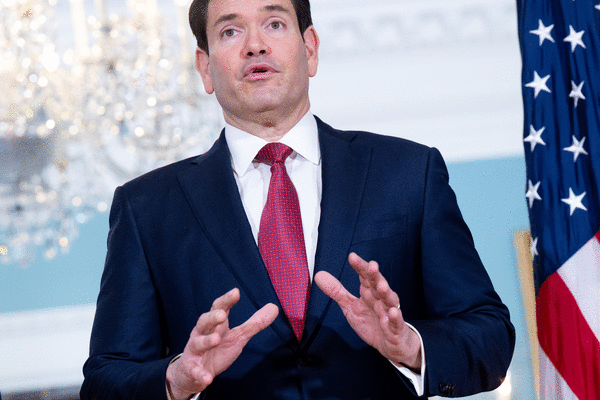
When Secretary of State Marco Rubio addressed reporters Tuesday ahead of that briefing, he led off his remarks with what was top of mind for him and many on Capitol Hill: the plight of Americans trapped in the Middle East.
Rubio said 9,000 U.S. citizens have left the region since the war began on Feb. 28, and 1,500 more have sought help leaving. Rubio said the government is looking for charter, military and commercial aircraft to bring those Americans and others home.
It is not known how many more U.S. citizens may need help getting to safety.
The secretary urged TV networks to post State Department helpline phone numbers on their screens.
Addressing Americans in the Middle East, he said: “We need to know where you are. We need to have contact information. They have to register with us, because as these options begin to open up, and as they open up, we have to be able to call you.”
GOP concerns muted
Republicans who are supportive of the U.S.-Israeli war on Iran are nonetheless concerned about Americans caught in the crossfire of a widening war, even if they are reluctant to criticize the administration.
Wicker, for one, said he does not fault the administration for not warning Americans soon enough. He suggested that security concerns may have been behind the timing of the post-invasion warnings.
“There are drawbacks to war secrecy for sure,” he said, though he acknowledged he has “dear friends” trying to leave the region.
Similarly, Sen. Markwayne Mullin, R-Okla., a member of the Armed Services Committee, said of Americans caught in the crossfire: “We knew that was a risk going into it. War is very ugly. We understood that.”
Democrats, meanwhile, expressed grave concerns about the fate of their fellow citizens in the region.
Rep. Donald S. Beyer Jr., D-Va., whose district includes a lot of diplomatic, military and intelligence agency employees, said he is being peppered with requests for help from constituents.
“The Trump Administration’s incompetence is stranding Americans abroad,” Beyer said on X.
“It’s not as if people didn’t know what was coming, they had telegraphed this attack by moving a significant carrier group into the region,” Murphy said after emerging from the classified briefing. “Right now, they’re telling us that they can barely get anybody out, and they’re putting a lot of people purposely at risk in the region by having no plan ahead of time for getting people out.”
_____
(Mark Satter contributed to this report.)
_____
©2026 CQ-Roll Call, Inc. Visit at rollcall.com. Distributed by Tribune Content Agency, LLC.






Comments