As talks with Cuba advance, Trump administration eyes change in top leadership
Published in News & Features
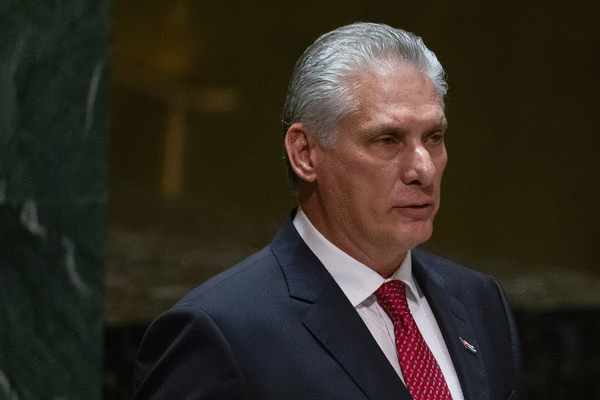
Cuban leader Miguel Díaz-Canel’s time as the face of the island’s communist leadership might be coming to an end, as the Trump administration has signaled a replacement may be needed as part of ongoing negotiations to push for economic and political changes on the island, the Miami Herald has learned.
Cuba’s handpicked president, Díaz-Canel, 65, has been sidelined in ongoing conversations between Secretary of State Marco Rubio advisers and Raúl Castro’s grandson and other people in Cuba. And the Trump administration sees him as “as an obstacle” to the changes it would like to see happen on the island, a source with knowledge of the matter, who asked for anonymity to discuss the sensitive topic, told the Herald. The source said that such a view has been communicated to the Cubans in the ongoing back-channel talks.
President Donald Trump has called Cuba a “failing nation” and has put unprecedented pressure on the country’s leaders to negotiate a deal. He moved to halt oil supplies from Venezuela and Mexico to the island following the capture by the U.S. military of Cuba’s closest ally, Venezuelan strongman Nicolás Maduro. Rubio has said the U.S. government is not expecting changes overnight on the island, but would like to see Cuban leaders make “dramatic” economic changes to their centrally planned socialist economy.
Last week, the Herald reported on a meeting between Rubio’s advisers and Raúl Guillermo Rodriguez Castro, Raúl Castro’s grandson, bodyguard and closest aide. The meeting took placed last Wednesday in Saint Kitts on the sidelines of the annual conference of CARICOM Caribbean leaders. Rodriguez Castro is also involved in running GAESA, the military conglomerate that controls about 40% of the island’s economy and key assets like the country’s gas stations, the Port of Mariel and tourist hotels. Several sources told the Herald the U.S. discussed the possibility of gradually easing U.S. sanctions on Cuba in exchange for reforms on the island.
After the meeting, Trump said that a “friendly takeover” of Cuba might be possible.
But Trump’s team sees Díaz-Canel as too ideological and at the same time not having the power to guarantee Cuba’s side of any potential agreement, the source said.
The possibility of Díaz-Canel’s removal would be a test of how much the Castro family, which remains at the center of power in Cuba, is interested in cutting a deal with the Trump administration that would avert U.S. military action and open up the island’s economy to avoid a total collapse of the country. And it would also signal how much control members of the family have over the leadership’s different factions, including the military and the large Communist Party and government bureaucracy.
There are significant obstacles, experts say, mainly because Díaz-Canel is also the first secretary of Cuba’s Communist Party, which carries symbolic clout.
“If they do it, it would have to be the result of negotiations with guarantees from both sides, because that would be a drastic change in Cuba,” said Ricardo Torres, a Cuba-born economist and faculty fellow at American University in Washington, D.C. “One of the things they have always been careful about is maintaining the idea of institutional stability.”
Removing Díaz-Canel, “is not impossible, but it would have to be part of a comprehensive agreement for a major transformation because that decision would be a scandal” in Cuba, he added.
That Díaz-Canel could be sacrificed in negotiations with the U.S. might come as an ironic twist for a man who has made loyalty to the Castros’ legacy his political brand. He made the phrase “We are continuity” his personal slogan.
Díaz-Canel is one of the regime’s most unpopular figures, earning a popular expletive as a nickname on the island. He climbed up the government ladder and was the last standing member of a group of young party stalwarts groomed to succeed Fidel Castro and later Raúl, and has survived several rounds of purges over the years.
Raúl Castro chose him to succeed him, first as the country’s president in 2018, and in 2021 as head of the Communist Party. Hopes that he could be Cuba’s Mikhail Gorbachev – the last Soviet leader, who ushered in reforms and led to the dissolution of the Soviet Union – quickly dissipated.
Díaz-Canel has presided over the largest exodus in Cuba’s recent history — almost three million Cubans have left since 2020 — and the largest demonstrations since Fidel Castro took power in 1959. And while Raúl Castro never truly retired and is still Cuba’s ultimate authority, it was Díaz-Canel who became the face of the economic crisis and the botched government policies that have run the country into the ground.
“He lost the little legitimacy he had left during the July 11 protests” in 2021, said a Cuban American who has met him and asked not to be named to speak about the interactions. On July 11, during island-wide anti-government protests, Díaz-Canel went on live television to urge government supporters to confront the demonstrators “by all means necessary,” a statement that many understood as condoning violence against the protesters.
Hundreds of the people arrested that day are still incarcerated, making up most of over 1,000 estimated political prisoners in Cuba.
The Cuban American source who spoke to the Herald said he grew disillusioned that Díaz-Canel might bring about significant change. The Cuban leader appeared to have his hands tied by the Castro family and Cuba’s powerful military, the source said.
For years, Díaz-Canel has urged changes and called for improved productivity in meeting after meeting —as if the government’s ability to do so was not directly tied to his own authority and ability to deliver.
In a council of ministers meeting on Sunday, Díaz-Canel called for “implementing the urgent, most necessary transformations that must be made to the economic and social model.” To Cuba observers and people on the island, there was little in his speech that was new or signaled major economic reforms.
The measures he mentioned — among them giving more autonomy to state enterprises and local governments — had been previously announced as part of a government plan that Cuban economists already deemed as insufficient to significantly overhaul the island’s failing economy.
“He is repeating the same message, just at a higher frequency and with the volume dialed to 11, but is the same thing, with no plan and no implementation,” said Ricardo Herrero, the executive director of the Washington-based Cuba Study Group.
Justifying Díaz-Canel’s removal, a figure long despised among Cubans on the island, might not be that difficult, given Havana’s long history in getting rid of members of the government deemed disloyal, corrupt or incompetent. Elsewhere in Communist bloc nations before the fall of the Soviet Union there were plenty of examples of party and government leaders suddenly being removed from their positions of authority.
But a change in leadership in Cuba would be a major concession to the United States, experts say, especially given Raúl Castro’s keen interest in providing Cuba’s communist government with apparent legitimacy in recent years by pushing through a new Constitution and several laws to strengthen institutional order.
Dismissing Díaz-Canel won’t really “remove the real foundations of power, but it’s not a merely symbolic gesture” either, said Armando Chaguaceda, a Cuban historian and political scientist who is a researcher at GAPAC, a Mexican think tank. ”In these systems, even though we know that power is exercised harshly, symbols matter, and a certain veneer of legitimacy matters.”
If someone must be sacrificed to close a deal with Trump, “clearly they won’t sacrifice Raúl Castro,” Chaguaceda said.
A change in Cuba’s top leadership will likely be well received by Cuban exiles, but might not be enough for many who would like to see Trump prioritize political changes and a transition to democracy in U.S. negotiations with Cuba.
Cuban American activists, lawyers, economists and business owners have shared with the Herald in recent days a sense of unease about the administration’s goals in dealing with Cuba. Many worry that the Trump administration might settle for leaving a member of the Castro family running the country, or leave GAESA, the vast military conglomerate that controls most of the country’s economy, intact.
Cuban exile organizations and the three Republican members of Congress from Miami have recently called for the indictment of Raúl Castro for the 1996 shootdown of two civilian planes belonging to the Miami-based Brothers to the Rescue group.
On Monday, several organizations of Cuban exiles and Cubans on the island who oppose the current government unveiled a plan for a democratic transition in Cuba that calls for the dismantling of Cuba’s Communist Party.
As expectations for regime change in Cuba grows, there’s also a chance Díaz-Canel might remain in his current roles after all.
“He is a fuse, something that can be blown if it affects the survival of the system,” Chaguaceda said, but compared him to a buoy, who somehow manages to stay afloat:
“He has survived many things.”
©2026 Miami Herald. Visit at miamiherald.com. Distributed by Tribune Content Agency, LLC.



Comments