Trial for Tampa college student in newborn's death could hinge on experts
Published in News & Features
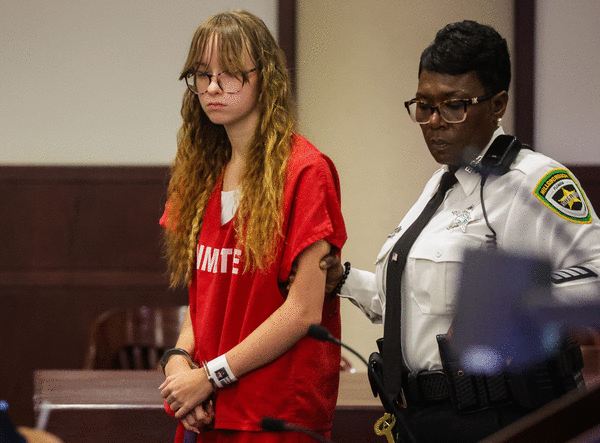
TAMPA, Fla. — When a jury is asked to decide whether Brianna Moore caused the death of her newborn daughter in a University of Tampa dormitory, their decision could come down to what medical and psychological experts say.
On the defense side are doctors who say the 19-year-old freshman was unaware she was pregnant until the morning she gave birth in a dorm bathroom. They say that extreme stress placed her in a dissociative state of mind and that the unattended birth caused medical complications resulting in the child’s death.
On the state’s side are doctors who say evidence suggests Moore knew she was pregnant and that the child died from asphyxiation.
In a court hearing last week, a judge weighed arguments over what evidence a jury might hear. The trial, which had been set to start later this month, was postponed again amid a legal dust-up over the ongoing exchange of evidence and experts.
In the coming days, it’s expected a new trial date will be set.
“We will lock this thing down,” Hillsborough Circuit Judge Thomas Palermo told the attorneys Friday.
On Wednesday, Palermo issued a ruling on some of the pretrial challenges, while others remain pending.
“The defense and the prosecution continue to give this important case the attention it deserves so that all the facts and the law are clarified,” said Moore’s attorney, Jonah Dickstein.
Moore, who turned 20 in jail, was arrested in the fall of 2024, several months after she gave birth to a baby daughter she later named Amara.
One of her roommates and a friend discovered the child, wrapped in a towel, in a dorm room trash can April 28, 2024. Moore later told police she did not know she was pregnant.
When she began to experience labor pains, she said, she puzzled over what to do. The baby cried for a few seconds after being born, she said, then went quiet.
She’s charged with aggravated manslaughter and other crimes.
A battle of experts
The case may hinge on two key issues: Moore’s state of mind during the birth and the precise cause of the baby’s death.
Her defense has tapped four expert witnesses.
Two of them are expected to testify that Moore had what’s known as a cryptic or unperceived pregnancy — a condition in which she either didn’t know or was in denial that she was carrying a child.
Nicole Graham, a psychologist, and Deborah Knudson Gonzalez, a psychiatrist, both opined in pretrial testimony that Moore showed signs of a dissociative disorder as she gave birth.
“My ultimate opinion is that Ms. Moore’s ability to recognize and appreciate the risk that she had (during labor and delivery) was impaired by her mental health diagnosis,” Knudson Gonzalez said in a deposition.
Moore’s attorneys plan to argue that her state of shock and confusion supports a defense of “mistake.” Such a mistake, the defense argues, is a legally recognized counter to the charge she faces.
Moore’s statements to police in the days after her daughter’s birth and death will be put before a jury. But the defense says they need experts to explain what Moore herself could not.
The state has argued that the experts should not testify at trial because there has been no assertion that Moore was insane when she gave birth. There likewise has been no argument that Moore had a mentally “diminished capacity” to form the intent to commit a crime.
“Only if insanity is raised does mental health become an issue,” Assistant State Attorney Lindsey Hodges said in court last week.
The judge ruled Wednesday that Graham will be allowed to testify. He has yet to rule on whether a jury will hear from Knudson Gozalez.
The defense’s two other experts include a licensed midwife and a doctor specializing in the care of infants and pregnant mothers. They’re expected to say that the circumstances of the unattended birth resulted in injuries to the baby that were accidental. The state has sought to exclude the midwife’s testimony; the judge has yet to rule on that request.
In January, the state listed as witnesses two of their own doctors to counter those from the defense.
That prompted a legal quarrel. Moore’s team accused the state of bringing in new witnesses at the last minute, leaving little time before trial for them to be questioned. The state told the judge they brought the doctors into the case after receiving a report from one of the defense experts long after a court-imposed deadline.
The judge scolded the defense, calling the issue a “self-inflicted wound.” He postponed the trial to give each side more time to question the other’s experts.
A concerning text message
Another point of contention concerns a series of text messages found on Moore’s phone after she turned it over to investigators.
The exchange occurred between Moore and a male friend about eight months before she gave birth. Amid lighthearted banter, they discussed the legality of birth control and abortion in different U.S. states.
“hey man sometimes you need a plan c,” Moore wrote.
“plan a was condoms,” he responded. “plan b was the pill. plan c was to kill (the) kid.”
“plan c is my favorite,” she wrote.
In court, the judge asked if the state had evidence that Moore knew she was pregnant when she sent those text messages.
“Overt evidence, no,” Hodges said. The prosecutor explained that she has circumstantial evidence: Moore told police that she was not taking any birth control medication and had not had a menstrual cycle in some time.
“I have nothing where I can say, ‘On this day she knew she was pregnant,’” Hodges said.
Dickstein, Moore’s lead defense attorney, clarified that her last menstrual cycle was in March 2023. She is believed to have become pregnant between Aug. 15 and Aug. 22 that year.
The text was sent Sept. 13.
The baby was born and died April 27, 2024.
Dickstein argued there was nothing to logically connect the text messages to the birth. The young man with whom she chatted was not the father of her child.
Dickstein also pointed out that investigators downloaded and examined the entirety of Moore’s phone and found no evidence she knew she was pregnant.
The messages, Dickstein argued, would “enflame the jury” and distract from the other relevant issues.
The prosecutor countered that the messages suggest a “conscious intent” to kill a child.
“The first opportunity she has to do that is seconds after giving birth,” Hodges said. “And, in fact, that is exactly what happened.”
That argument could be undermined by a litany of witnesses the defense wants to put in front of the jury to discuss Moore’s reputation and character. They include her younger brother, a middle school basketball coach, leaders in her church and friends who came to know her in their small, close-knit community in Mississippi.
All of them, the defense says, can say Moore is honest, peaceful, intelligent and compassionate.
In his Wednesday ruling, the judge excluded some of those witnesses but said others can testify.
In court, the judge noted there is danger in presenting such testimony; with each witness, the state could show images of the dead child and ask, “Is this something a compassionate person would do?”
Dickstein said he was aware of that possibility. But he said such testimony supports the notion of an unintentional mistake by a young woman who was smart but impractical and ill-equipped to know what to do.
“This is a perfectly normal-looking baby that suddenly died after Brianna gave birth, after doing her best to deliver it herself,” he said. “And then, being a book-smart type of person, she did nothing until confronted about it the next day.”
©2026 Tampa Bay Times. Visit at tampabay.com. Distributed by Tribune Content Agency, LLC.






Comments