Minneapolis council members press chief on why police didn't do more during ICE surge
Published in News & Features
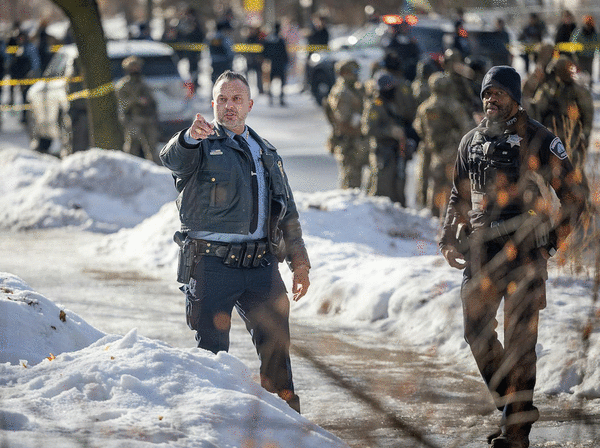
Several members of the Minneapolis City Council pressed Police Chief Brian O’Hara Wednesday on why police didn’t do more about the conduct of federal agents during the 12-week federal immigration surge.
The questions from the more-progressive council members came a day after Hennepin County Attorney Mary Moriarty suggested police officers could have intervened and even arrested federal agents.
That’s easier said than done, O’Hara responded, adding that his department is investigating two misdemeanor assaults by federal agents.
During a committee meeting of the entire council, several members questioned why police didn’t attempt to prevent what was widely seen as excessive force and reckless use of chemical munitions by immigration and border patrol agents, but also why the Minneapolis Police Department took other actions such as dismantling makeshift street barricades erected by residents.
The question of whether local police could physically intercede with federal agents surfaced before and during the crackdown, with Mayor Jacob Frey noting that the federal force vastly outnumbered local and state law enforcement and was better armed. A true confrontation could lead to actual warfare in the streets, he warned.
O’Hara described a type of Catch-22: The city has an ordinance that bars police from assisting with federal immigration enforcement, so officers could not be deployed unless there was violence, life-threatening situations or destruction of property.
“However we all feel” about Operation Metro Surge, he said, U.S. Immigration and Customs Enforcement and Border Patrol are lawful government agencies, and MPD cannot prevent their agents from enforcing federal law unless they witness egregious behavior. And since the city’s ordinance bans police officers from helping ICE, they often weren’t on the scene to witness federal agents’ conduct as it was happening.
“So everyday people should just do that with their bodies and their whistles?” Council Member Aisha Chughtai asked at one point during the meeting.
Police were in another bind: While they were being called on by residents and some city leaders to arrest federal agents, they were also being accused by the Trump administration of not doing enough to stop people from assaulting and impeding federal agents.
Several council members pressed O’Hara on why his department is only looking into two possible cases of agents breaking the law, given that the chief had said in December that officers could be fired for not intervening if they saw federal agents use excessive force.
O’Hara said that was his clear expectation, even though he fully expected his officers “to be in handcuffs” — arrested by federal agents — if they did so, given how the federal crackdown played out. “But it didn’t mean we were not prepared and willing to do that,” O’Hara said.
Council Member Jason Chavez said he was disappointed that police did not intervene in “countless incidents,” but O’Hara said there was no single incident where it would’ve been possible for MPD officers to intervene based on the state’s “duty to intervene” statute, which requires officers to take action if they see egregious, unlawful use of force — and are physically able to take action.
O’Hara said it was a “very complicated situation” where it’s difficult to prove a crime occurred when the federal agents were operating under different laws and rules. But he said his department would be “happy” to look into specific incidents provided times, dates and places.
Overall, O’Hara said he was pleased with MPD’s response to the surge, even though it wasn’t perfect. He admitted the department could’ve better handled a hotel protest, when most officers were on their 18th day on duty and the department wasn’t able to get officers there fast enough. They arrived to find federal agents leaving the hotel with guns pointing in the direction of protesters. MPD “disengaged” and came back later, he said.
Chughtai said she felt “disgust and disappointment” over the officers leaving.
O’Hara agreed federal agents used “terrible tactics” with “seemingly no objective” — but was it unlawful? That’s a different question, he said, noting that there’s a high legal bar to prosecute law enforcement officers carrying out their duty.
The Hennepin County attorney told the council its police department has not submitted any cases involving federal agents, but her office is investigating 15 instances of possible unlawful activity in Minneapolis. She’d like Minneapolis police to look at the cases, but had not yet gotten a commitment to collaborate.
O’Hara told the council he’d like to partner with the county attorney but needs to meet with the public safety commissioner first.
Moriarty said she talked to county police chiefs about a month ago and assured them they had the authority to intervene and even arrest ICE agents.
“I said I get it, this is unprecedented, this is scary,” she said. “I wouldn’t want to be in that position either. But our community members are. And our community members are telling us, ‘Who’s here to help us? Where is the government when our own government is attacking us?’”
O’Hara said the surge came at a time when MPD is grappling with staffing and swelling numbers of officers on leave.
While the department hired 125 more people than it lost last year, most of those hires are in various stages of training and not on the streets yet.
In addition, O’Hara said, 14 of the 619 sworn officers are on leave seeking help for post-traumatic stress disorder, eight retired, and 27 officers are out on a new family medical leave program the state started this year.
More than 1,000 days off were cancelled and more than 500 shifts were extended during the surge, O’Hara said.
All of that added up $6.4 million in police overtime as of Feb. 8.
©2026 The Minnesota Star Tribune. Visit at startribune.com. Distributed by Tribune Content Agency, LLC.






Comments