Alligator Alcatraz environmental assessment leaves 'more questions than answers'
Published in News & Features
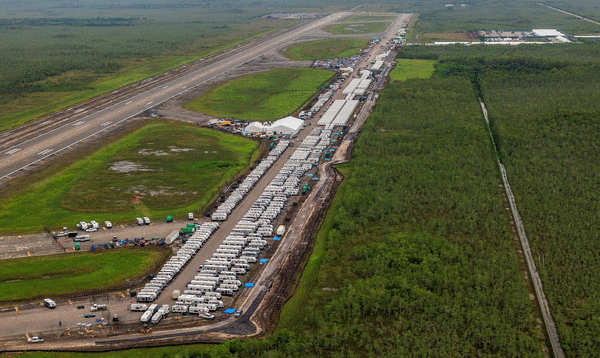
MIAMI — For months, environmental groups and the Miccosukee Tribe have been suing the state and federal government over the opening of Alligator Alcatraz, arguing they ignored the need to conduct an environmental study before opening the immigration detention center in the middle of the Everglades.
It turns out, the state did conduct its own assessment months ago, which concluded that “with possible exceptions of air quality, no significant adverse impacts” were anticipated from the operations of the tent facility.
The plaintiffs, Friends of the Everglades and the Center for Biological Diversity, say the report appears to be an effort by the state to comply with federal review standards, even as it argues in court that there is no requirement to do so.
The groups are also questioning the study’s value, saying the assessment doesn’t meet the standards for a deeper review and glosses over environmental concerns without citing qualified experts or data.
“This assessment raised more questions than answers,” said Eve Samples, executive director of Friends of the Everglades.
The October environmental assessment report is part of nearly 3,000 pages of documents and emails released by the Florida Division of Emergency Management after a public records lawsuit. The report’s description states that it was commissioned to comply with the National Environmental Policy Act.
The assessment, completed by a Texas-based environmental consulting firm and stamped ‘final draft,’ found “no impact” to the Everglades wetland and “minor to moderate” impacts to its endangered wildlife.
Findings that the environmental groups and experts are already picking apart.
The report had not been made public prior to its court-ordered release. The Florida Division of Emergency Management did not respond to requests for comment.
'Too little, too late'
The assessment — which Samples called “too little, too late” — does identify one possibly “significant” problem: the air quality from running 200 diesel-powered generators.
According to the assessment findings, pollution from the generators likely exceeds legal limits, which would require a special permit and air-quality testing. Those guardrails are in place because air pollutants that come from the generators, like nitrogen oxides, carbon monoxide, and ‘fine particulate matter’ are known to cause lung and heart health issues when inhaled.
Without mitigation, according to the report, the release of “greenhouse gases” like climate-warming carbon dioxide could also potentially result in “cumulative impact on the environment.”
The report recommended that the state add a “control device” to the exhaust pipes to trap emissions and limit noise.
To power the generators and light the tent city, the site uses up to 12,000 gallons of diesel. It also burns through about 1,000 gallons of gasoline each day.
Pratim Biswas, the dean of engineering at the University of Miami and an air-quality expert not involved in the report, said that it is like ‘a 16-wheeler diesel truck traveling roughly 100,000 miles every single day.’
“They have to be careful,” Biwas said.
The report says the state is following guidance to limit spills from the diesel tanks that could cause water pollution. But it recommends that the state put in additional safeguards.
A few fuel tanks had “minor staining” beneath them, and according to the report, the staining was assumed to have come from overfills or “minor leakage” during refueling.
“When you have this much diesel, this much gasoline, and you have newly paved areas that are impervious, there’s a real risk to water quality,” Samples said.
Samples also pointed to ‘gaping holes” in the assessment. One example she highlighted was listing the closest school to the site as Everglades City School, 31 miles away, while excluding Miccosukee Indian School, which is much closer.
The Miccosukee Tribe said they did not want to comment because of “pending legal matters.”
Endangered wildlife
Twelve federally listed threatened and endangered animals and plants were identified as living in the same shallow marshes where Alligator Alcatraz sits. The report said operations at the controversial site had no impact on the surrounding wetland ecosystem, including the threatened and endangered species that live there.
Elise Bennett, Florida director of the Center for Biological Diversity, said the report reaches those conclusions without citing data, analysis or explaining how decisions were made. She added the report “admits to issues, then brushes them off.”
Bennett contested the report’s conclusion on impacts to the Florida bonneted bat, whose designated critical habitat is within Alligator Alcatraz’s footprint. The report notes that no trees or structures were removed that would disturb the bat’s roosting, but it also did not evaluate potential impacts from light and noise, which can also affect roosting, she said.
In U.S. Fish and Wildlife Service guidelines for operating near the bonneted bats, the agency recommends avoiding or minimizing artificial lighting during construction to protect the species.
The assessments classified the bats as in “moderate” risk, a category it defined as having a long-term impact that could last “decades, centuries, or even millennia.” It suggested the state add measures that include “light shields, fencing, traffic calming and generator retrofits.”
In their court arguments, the environmental groups have maintained that the detention center encroached on the habitat of the Florida Panther.
The report disagrees. It designated the Florida panther as at “minimal” risk.
It also found that grass fields cleared for asphalt “may have contained” Florida prairie clover, an endangered plant, but says the area was significantly disturbed during the airport’s original construction.
The brief one- to two-paragraph summaries, which mostly contain descriptions of what different animals and plants look like, don’t meet the standards of the Endangered Species Act, Bennett said.
“I think if anything, all they’ve shown is that now they’re admitting that there is actually an impact, and that there’s much more work to be done to ensure the survival and recovery of these species and to ensure the integrity of Big Cypress and the waters around it,” Bennett said.
The DeSantis administration has dismissed the alleged harms as “speculative” in its court filings regarding whether it is required to complete an environmental assessment under NEPA.
These concerns, according to a February brief by the state with the Eleventh Circuit Court of Appeals, “pale in comparison to the very real public-safety and national-security crisis created by years of a free-for-all at the border.”
_____
©2026 Miami Herald. Visit miamiherald.com. Distributed by Tribune Content Agency, LLC.






Comments