World races to protect oil flows as Iran attacks continue
Published in News & Features
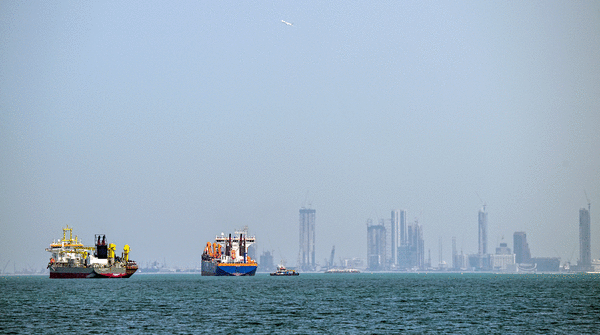
The U.S. and Israel’s war on Iran is forcing world governments to intervene to shore up energy supplies, with ongoing missile fire from both sides disrupting flows through a key waterway.
The International Energy Agency is proposing a release of emergency oil reserves that would be the largest in its history, with a decision possible later on Wednesday, according to a person familiar with the matter. The IEA’s suggestion is to release 400 million barrels, German Economy Minister Katherina Reiche said. That dwarfs the 182 million barrels member countries released after Russia invaded Ukraine in 2022.
The deliberations come as the U.K. Navy said three vessels were hit with suspected projectiles in the Strait of Hormuz and the Persian Gulf, underlining the ongoing threat to shipping from the conflict. Oman reported that a Thai-flagged cargo vessel was also targeted.
The strait has been all but impassable since the opening salvos of the now 12-day old war, triggering energy shortages and raising fears of an inflation crisis.
Brent soared to almost $120 a barrel at the start of the week, though has since pared gains to around $90. It remains around 50% higher year-to-date. Global consumption of oil is slightly more than 100 million barrels a day and Gulf producers have had to cut roughly 6% of that so far.
The war, which has spread across the Middle East, showed little sign of abating on Wednesday, with Iran staging more strikes against Israel, the United Arab Emirates, and other Gulf countries. Dubai International Airport briefly halted operations after drones struck the facility, resulting in four injuries at the world’s busiest international hub.
“The policy of reciprocal strikes has ended; from now on, our policy will be strike after strike,” Iran’s semi-official Fars news agency cited a military spokesman as saying.
The U.S. and Israel continued to hit targets in the Islamic Republic, after Defense Secretary Pete Hegseth pledged to “not relent until the enemy is totally and decisively defeated.” That followed a suggestion by U.S. President Donald Trump earlier in the week that an end to the conflict is in sight.
U.S. officials say Iran’s attacks are down more than 80%, though Washington’s own war effort is showing unexpected signs of strain because of the Iranian military’s resilience. Tehran is still hitting valuable military installations and energy infrastructure daily, while its ability to block the Strait of Hormuz remains a key advantage.
Trump’s administration on Tuesday delivered a series of rapidly shifting comments over the direction of the war, causing energy prices to whipsaw. Oil plummeted after Energy Secretary Chris Wright posted — and then deleted — an erroneous message that the U.S. Navy had escorted an oil tanker through the Strait of Hormuz.
Trump posted a flurry of messages on social media. He first insisted the U.S. had “no reports” of mines being placed in the strait, before urging Iranian forces to remove any explosives they may have laid. The president then said the U.S. had “hit, and completely destroyed, 10 inactive mine laying boats” and promised “more to follow.”
Saudi Arabia, Iraq, the UAE and Kuwait have all cut production because of Hormuz’s de facto closure. Saudi Aramco Chief Executive Officer Amin Nasser warned the impact on global petroleum markets could be “catastrophic.”
The UAE’s biggest oil refinery at Ruwais halted operations after a drone strike caused a fire in the industrial area in which it’s located, according to people familiar with the matter.
Group of Seven leaders will convene Wednesday to discuss the crisis in Iran and its ramifications for the world economy, with traders now widely expecting central banks to have to slow their pace of interest-rate cuts.
Any attempt by the U.S. and Israel to dislodge Iran’s conservative clerics and the well armed and funded Islamic Revolutionary Guard Corps will be a formidable task. The Guards — which are separate from the regular military — has around 200,000 active troops and another 600,000 volunteers, including the Basij paramilitary militia, U.S. assessments show.
More than 1,300 Iranians have been killed in the war so far, according to an official toll, although that number hasn’t been updated for several days.
Mojtaba Khamenei was named Iran’s supreme leader after his father, Ali Khamenei, was killed in the initial wave of strikes. Iranian state television has reported that the younger Khamenei had been injured, but the semi-official Iranian Students’ News Agency cited Yousef Pezeshkian, a son and adviser of Iran’s president, as saying he’d been told he was in good health.
At least seven U.S. service members have died, most of them in the first two days of fighting. The White House confirmed Tuesday that around 150 personnel had been injured so far. There have been several deaths in Gulf countries and Israel.
Israeli forces maintained attacks on southern Lebanon, aiming to degrade Iran-aligned Hezbollah. Some 570 people have been killed in Lebanon and 1,444 injured, according to the nation’s health ministry. Two Israeli soldiers were killed in the Lebanese operations.
Trump pledged during his election campaign not to allow the U.S. to become involved in protracted foreign wars, and there’s a risk that more American casualties and sustained high gasoline prices will weigh on Republicans’ chances in November midterm elections.
----------
—With assistance from Patrick Sykes and Kateryna Kadabashy.
©2026 Bloomberg L.P. Visit bloomberg.com. Distributed by Tribune Content Agency, LLC.





Comments