Fayette Judge Julie Goodman: What happens next in Kentucky's impeachment proceedings?
Published in News & Features
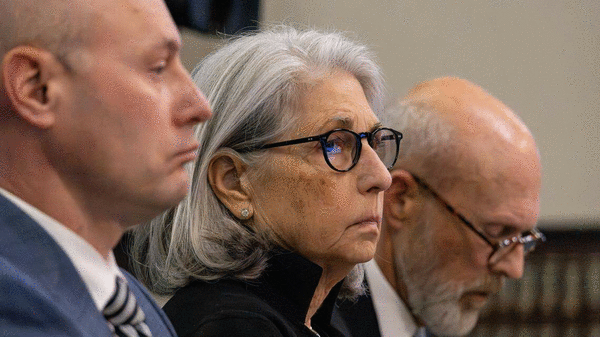
LEXINGTON, Ky. — For the first time since Kentucky’s unified court system was implemented in 1976, the state House of Representatives impeached a sitting judge.
The Kentucky House of Representatives on Friday voted overwhelmingly to send five articles of impeachment against Fayette Circuit Judge Julie Goodman to the Senate for a potential trial. The articles say Goodman abused her power, defied binding precedent, did not follow state laws or court rules and interfered with the rights of others, which constitute a misdemeanor in office, warranting impeachment and removal.
It was a moment years in the making, as Goodman and her high-profile rulings have faced public pushback from the top local prosecutor, the state attorney general and others.
Opponents of the impeachment say it sets a “dangerous precedent” to seek Goodman’s removal “because (lawmakers) don’t like her rulings.”
The legislator carrying the effort said that’s not what’s happening.
Rep. Jason Nemes, R-Middletown, told his House colleagues he brought the resolution forward with “a heavy heart, but with absolute confidence that it is right, and it is just.” He noted judges get reversed by higher courts regularly; that is how the system should work.
“Getting it wrong sometimes is part of the job. This body will never and should never make a judge’s reversal rate the basis of an impeachment proceeding,” Nemes, an attorney, said. “What makes this case different is not that Judge Goodman was wrong. It was not even that she was wrong repeatedly.
“It is that the record before us, before this body, establishes in case after case, that she was not simply wrong; she was intentionally wrong. ... Yet she proceeded and did it anyway. That is not a judge that made a mistake; that is something else entirely.”
Robert McBride, one of Goodman’s attorneys, called the vote a “historic error (that) may well serve to undermine the independence of our judicial system.”
How the impeachment effort began
The proceedings against Goodman began in January when Killian Timoney, a former GOP lawmaker running this year to reclaim the Lexington-area House seat he lost in 2024, filed a petition with the General Assembly.
In the petition, he cited six cases from Goodman’s court he believes warrant impeachment: cases involving defendants Cornell Thomas, Domonick Jones, James Harvey Hendron, and Gregory Simpson, and two cases involving the University of Kentucky. Attorney General Russell Coleman also intervened in some of the criminal cases in 2024, including in one instance a legal expert told the Herald-Leader at the time bordered on “legal warfare by the government” toward Goodman.
The most high-profile of the cited cases is Thomas’. He was charged with murder in a June 2020 car crash that killed 50-year-old Tammy Botkin. Goodman dismissed the murder case in 2023, a decision Fayette commonwealth’s attorney Kimberly Baird and Coleman appealed. The Kentucky Court of Appeals sided with the prosecutors in December, noting Goodman’s ruling was “fraught with legal errors and abuses of both its discretion and its authority.”
Baird testified in support of the impeachment effort, saying her “ultimate goal” is that Goodman no longer sit on the bench. Baird told lawmakers her team handles cases in Goodman’s courtroom differently, even offering defendants plea deals in an effort to avoid her ruling.
At the same hearing, Goodman said she was “duty-bound” not to defend herself against many of the allegations because five of the cases in question are still pending, and she is therefore prohibited from discussing them due to professional ethics. She noted Baird is held to a similar standard as a prosecutor, and therefore found her testimony troubling.
In her 46 years of practicing law, Goodman said she has never been sanctioned by the Kentucky Bar Association or Judicial Conduct Commission. She was first elected to the district court bench in 2008, and in 2019, she was elected to the circuit court bench. In all, she’s been elected by Fayette County voters six times, serving 18 years as a judge.
Goodman told the committee she stands by her decisions, though she acknowledged she’s capable of being wrong.
“These decisions were not made lightly,” she said to lawmakers. “They were made after very purposeful thought, reviewing the facts and the law, and knowing when making some of them, the public might not be happy. I could not be run by how the public would feel, or how you all would feel. I had to do what was right, legally.”
Though Goodman’s request for a Franklin Circuit Court judge to intervene in the proceedings was denied, it wasn’t a ruling Judge Phillip Shepherd made without expressing concerns about “substantial legal issues.”
He also said Baird’s complaints were because Goodman does not go “with the Commonwealth’s preferred outcome in criminal cases,” and accused her of “forum shopping” by taking part in the impeachment proceedings instead of filing a complaint through regular channels.
History of impeachments in Kentucky
Impeachments have been exceedingly rare in Kentucky history.
When the House unanimously impeached and the Senate unanimously convicted disgraced ex-prosecutor Ronnie Goldy in 2023, it was the first Kentucky Senate trial since 1888. At the time, Goldy, the commonwealth’s attorney for Rowan, Bath, Menifee and Montgomery counties, was accused of abusing his office by doing favors for a woman facing criminal charges and in return soliciting sexually explicit videos from her.
Goldy resigned from office during the process and did not mount a defense. Senate proceedings were done in less than 30 minutes with no debate. Though he resigned, the conviction bars him from holding future office.
He has since been convicted on 14 federal charges and is in a federal facility in Cincinnati with an Aug. 7 release date. The 6th Circuit U.S. Court of Appeals upheld his conviction in January.
More than a century ago, the ironically nicknamed treasurer James “Honest Dick” Tate was tried and convicted in absentia for stealing more than $200,000 in state money, a sum that’d be worth millions today. He was last seen leaving his office March 14, 1888, reportedly taking two sacks of gold and silver coins and a roll of bills. By the end of the month, he was impeached, convicted on four counts and removed from office — not that he ever tried to come back.
Tate, who had served as treasurer since 1867, abandoned his family and was never found again; no one really knows where he absconded to or when he died.
No judge has been impeached in the state’s modern court system. In the roughly 234 years since Kentucky’s inception as a commonwealth, the House has never impeached a sitting judge on a petition over disagreements with judicial rulings.
Impeachment hearings were held for elected officials in 1916 and 1991, but never went to trial.
How are Kentucky judges held accountable?
There are other ways to sanction a judge, as many attorneys — including Gov. Andy Beshear, who was attorney general for a term; former Kentucky Attorney General Fred Cowan, who also served in the legislature and as a circuit judge; and dozens more — have pointed out. Pursuing impeachment, they have cautioned, raises serious concerns about separation of powers and the precedent being set.
Kentucky has a Judicial Conduct Commission (JCC), which is the “only entity authorized under the Kentucky Constitution to take disciplinary action against a sitting judge.”
That can include removing a judge from office, which has happened a handful of times in recent years, like with Kenton Family Court Judge Dawn Gentry in 2020, Daviess Family Court Judge Julie Hawes Gordon in 2022 and 42nd Judicial Circuit Judge Jamie Jameson, also in 2022.
The JCC’s website says “any individual or group with knowledge of possible judicial misconduct or wrongdoing may file a complaint.” The process for filing a complaint is plainly spelled out, and the form is available in English and Spanish. In the past decade, it has fielded 2,640 complaints.
During the previous fiscal year, which runs from July 1, 2024, through June 30, 2025, the JCC received 373 total complaints, including about bias, conflict of interest, legal error and judicial temperament. It closed 362 complaints in that time, resulting in three sanctions: a private admonition, a private reprimand and a suspension.
JCC discipline is subject to Kentucky Supreme Court review on appeal. When Jameson appealed his removal, the state Supreme Court held in 2024 that the JCC had the power to remove him for the remainder of his term, but it could not permanently remove him from office, as that would encroach “upon the impeachment powers vested solely in our legislature.”
The JCC reminded Kentuckians of its power to discipline when it sent a press release Friday morning, about 20 minutes after the House began considering the Goodman impeachment resolution. In it, the commission made the reprimand of 14th District Judge Bolton Bevins public.
The JCC found Bevins had violated the Code of Judicial Conduct on several counts: failure to exercise judicial temperament; failure to follow the law; and “hostile, impatient, undignified and discourteous conduct demonstrating bias, lack of impartiality, lack of judicial decorum, and abuse of judicial authority.” Bevins agreed to the reprimand and has “already implemented corrective measures” and “committed to receiving additional training and mentoring.”
What happens next in Judge Goodman case?
The 38-member Kentucky Senate will soon decide Goodman’s fate.
Though judicial races are nonpartisan, the House vote of 73-14 broke down largely along party lines, with only one Republican opposing (Rep. Daniel Elliott, of Danville) and one Democrat supporting (Rep. Adam Moore, the Democrat facing Timoney in the November general election). Thirteen House members did not vote.
The Senate has 32 Republicans and six Democrats. It takes two-thirds of senators present to convict, per the Constitution. More than a quarter of the members have law degrees, which could make for an interesting process.
Senate President Robert Stivers, R-Manchester, told reporters in January the Senate was talking with attorneys and other constitutional experts about what a trial would look like because “nobody’s really done it in 100 years.”
The Senate can stay in session when “sitting as a court of impeachment,” per the Constitution. That means this could go beyond April 15, when the legislature is scheduled to adjourn sine die for the year.
Two other petitions remain pending in the House, both concerning Lexington-area elected officials: an impeachment petition for Supreme Court Justice Pamela Goodwine and a removal petition for Fayette school board chair Tyler Murphy.
_____
©2026 Lexington Herald-Leader. Visit kentucky.com. Distributed by Tribune Content Agency, LLC.






Comments