UN names head to oversee Haiti gang-suppression force to be deployed in April
Published in News & Features
Even as Haitian security forces make some progress in clearing roads and deploying armored vehicles into previously inaccessible neighborhoods, Haitians living under gang control continue to be subjected to harsh punishment and enforcement tactics, a new United Nations human-rights report details.
In some cases, victims are subjected to gang-run “trials” and held captive in buildings under gang control, forced to pay fines to secure their release. Others are “sentenced” to death, shot and, in many cases, their bodies burned with gasoline. Women and girls are also subjected to sexual violence.
“Gangs have terrorized the population by killing and kidnapping people, trafficking children, stealing at illegal checkpoints, extorting money from businesses, and destroying and ransacking public and private properties,” said Marta Hurtado, spokesperson for the Office of the U.N. High Commissioner for Human Rights.
The persistent violence Haitians face, however, isn’t limited to armed gangs, according to the report published Tuesday. Security forces, private contractors and self-defense groups have also been at fault, hitting bystanders with stray bullets and explosive drones.
According to data verified by the U.N., 5,519 people were killed in Haiti and 2,608 injured between March 1, 2025, and Jan. 15, 2026. Violence perpetrated by gangs resulted in at least 1,424 people killed and 790 injured; operations against gangs led by security forces, meanwhile, caused at least 3,497 deaths and 1,742 injuries; attacks against gangs by self-defense groups have caused at least 598 deaths and 76 injuries.
The findings come as the Kenya-led Multinational Security Support mission transitions into the larger and more lethal Gang Suppression Force. Mandated to “neutralize, isolate and deter gangs” the new U.N. authorized force is supposed to field 5,500 uniformed personnel and 50 civilians.
In order for the new force to be effective, the U.N. human rights office said it will need to take actions “beyond its purview, such as increased measures against those who finance, lead, and enable the gangs’ operations.”
Senior diplomat named
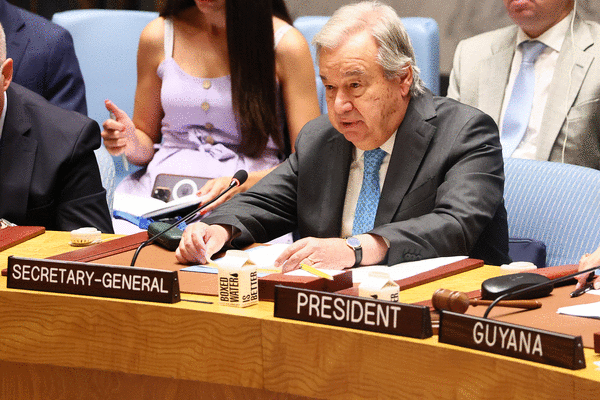
Earlier this week, U.N. Secretary-General António Guterres announced the appointment of Daniela Kroslak of Germany to head a new U.N. Support Office in Haiti, which has been established to provide logistical and financial support to the new anti-gang force.
Kroslak’s appointment comes days ahead of the arrival of the force’s first military contingents, an advance team from Chad.
Kroslak previously served as chief of staff of the U.N. Mission for Justice Support in Haiti, and will also serve as a U.N. assistant secretary general in her new post.
“She has a distinguished record in strategic and organizational leadership, high-level coordination, mediation and human rights,” the U.N. said, noting Kroslak has 25 years of experience in political affairs, peace operations and mission leadership.
Though the new gang force is not a U.N. peacekeeping mission, its leadership includes officials with extensive experience serving in challenging environments under U.N. mandates. Jack Christofides, who was recently tapped to spearhead the overall effort as special representative, is a longtime U.N. expert.
Guterres proposed the U.N. Support Office in an effort to deal with the financial challenges the ill-resourced Kenya force faced. Under the plan, the Support Office in Haiti would use funds from the U.N. peacekeeping budget to provide logistics while voluntarily contributions to a U.N. trust fund would support the troops.
Rubio’s calls
The force’s trust fund currently has $203.3 million in voluntary pledges from France, Germany, Italy, South Korea, Singapore, Spain, Turkey, Denmark, Austria, the United States and Qatar. Canada, which has led contributions, recently provided an additional $30 million Canadian dollars, while Mexico remains the only Latin American country to contribute to the fund, donating $100,000.
With only $174.1 million in hand, the fund is still not large enough to support the mission, experts say.
The new force and Haiti’s ongoing gang crisis were discussed in two phone calls Monday by Secretary of State Marco Rubio, according to the State Department. Deputy spokesperson Tommy Pigott said Rubio spoke with Kenyan President William Ruto and Canadian Foreign Minister Anita Anand.
In his call with Anand, Rubio discussed “efforts to promote security and stability in Haiti, including support for the U.N.-authorized Gang Suppression Force,” Pigott said.
In his conversation with Ruto, the secretary “expressed his gratitude for Kenya’s significant contributions to peace and security in Haiti and Kenya’s commitment to ensuring a smooth transition to the Gang Suppression Force,” Pigott noted.
Problematic security operations
Though the U.N. human rights report doesn’t devote much focus to the new force, the report highlights the complex situation its personnel will face. Even as Haitian police tout recent successes in curtailing gangs’ territorial expansion, they still face problems holding onto territory.
At the same time, the report underscores extrajudicial killings by police, mob justice by so-called defense groups and controversial drone strikes.
The report said that “some or even most, of these drone strikes and helicopter operations could be described as targeted killings, given the apparent predetermined, intentional, and deliberate use of lethal force against individuals specifically identified in advance, whereas the sole objective of targeted law enforcement operations against individuals should be their arrest and detention.”
The U.N. office also noted that no investigation appears to have been opened by the judicial authorities to establish the legality of the operations and the circumstances in which the killings and injuries occurred. “In addition, no accountability mechanism appears to have been put in place to enable victims and members of the population to access effective remedies and justice,” the report said.
“All law enforcement operations, including those delegated to private actors, are governed by international human rights law,” the report said.
There are also at least 247 documented instances of excessive or disproportionate use of force by Haitian police outside of anti-gang operations, the report noted.
“Since the vetting process of the Haitian National Police began in June 2023, the General Inspectorate of the Haitian National Police has opened investigations into 334 police officers; however, none of these cases has been finalized,” the report said.
The report also noted the continue use of force by a highly controversial public prosecutor of Miragoâne in the Nippes region, who was “reportedly involved in the summary execution of at least 34 men suspected of gang affiliation or committing crimes such as theft.”
_____
©2026 Miami Herald. Visit miamiherald.com. Distributed by Tribune Content Agency, LLC.



Comments