Divided Supreme Court weighs the right to seek asylum at the southern border
Published in News & Features
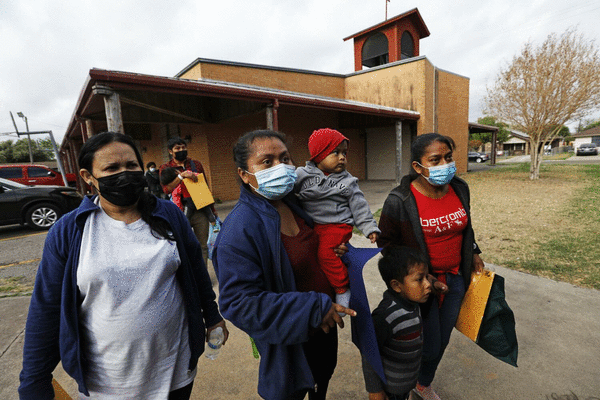
WASHINGTON — The Trump administration urged the Supreme Court on Tuesday to rule that it may block migrants from applying for asylum at ports of entry along the southern border.
The administration's lawyers argued that the right to asylum, which arose in response to Nazi Germany and the Holocaust, does not extend to those who are stopped just short of a border post in California, Arizona or Texas.
They pointed to part of the immigration law that says a noncitizen who "arrives in the United States ... may apply for asylum."
"You can't arrive in the United States while you're still standing in Mexico. That should be the end of this case," Vivek Suri, a Justice Department attorney, told the court.
Immigration rights advocates called this claim "perverse" and illogical. They said such a rule would encourage migrants to cross the border illegally rather than present themselves legally at a border post.
The justices sounded divided and a bit uncertain over how to proceed. But the conservative majority is nonetheless likely to uphold the administration's broad power over immigration enforcement.
Several of the justices noted, however, the Trump administration is not currently enforcing a "remain in Mexico" policy.
Liberal Justices Sonia Sotomayor and Ketanji Brown Jackson questioned why the court would make a major decision on immigration and asylum with no immediate, practical impact.
Jackson also questioned how the government read the law.
"The text has to make sense," she said. "Your reading of the statute suggests Congress was authorizing asylum by requiring people to break the law in order to obtain it."
Justice Brett M. Kavanaugh said he had the same question.
"Why would Congress do that?" he asked. "Your interpretation privileges someone who illegally enters over someone who legally comes close to the border."
The Justice Department lawyer replied that the government's "metering" policy was a response to a surge. It is not saying "you can never enter the United States and your only option is to enter illegally. It's saying our port is at capacity today. Try again some other day," Suri said.
The case posed a fundamental clash between the government's need to manage surges at the border and the moral and historical obligation to offer asylum to those fleeing persecution.
In 1939, more than 900 Jewish refugees who were fleeing Nazi Germany aboard the MS St. Louis were turned away by Cuba and the United States. They were forced to return to Europe and more than 250 of them died in the Holocaust.
The worldwide moral reckoning spurred many nations, including the United States, to adopt new laws that offer protection to those fleeing persecution.
In the Refugee Act of 1980, Congress said that noncitizens either "physically present in the United States" or "at a land border or port of entry" may apply for asylum.
To be eligible for asylum, a noncitizen had to demonstrate a well-founded fear of persecution in their home country due to their race, religion, nationality, membership in a particular social group, or political opinion.
Only a small percentage of applicants win their asylum claims, and only after years of litigation.
But faced with an overwhelming surge of migrants, the Obama administration in 2016 adopted a metering policy that required people to wait on the Mexican side of the border.
The Trump and Biden administrations maintained such policies for a time.
Immigrant rights advocates sued, contending the metering policy was illegal. They won before a federal judge in San Diego who ruled the migrants had a right to claim asylum.
In a 2-1 decision, the 9th Circuit Court of Appeals agreed in 2024.
"To 'arrive' means 'to reach a destination,'" Judge Michelle Friedland wrote for the appeals court. "A person who presents herself to an official at the border has 'arrived.'"
The Trump administration appealed.
Solicitor Gen. D. John Sauer said the "ordinary meaning of 'arrives in' refers to entering a specific place, not just coming close to it. An alien who is stopped in Mexico does not arrive in the United States."
On Tuesday, the Justice Department attorney said the court should reverse the 9th Circuit and uphold the government's broad power to block migrants approaching the border.
"I can't predict the next border surge," Suri said.
"For more than 45 years, Congress has guaranteed people arriving at our borders the right to seek asylum, consistent with our international treaty obligations," said Kelsi Corkran, Supreme Court director of the Institute for Constitutional Advocacy and Protection, who argued the case. "Yet this administration believes that Congress gave it discretion to completely ignore those requirements, and turn back those who are seeking refuge from persecution at its whim."
"The people turned away at our border are fleeing rape, torture, kidnapping, and death threats. You cannot tell families running for their lives to go back and wait in danger because their suffering is inconvenient," said Nicole Elizabeth Ramos, border rights project director at Al Otro Lado, which was the plaintiff in the case. "We brought this case because the United States made a legal and moral commitment to protect people fleeing persecution."
_____
©2026 Los Angeles Times. Visit latimes.com. Distributed by Tribune Content Agency, LLC.





Comments