Will US stop it? Russian tanker with desperately needed oil closes in on Cuba
Published in News & Features
A Russian oil tanker carrying hundreds of thousands of barrels of crude is steadily approaching Cuba, setting up a high-stakes test of Washington’s willingness to enforce its tightening energy embargo on the island as it grapples with a deepening fuel crisis.
Jorge Piñón, an energy expert at the University of Texas at Austin, said the vessel — the Anatoly Kolodkin — appears to be maintaining a steady course toward Cuba.
“This morning — when I checked it; I haven’t checked it just now — it was en route to Cuba. It is maintaining a speed of roughly 12 knots,” Piñón said. “I imagine it should arrive sometime within the next six days. However, for the moment, it hasn’t changed either its direction or its speed.”
Ferrying an estimated 700,000 to 730,000 barrels of Russian crude across the Atlantic, the tanker is widely believed by analysts to be heading for the Cuban port of Matanzas, despite broadcasting a misleading destination.
Its approach comes at a moment of heightened geopolitical tension, as the United States seeks to tighten pressure on Havana while managing global energy disruptions triggered by conflict in Iran and ongoing confrontations with Russia.LL
Looming decision for Washington
The tanker’s expected arrival is emerging as a key test of U.S. policy toward Cuba under President Donald Trump, whose administration has effectively imposed a de facto oil embargo on the island.
In a move underscoring that stance, the U.S. Treasury Department last week amended a temporary waiver allowing certain sales of sanctioned Russian oil to explicitly exclude shipments to Cuba, as well as Iran and North Korea.
That leaves open a central question: What will the United States do if the tanker presses ahead?
“Here, anyone can say whatever they want, but at the end of the day, what we really have to watch for is what actually happens when that time comes,” Piñón said. “Are they going to board it? Are they going to stop it? Are they going to fire a cannon shot at it? What exactly are they going to do?”
U.S. officials have not publicly outlined their response, but analysts say options could range from diplomatic pressure to maritime interception by the U.S. Navy or Coast Guard, which maintain a strong presence in the Caribbean.
Cuba’s worsening energy crisis
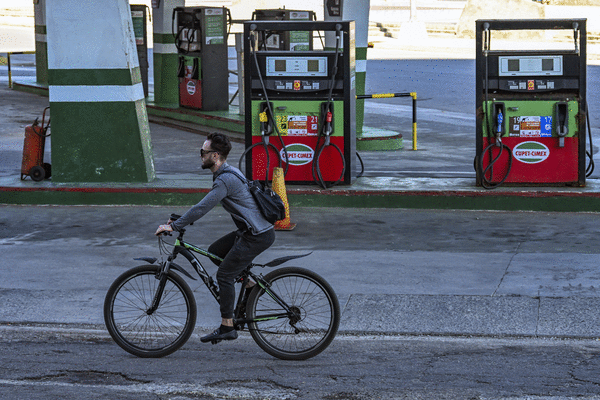
The potential delivery comes as Cuba faces one of its most severe energy shortages in years. The island has received only two oil tankers so far this year, contributing to chronic power outages that have become a daily occurrence.
The situation worsened further when another tanker originally bound for Cuba diverted to Trinidad and Tobago, depriving the island of a much-needed shipment.
Russia has described its support as humanitarian. Energy Minister Sergei Tsivilev said Wednesday that Moscow is supplying fuel to Cuba as aid, though he did not provide details.
If delivered, the crude could provide only temporary relief. Cuba’s aging refineries would need roughly two to three weeks to process the oil into usable fuels such as diesel, Piñón said.
Broader geopolitical signal
A second vessel, the Hong Kong-flagged Sea Horse, has added to the uncertainty. The tanker, believed to be carrying about 190,000 barrels of Russian diesel, spent weeks drifting in the Atlantic before diverting toward Venezuela, according to tracking data.
Analysts say its unusual movements — including disabling its tracking signal — are consistent with tactics used to evade sanctions.
For many observers, however, the significance of the Kolodkin goes beyond the fuel it carries.
Russia’s move is widely seen as a geopolitical signal — a way to test Washington’s resolve in the Western Hemisphere at a time when the United States is already managing conflicts involving Ukraine and Iran.
Whether the tanker is allowed to dock, turned away or intercepted at sea could shape not only Cuba’s immediate energy outlook, but also the broader balance of power playing out across the region.
For now, Piñón said, the focus remains on the ship’s steady advance — and the uncertainty that lies ahead.
“It hasn’t changed either its direction or its speed,” he said. “Now we wait to see what happens.”
_____
©2026 Miami Herald. Visit miamiherald.com. Distributed by Tribune Content Agency, LLC.






Comments