Judge voices concern over US sanctions blocking funds for Venezuelan President Maduro's defense
Published in News & Features
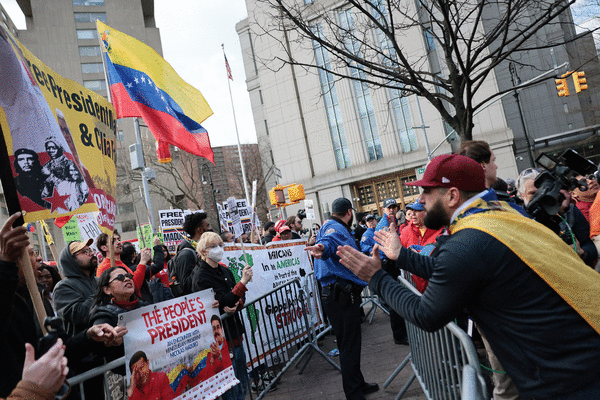
NEW YORK — A Manhattan judge on Thursday said he wouldn’t throw out narco-terrorism charges against ousted Venezuelan President Nicolás Maduro and his wife, but sounded sympathetic to arguments about U.S. sanctions interfering with their defense.
The Manhattan Federal Court hearing was the first for Maduro and Cilia Flores Maduro since their initial appearance in January following their stunning capture in Caracas by U.S. special forces, in which at least 100 people were reportedly killed.
The deposed Latin American leader, wearing beige and fluorescent orange prison garb and ankle shackles, appeared in good spirits despite the high stakes, jovially greeting his attorneys in Spanish when he was brought into the 26th-floor courtroom around 11:40 a.m. and gesturing a finger-gun salute to others by the defense table.
The couple asked Manhattan Federal Judge Alvin Hellerstein in February to dismiss the case, arguing that U.S. sanctions blocking them from using Venezuelan public funds to pay their legal bills violated their due process right to present a defense.
Hellerstein reserved a decision after hearing arguments for about an hour, though he quipped at one point, “I’m not going to dismiss the case,” and later suggested the request was premature.
But the jurist appeared sympathetic to the defense position on the sanctions, repeatedly acknowledging the significant resources needed to mount a defense against the sweeping prosecution and the burdens it would place on court-appointed lawyers.
“This is a case that is beyond normal,” the judge said, describing it as unlike any other. “It would tax (public defenders) in a way that would hamper their primary job to defend people in this court.”
The U.S. Treasury’s Office of Foreign Assets Control (OFAC), which has authority over the sanctions, initially issued a license allowing the Maduros to access the money in the days after their capture, only to revoke it hours later.
Maduro’s lawyer, Barry Pollack, argued Thursday that Supreme Court precedent made clear that the couple had a right to access funds Venezuela’s current leadership is willing and obligated to pay per the country’s laws. He said there was no allegation the funds in question were tainted and that they should be accessible to the Maduros to foot the bill for lawyers of their choice.
“The government has the right to block the funds, but doing so has consequences,” the lawyer said, arguing that in response to the government refusing to budge, Hellerstein “must” throw out the case.
“The court cannot let trial proceed without defendants’ rights being fully vindicated,” Pollack said.
Arguing for the Justice Department, Kyle Wirshba from the Manhattan U.S. attorney’s office said national security and foreign policy interests underpinned the government’s interests in upholding the sanctions against Maduro and the Venezuelan government, which have been in place since 2019.
“We are doing business with Venezuela!” Hellerstein retorted in one exchange with the prosecutor, questioning how the Madruros’ ability to pay their lawyers had any bearing on national security.
During one back-and-forth, the judge described Venezuela’s vast oil reserves as vital, “specifically because of the crisis in the Strait of Hormuz.”
Wirshba countered that the U.S. shouldn’t be expected to drop the sanctions in place against Maduro and Venezuela “simply because there are relations” between the two governments. He said the feds were skeptical that the Maduros didn’t have cash stashed away to afford their lawyers and were investigating it.
The prosecutor said that Maduro was accused of maintaining an authoritarian state while plundering public funds, and allowing a sanctioned person to access a slush fund controlled by a sanctioned government would undermine the prosecution.
Conceding the government had a right to sanction the Latin American country, Hellerstein said, “I don’t concede that in this case it would serve any purpose.”
“We have changed the situation in Venezuela,” Hellerstein later added. “The Venezuelan government is no longer implicated in the kinds of atrocities we’re talking about now. We corrected that.”
Wirshba forcefully argued that the Maduros had no right to third-party funds in another country to spend in the U.S. and said the judge had no authority to order the Treasury to make an exception. He said the defense could bring a lawsuit against OFAC.
Wirsha later said if the judge was inclined to support some form of remedy, the government could communicate it to the relevant stakeholders and would request fact-finding hearings.
Federal prosecutors allege Maduro and his wife plotted to import thousands of tons of cocaine into the U.S. over a decades-long period to fund illicit government activities. They are indicted alongside four others, including Maduro’s son, who have not been apprehended.
The couple are being detained at the Metropolitan Detention Center in Brooklyn and have pleaded not guilty to the charges carrying a potential life sentence, with Maduro defiantly telling Hellerstein in January he had been “kidnapped” and was “a prisoner of war.”
_____
©2026 New York Daily News. Visit at nydailynews.com. Distributed by Tribune Content Agency, LLC.



Comments