Cash-strapped Boston City Hall facing $48.4 million budget gap
Published in News & Features
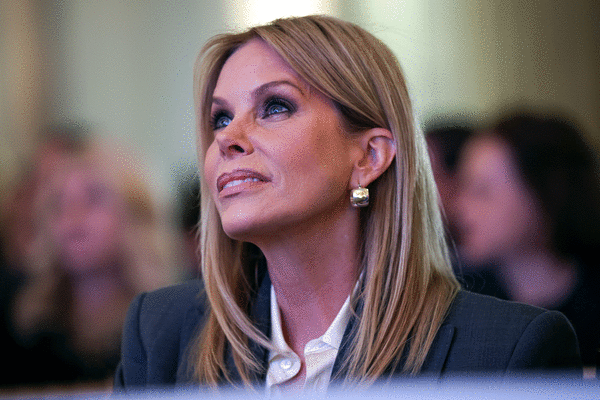
BOSTON — Boston’s financial chief said the city is scrambling to close a projected $48.4 million budget gap before the fiscal year ends on June 30, a daunting number that has already led the mayor to freeze some spending and delay hiring.
Chief Financial Officer Ashley Groffenberger said Monday that the fiscal year 2026 budget deficit is largely driven by $47.1 million in overspending for unanticipated snow removal costs from two major winter storms, along with a $48.7 million excess in public safety overtime.
“The city is facing significant external cost pressures that are largely outside of local control,” Groffenberger wrote in a letter to the City Council. “These include high snow removal and hauling expenses due to record snowfall this winter, rising public safety overtime demands, and continued increases in health insurance costs.”
The shortfall represents roughly 1% of this fiscal year’s $4.8 billion budget, and has to be closed in order for the city to deliver a balanced budget for FY27, which the Wu administration plans to roll out next week, Groffenberger said.
“This projected deficit reflects slightly stronger than expected overall revenue performance and various expenditure savings in certain areas — offset by significant unanticipated costs, most notably in snow removal and public safety overtime,” Groffenberger wrote.
This year’s budget deficit was revealed by the city’s financial chief for the first time on Monday, after Wu administration officials dodged questions from councilors about the projected shortfall in a Council budget hearing last week.
Questions about the budget gap began after an internal city memo detailing the Wu administration’s decision to freeze some spending and delay hiring amid a budget crunch came to light earlier this month.
The memo stated that the city had opted to freeze spending on office supplies, food, and travel, and cut back on building renovations.
The Boston Public Schools had already taken similar steps in January, in response to a separate $53 million budget shortfall. Groffenberger said the city’s deficit does not include the BPS shortfall, as the city and schools prep separate budgets.
Groffenberger said the measures outlined in the memo will remain in place for the remainder of the fiscal year, which ends June 30.
She added that the city is looking at further “targeted reductions” as it looks to close the FY26 budget gap, though she didn’t specify what that may entail, only to say that Wu officials are aiming to avoid cuts that will impact core city services like trash removal and public library hours. There was no mention of layoffs.
Mayor Michelle Wu reached a deal with City Hall unions last week to limit GLP-1 drug coverage for weight loss treatment for city employees, which her office estimated will save the city roughly $10.6 million and curb increased health costs.
The Wu administration has also directed city department heads to trim their budgets by 2% for the next fiscal year. The mayor has previously cited federal funding uncertainty and falling commercial property revenue as challenges.
“The city has well-established strategies for managing a projected year-end deficit, each involving careful decision-making and necessary choices, particularly to guard against challenges in future years,” Groffenberger wrote. “These measures will remain in place through the remainder of the fiscal year to ensure we reduce the deficit as much as possible through June 30.”
The CFO said that the city may dip into its roughly $1 billion reserve fund to balance the budget, which critics and watchdog groups have urged the mayor to do in recent years, but emphasized that the focus is on targeted reductions to expenses and living within a so-called constrained fiscal environment.
Groffenberger said closing out a fiscal year with a budget shortfall is unusual, and she couldn’t recall the last time the city faced a deficit.
She blamed what she called extraordinary snow removal expenses, and said the city is considering proposing a supplemental budget to close out the fiscal year — a step that she said a couple of other Massachusetts municipalities have taken to address the snow budget.
Groffenberger said the city is evaluating how it budgets for snow removal in the future to prevent overages, but characterized this year’s record snowfall as an outlier in budget preparation.
The CFO said the city plans to monitor and update its projected budget deficit “regularly,” to take into account revenue and expenses from this summer’s large-scale events in addition to further impacts from health insurance costs, but expects its spending controls will close the shortfall by June 30.
“We are preparing to enter FY27 in an environment of constrained revenue growth,” Groffenberger wrote. “With fewer resources available to absorb rising costs, targeted reductions and careful prioritization will be necessary as we work to deliver a balanced budget. It is critical that we budget responsibly in order to mitigate future risks and ensure the long-term fiscal stability of the city.”
Gregory Maynard, executive director of the Boston Policy Institute, called the projected deficit “stunning.” He said a “careful and independent accounting” of the city’s finances needs to take place, so that an outside expert can determine whether this year’s shortfall is “an act of God or the result of mismanagement by city budget officials.”
“It is stunning that this kind of deficit was allowed to develop in Boston,” Maynard said in a statement. “Adding up all the overspending, between City Hall and BPS the total is $153 million – 3% of the FY26 budget and more than twice as high as the overspending in FY25.
“The fall in revenue is equally shocking,” Maynard added. “It seems clear that over the last few years Boston relied on un-budgeted revenue to pay for over-spending. Now un-budgeted revenue has dried up just as overspending has exploded. The fall in ‘licenses and permits’ revenue in particular isn’t just bad for FY26: a lack of building permit revenue now means less new growth, and less property tax revenue, in the years to come.”
Mayor Wu plans to propose her FY27 budget next week to the City Council, which has the authority to approve, deny or amend her spending plan.
________
©2026 MediaNews Group, Inc. Visit at bostonherald.com. Distributed by Tribune Content Agency, LLC.






Comments