Trump threatens Iran infrastructure as markets fear more war
Published in News & Features
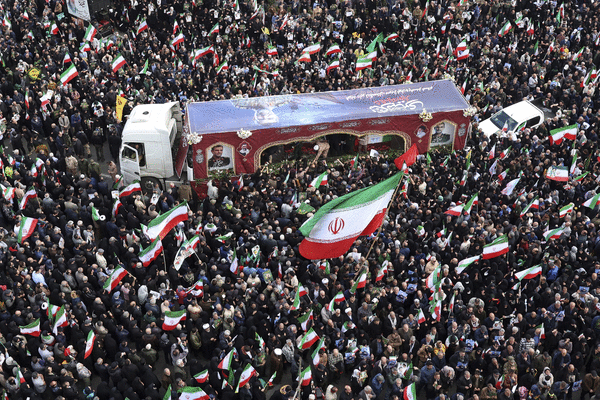
WASHINGTON — President Donald Trump issued fresh threats to Iranian infrastructure in an effort to pressure Tehran in negotiations, a day after his pledge to continue the war touched off global market and economic turmoil.
“The biggest bridge in Iran comes tumbling down, never to be used again — Much more to follow!” Trump posted to social media, accompanied by a video. “IT IS TIME FOR IRAN TO MAKE A DEAL BEFORE IT IS TOO LATE, AND THERE IS NOTHING LEFT OF WHAT STILL COULD BECOME A GREAT COUNTRY!”
Iranian Foreign Minister Abbas Araghchi said striking civilian structures “will not compel Iranians to surrender” in a social media post. Earlier Thursday, Iran’s semi-official Fars news agency reported that airstrikes had hit numerous targets, including a bridge connecting Tehran to the city of Karaj.
Trump’s comments and the continued strikes on Iran complicated efforts by the United States and partners to broker a deal with the Islamic Republic, including to reopen the vital Strait of Hormuz, as the war approaches the five-week mark.
The strait will remain shut for the U.S. and Israel over the long term, Fars reported, citing an armed forces spokesman.
US oil prices settled above $110 a barrel for the first time since 2022 while Brent ended the session just above $109 a barrel. Fuel continued to edge higher worldwide, with diesel prices in Europe rising above $200 a barrel.
While markets are closed for Good Friday and into the weekend, most traders were unwinding bearish positions rapidly following Trump’s prime-time address Wednesday, in which he indicated U.S. operations could continue for two or three more weeks.
The president has oscillated between casting diplomatic efforts as productive, and threatening further destruction — including on civilian and energy infrastructure. Earlier this week, he threatened to target Iran’s energy facilities and water desalination plants if the strait stays shut — a move that could constitute a war crime under the Geneva Conventions.
In his Wednesday address, Trump pledged “to hit each and every one of their electric-generating plants” if Tehran doesn’t agree to U.S. demands.
He reported no progress on efforts to reopen the vital waterway, with European and Gulf countries initiating their own efforts to do so.
The United Kingdom convened more than 40 U.S. allies for a virtual meeting Thursday to consider diplomatic outreach to Tehran and potential sanctions if it did not agree to unblock the Strait of Hormuz.
The coalition was clear the U.S. needed to include a solution for Hormuz in ceasefire talks with Iran, people familiar with the discussions said. Military planners from the group will meet next week to discuss how their naval assets could be deployed to help police and de-mine the strait after the war.
The United Nations Security Council will likely vote Friday on a resolution that would support measures to reopen Hormuz, Bahrain Foreign Minister Abdullatif bin Rashid Al Zayani said. The United Arab Emirates is appealing to the U.N. to authorize a range of measures, including force, to get oil and gas flowing through the strait again, with fears growing of a global supply crisis.
Ukrainian President Volodymyr Zelenskyy said in a social media post that his country was willing to support security efforts in the strait.
There are few signs that Iran is willing to budge on Hormuz, which has remained effectively shut since the start of the war. The Islamic Republic is drafting protocol with Oman to monitor traffic through the strait, state-run IRNA reported. That would require shippers to pay tolls to Iran, Deputy Foreign Minister Kazem Gharibabadi said in an interview with Sputnik.
The passage is officially international waters and any attempt by Iran to assert control over traffic would be opposed by Western powers and Gulf Arab states.
Iran continued attacks across the Persian Gulf and showed little appetite to start talks, let alone concede defeat. The foreign ministry said the government had received U.S. messages through intermediaries including Pakistan, but that American demands were “maximalist and illogical.”
Iranian missile and drone attacks were reported by Gulf Arab states overnight and into Thursday. The US embassy in Baghdad warned that Iraqi militias may carry out attacks on central parts of the city in the next two days, including against American citizens.
Israel on Wednesday night experienced one of the biggest barrages of Iranian missiles of the war.
United Nations Secretary General Antonio Guterres called for freedom of navigation and the protection of civilians and infrastructure, including nuclear installations. He told reporters on Thursday that he’s dispatching an envoy to seek peace, urging the U.S. and Israel to end the conflict and for Iran to stop attacking neighbors.
Before Trump’s address, Iranian President Masoud Pezeshkian took the unusual step of posting a letter to Americans on social media. He argued Iran had no enmity with the U.S. and warned that “continuing along the path of confrontation is more costly and futile than ever before.”
Trump, while insisting the energy shock will ease, did not lay out a plan for how the U.S. would convince Iran to let traffic resume through the strait. He exhorted allies who rely on Middle Eastern oil supplies to “take care of that passage,” calling on them to “grab it and cherish it.”
As the U.S. military campaign forges ahead, Defense Secretary has Pete Hegseth has asked Army Chief of Staff General Randy George to step down, according to a Pentagon official familiar with the situation.
A prolonged conflict carries political risks for Trump and his Republican Party as the November midterm elections approach. Gasoline prices are above $4 a gallon for the first time since 2022. Polls show significant numbers of Americans disapprove of military operations against Iran.
More than 5,000 people have been killed in the conflict so far, almost three-quarters of them in Iran, according to government organizations and the U.S.-based Human Rights Activists News Agency. Just over 1,300 people have been killed in Lebanon, where Israel is fighting a parallel war with Iran-allied Hezbollah.
_____
(With assistance from John Bowker, Devika Krishna Kumar, Alex Wickham and John Harney.)
©2026 Bloomberg L.P. Visit bloomberg.com. Distributed by Tribune Content Agency, LLC.




Comments