Trump delays Iran infrastructure bombing by 2 weeks after threatening 'whole civilization'
Published in News & Features
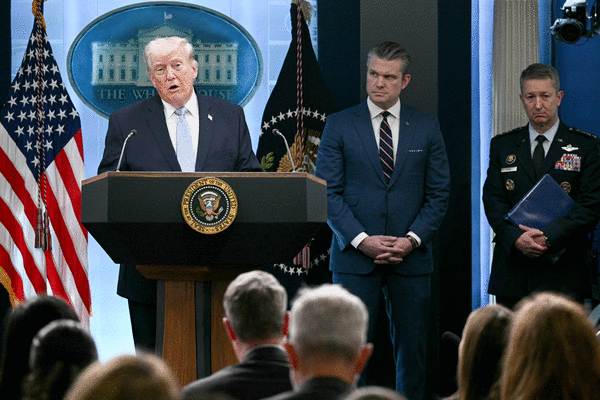
WASHINGTON — The United States and Iran reached an 11th-hour ceasefire deal on Tuesday night, pausing for two weeks the threat of military strikes that President Donald Trump had warned would wipe out a "whole civilization" unless Tehran agreed to reopen the Strait of Hormuz.
The agreement, announced by Trump in a social media post just over an hour before the 8 p.m. EDT deadline, came shortly after Pakistan, a mediator in the peace talks, asked Trump to give more time for diplomacy.
Trump said the agreement was "subject to the Islamic Republic of Iran agreeing to the COMPLETE, IMMEDIATE, and SAFE OPENING of the Strait of Hormuz."
"This will be a double sided CEASEFIRE!" Trump said. "The reason for doing so is that we have already met and exceeded all Military objectives, and are very far along with a definitive Agreement concerning Longterm PEACE with Iran, and PEACE in the Middle East."
The full details of the agreement were not immediately made public, but Trump said that "almost all of the various point of past contention have been agreed to between the United States and Iran."
The agreement came after hours after Trump warned on social media that a "whole civilization will die" Tuesday night if Iran does not meet his deadline to fully reopen the Strait of Hormuz, escalating tensions as diplomatic talks to end the war remain underway.
"A whole civilization will die tonight, never to be brought back again," Trump wrote Tuesday morning on his social media website. "I don't want that to happen, but it probably will."
Trump has a history of issuing deadlines in diplomatic standoffs, only to quietly walk them back when they pass without resolution. But his warning Tuesday stood apart as it invoked apocalyptic language that goes well beyond his previous ultimatums.
Leading up to the deadline, the White House provided few details on where negotiations stood. But on Tuesday afternoon, Pakistani Prime Minister Shehbaz Sharif, whose country is helping mediate peace talks, asked Trump to give Iran and diplomacy more time.
"To allow diplomacy to run its course, I earnestly request President Trump to extend the deadline for two weeks," Sharif wrote on X. "Pakistan, in all sincerity, requests the Iranian brothers to open Strait of Hormuz for a corresponding period of two weeks as a goodwill gesture."
Shortly after, White House Press Secretary Karoline Leavitt said in a statement that Trump was reviewing the proposal and would offer a response. Trump later said he decided to "hold off the destructive force" after Pakistani officials made the request.
A spokesperson for Iran's foreign ministry, Esmail Baghaei, wrote on X that the "power of a 'CIVILIZED' nation's culture, logic, and faith in its righteous cause will undoubtedly prevail over the logic of brute force."
"A nation that has every faith in the righteousness of its path shall harness all its capacities and capabilities to safeguard its right and legitimate interests," Baghaei wrote with the hashtag #IranWillWin.
The threat came a day after Trump indicated that a ceasefire proposal communicated by mediators in the Middle East ahead of the deadline was insufficient. He called the offer "not good enough," but acknowledged it as a "significant step" in negotiations.
Vice President JD Vance said during a visit in Hungary on Tuesday that negotiations were ongoing, adding that he remained "hopeful that it gets to a good resolution."
"I hope they make the right response because what we really want is we want a world where oil and gas is flowing freely, where people can afford to heat their homes and cool their homes, where people can afford to transport themselves to work," Vance said. "That's not going to happen if Iranians are engaging in acts of economic terrorism."
Vance added that the U.S. military still has "tools in our toolkit that we so far haven't decided to choose," but that could change if Iranians "don't change their course of conduct."
Iranian envoy Amir-Saeid Iravani said during a Security Council session on Tuesday that if Trump carries out the threatened strikes, Iran "will take immediate and proportionate reciprocal measures."
U.S. intelligence agencies are already monitoring Iranian actors attempting cyberattacks against U.S. critical infrastructure," according to a government notice reviewed by The Times. Iran's efforts on that front have recently escalated, "likely in response to hostilities between Iran and the United States and Israel," the notice warned.
More than a dozen Democratic lawmakers this week began calling for the 25th Amendment to be invoked to remove Trump from office, arguing that his threats amount to "genocide" and "war crimes." Some raised concerns about the president's mental fitness.
"Donald Trump has lost his mind and his threats to wipe out the Iranian people should be taken seriously," Rep. Robert Garcia, D-Calif., the top ranking member of the House Oversight Committee, wrote on X. "He's out of control and his cabinet and those around him must be loyal to the constitution and invoke the 25th amendment. He must be removed."
Rep. Sara Jacobs, D-Calif., pointing to Trump's threat to kill "a whole civilization," called on the Joint Chiefs of Staff to "disregard any such military orders that violate federal and international law."
Trump's threats also alienated some prominent conservative figures who have long been aligned to the president's "Make America Great Again" movement.
Right-wing provocateur Alex Jones and former Rep. Marjorie Taylor Greene both called for the Cabinet to use the 25th Amendment to declare Trump unfit for office.
Tucker Carlson said it was time for those closest to Trump to rein him in and refuse to participate in carrying out his threats against Iran.
"If you work in the White House or in the U.S. military, now is the time to say no, absolutely not," Carlson said on his podcast. "Those people who are in direct contact with the president need to say no, or resign."
Ceasefire negotiations
Trump has declined to provide details on the ceasefire negotiations on Monday, but he has made clear that a core part of the negotiations hinges on the reopening of the Strait of Hormuz, a crucial waterway through which roughly a fifth of the world's oil passes daily.
On Tuesday morning, Iranian leaders remained defiant ahead of the looming deadline.
Iranian President Masoud Pezeshkian wrote on X that "more than 14 million proud Iranians have so far registered to sacrifice their lives to defend Iran."
"I too have been, am, and will remain devoted to giving my life for Iran," Pezeshkian wrote ahead of the looming deadline.
In the northwest part of Iran, people were seen locking arms and gathering around power plants, according to photographs reported by the local news outlets Irna and Mehr. One protester at a power plant was shown in a photograph carrying a sign that read: "Infrastructure is not a battlefield; it is the backbone of civilian life."
Trump on Monday mused about taking control of the waterway and charging tolls for passage, as well as taking control of Iranian oil.
"If it were up to me, I'd take the oil, keep the oil and make plenty of money," Trump told reporters at the annual White House Easter Egg Roll.
Iranian officials on Monday rejected a ceasefire proposal, calling American demands "both highly excessive and unusual, as well as illogical."
The ceasefire proposals have been communicated through mediators from Egypt, Pakistan and Turkey, according to the Associated Press.
After Iranians rejected the American proposal, Trump said at a news briefing on Monday that the U.S. military was prepared to strike Iran's vital infrastructure if a deal cannot be reached.
The president has also dismissed questions that targets to infrastructure would amount to war crimes because it would impact civilians.
"You know what's a war crime? Allowing a sick country with demented leadership to have a nuclear weapon," Trump said.
Hostilities continue throughout the day
As talks reached a critical moment, airstrikes continued in the region.
The U.S. military carried out a second wave of strikes on Iran's Kharg Island Tuesday, targeting military sites previously hit in a similar assault last month. Like those attacks, the renewed blitz avoided hitting infrastructure tied to the island's oil export terminal, which handles roughly 90% of Iran's crude exports. Vance said the attacks do not represent a significant shift in American strategy.
Israel on Tuesday hit eight bridges across Iran that were used by the Islamic Revolutionary Guard Corps to transport weapons and military equipment, Israel Defense Forces said in a statement on X. The military said the bridges targeted were in Tehran, Karaj, Tabriz, Kashan and Qom.
"Prior to the strike, several steps were taken to mitigate harm to civilians," the statement added.
As tensions escalated in the region, the U.S. Embassy in Bahrain issued a travel advisory on Tuesday, directing all U.S. government employees and Americans in the country to shelter in place until further notice.
"To the extent possible, remain in a secure structure, and stay away from windows," the advisory stated.
_____
Times staff writer Gavin J. Quinton, in Washington, contributed to this report.
_____
©2026 Los Angeles Times. Visit at latimes.com. Distributed by Tribune Content Agency, LLC.






Comments