Curbing a 'catastrophe': SC Senate plan would suspend vouchers for homeschool students
Published in News & Features
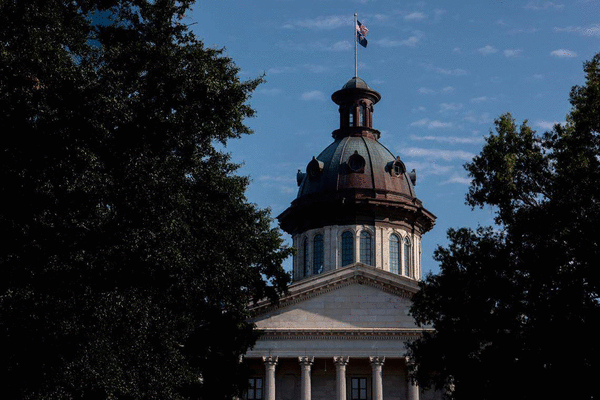
COLUMBIA, S.C. — A South Carolina Senate finance panel has adopted a proposal that freezes the state’s school voucher program at 10,000 students and suspends portions of the law that have been used to award taxpayer-funded scholarships to students educated at home.
The temporary measure grandfathers in roughly 1,000 home-educated students who are currently enrolled in the Education Scholarship Trust Fund program, but prohibits the South Carolina Department of Education from admitting any additional homeschool students.
State Senate Education Committee Chairman Greg Hembree, R-Horry, who introduced the measure at Tuesday’s Senate Finance Committee hearing, said it was intended to pause the flow of home-educated students until lawmakers could fully debate their participation and devise a statutory structure to support it, if desired.
“I think we need to tap the brakes on this whole thing until we can get our feet under us a little bit,” said Hembree, who put forth the proviso, or one-year law, after learning the S.C. Department of Education was awarding $7,500 scholarships to home-educated students in contravention of what he and other senators said was their intention.
While South Carolina’s voucher law expressly prohibits the participation of students enrolled in one of the state’s three statutory homeschool options, it says nothing about students educated at home outside those options.
Ordinarily, such students would fail to satisfy South Carolina’s compulsory attendance requirement. But under the voucher law, recipients meet that requirement as long as they attest that their children are being provided instruction in several core subjects and taking certain assessments.
Nearly 1,200 of the 10,000 students enrolled in the program this year are being educated at home outside the statutory homeschool framework, and more than 2,600 of the 15,000 awarded scholarships for next year plan to do the same, according to the S.C. Department of Education, which refers to such students as “unbundlers.”
The department’s decision to award scholarships to unbundlers has raised the ire of some senators who view it as a failure to faithfully implement the program that has diverted public money to unaccountable participants.
“This approach has been a catastrophe,” Hembree said Tuesday, lamenting the lack of guidelines for unbundlers. “I mean, it’s just been a mess.”
The senator said he’s not necessarily opposed to homeschool students receiving education scholarships, but wants to ensure there’s a coherent policy in place to support them if they do.
As things currently stand, the lack of any legal framework around unbundling means that participants are ineligible to compete in high school athletics and unable to receive high school diplomas or qualify for education lottery college scholarships, Hembree said.
“I think there’s a way to get there and a way to do it the right way,” he said Tuesday. “This is not it. We didn’t build it, and that’s the real problem.”
The Department of Education did not immediately respond to a request for comment on Hembree’s proviso.
State Superintendent Ellen Weaver has previously defended her department’s implementation of the Education Scholarship Trust Fund, arguing that it had no choice but to award scholarships to unbundlers.
“We don’t believe that we have the statutory authority to deny these students who are meeting all of the criteria of the program,” Weaver said during a Senate hearing in February. “To do so would actually open up the program and the department to potential legal liability.”
What would unbundler proviso do?
In order to rein in the department’s administration of the program, Hembree’s proviso strips two provisions from the voucher law that the department has used to argue for the inclusion of unbundlers and suspends the program’s planned expansion to 15,000 students next year.
The Horry County Republican said he initially considered removing all unbundlers from the program, but ultimately decided that existing participants should be able to remain.
“I did not feel right about pulling the rug out from under these children,” Hembree said. “They’ve not done a thing wrong. So I don’t know why we should penalize them in midstream.”
The 958 unbundlers who received taxpayer-funded scholarships this year and have been awarded them again for next year will be able to remain in the program, according to the senator’s proposal. But the 1,700 unbundlers who were awarded first-time scholarships to begin in the fall will not receive them, he said.
The unbundlers who remain in the program will be treated as Option 1 homeschoolers, a statutory model of homeschooling that is sanctioned and overseen by a local school district.
Under Hembree’s proposal, the Department of Education would assume the role and responsibilities of the local district for home-educated voucher recipients.
“We’re trying to figure out a way to take care of those kids that are kind of caught in limbo, and we think that that’s a good option to try to accomplish that,” the senator explained.
Pausing the voucher program at 10,000 students, as Hembree’s measure proposes, would allow the Legislative Audit Council time to conduct a review of the program, as several senators have requested, and report back on any tweaks that might be necessary to improve it.
The Horry County senator has equated the process to how lawmakers used a performance audit of the Charter Institute at Erskine to inform charter school reform legislation the Senate passed earlier this year.
“The Legislative Audit Council is going to do the deep dive to see where ... (we’ve) wiggled off the road here, if we have, and try to give us some suggestions on how to get it straightened back out,” Hembree said Tuesday.
By limiting the program to 10,000 students next year, it would also mean that several thousand non-homeschoolers who were awarded vouchers in anticipation of a 15,000-student enrollment cap would not receive them. It isn’t immediately clear how the non-homeschool students whose scholarships are rescinded would be chosen.
For that reason and others, it remains to be seen whether Hembree’s proviso ends up surviving in its current form, if at all.
The one-year measure, approved Tuesday by a 16-3 vote, still needs to pass both chambers. The full Senate is scheduled to take up the state budget, which will include the proviso, beginning April 21.
©2026 The State. Visit at thestate.com. Distributed by Tribune Content Agency, LLC.





Comments