Appellate arguments for ex-Illinois Speaker Michael Madigan focus on those three little words: Quid pro quo
Published in News & Features
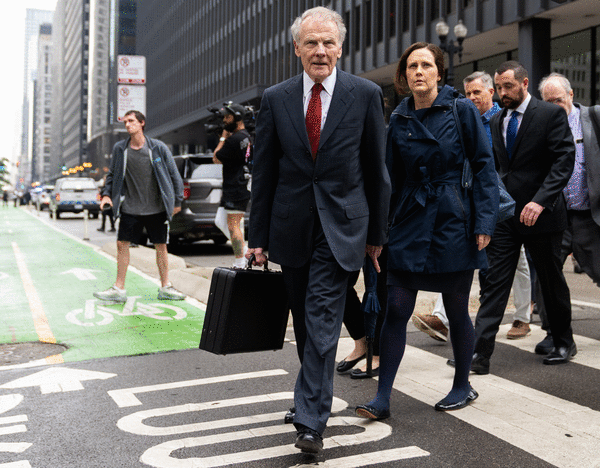
CHICAGO — A lawyer for imprisoned House Speaker Michael Madigan told a federal appeals court on Thursday his conviction on an array of corruption counts should be overturned because there was no evidence that he agreed to enter into a bribery conspiracy with ComEd or took any specific official action on the utility’s behalf.
In the long-awaited arguments before the 7th Circuit U.S. Court of Appeals, attorney Amy Saharia also argued that the district judge erred in several instructions given to the jury, and noted the alleged benefits Madigan received were “far outside” the typical bribery case.
The Democratic speaker took no cash from ComEd, Saharia said. He wasn’t given any Rolex watches, or “trips to Vegas.”
“The alleged benefit was that political allies were hired by ComEd,” she said.
Assistant U.S. Attorney Julia Schwartz, however, told the appeals court the verdict should stand, and that “the properly instructed jury had abundant evidence to find former House Speaker Madigan engaged in quid-pro-quo bribery.”
The 45-minute hearing unfolded before a courtroom packed with spectators, including Madigan’s daughter, former Illinois Attorney General Lisa Madigan, as well as Amarjeet Bhachu, the now-retired federal prosecutor who led what became one of the biggest political corruption investigations in the history of the Chicago U.S. attorney’s office.
The three-judge panel that held the roughly 45-minute hearing was composed of two Republican nominees, Judges Frank Easterbrook and Michael Scudder, and Judge Nancy Maldonado, who was nominated by Democratic President Joe Biden.
Scudder did the bulk of the questioning, which seemed to be evenly split between the sides and focused on language in jury instructions over the definition of “corruptly” as well as what prosecutors had to prove about Madigan’s intent.
Of the three on the panel, only Easterbrook, known for his often tough grilling of lawyers appearing before him, did not ask a question of either side.
A ruling will come at a later date.
The arguments in Madigan’s case had a familiar ring in a state where the line between legal politics and bribery has always seemed a blurry one.
Through the years, it’s been debated in bars, argued in newspapers, litigated in court, decided by juries and appealed all the way to the Supreme Court.
Next week, the 7th Circuit is expected to hear yet another round of similar arguments in the consolidated appeals of Madigan’s former confidant, Michael McClain, and ex-ComEd CEO Anne Pramaggiore, who were each convicted in 2023 in an alleged conspiracy to bribe the speaker.
The immediate stakes are high, as Madigan, McClain and Pramaggiore are all currently in federal prison. But the long-term impact on Illinois politics could be even greater.
The arguments are playing out amid a new legal landscape reset by the Supreme Court that has reined in federal corruption prosecutions with a series of rulings over the past decade.
Among them was the case of former Portage, Indiana, Mayor James Snyder, whose bribery conviction was overturned by the high court in an opinion that said a key federal bribery statute does not criminalize the giving of “gratuities” to elected officials after an official action.
Madigan’s trial was pending at the time the Snyder ruling came down in 2024, and his attorneys have argued prosecutors “scrambled” to repackage the charges he faced by arguing a “nebulous ‘stream-of-benefits’ theory.”
There is a distinct sense of deja vu.
Nearly 13 years ago, attorneys for former Illinois Gov. Rod Blagojevich made strikingly similar arguments before the 7th Circuit about where the hazy line of bribery falls, where Easterbrook invoked President Dwight Eisenhower’s nomination of Earl Warren to the U.S. Supreme Court in exchange for the California governor’s support in the 1952 election.
“If I understand your position, Earl Warren should have gone to prison, Dwight Eisenhower should have gone to prison. … Can that possibly be right?” Easterbrook memorably asked the government’s lawyer in the December 2013 hearing.
That Easterbrook-led appeals panel wound up reversing several counts against Blagojevich and sent him back to the district court for resentencing, though the judges noted he was guilty of many crimes and might not deserve any break. U.S. District Judge James Zagel in 2015 took their cue and resentenced Blagojevich to the same 14-year term he’d originally imposed.
Blagojevich’s legal saga wasn’t over from there, of course, since his friend from reality television, President Donald Trump, commuted his sentence in 2020 and later gave the former governor a full pardon, wiping out all counts of conviction.
Ironically, Blagojevich has now figured into the appeal of Pramaggiore. Not only did she officially apply for clemency from the White House, she’s paid the former governor at least $130,000 to personally lobby Trump for a pardon. Federal lobbying records show that to accept the money, Blagojevich had to disclose his legal status with Congress, noting that the president had pardoned him “for all convicted offenses.”
Madigan has also applied for clemency, but there’s no record he’s paid his old political nemesis, Blagojevich, a dime.
Madigan, 83, was sentenced in June 2025 to 7½ years in prison. He reported Oct. 13 to a medium-security camp in Morgantown, West Virginia, and his current release date is in early 2032, when he would be nearly 90.
Pramaggiore, 67, entered prison in January and is due to be released in September 2027. McClain, 78, is also scheduled for release around the same time.
After a trial that stretched nearly four months, Madigan was convicted on Feb. 12, 2025, of bribery conspiracy and other corruption charges. The jury found him guilty on 10 of 23 counts, including a multipronged scheme to accept and solicit payments from ComEd to Madigan associates for do-nothing subcontracts.
Madigan also was convicted on six out of seven counts — including wire fraud and Travel Act violations — regarding a plan to get then-Ald. Daniel Solis, who testified at length in the trial, appointed to a state board in exchange for Solis bringing Madigan business for his private law firm.
The jury acquitted Madigan of several other schemes alleged in the indictment and deadlocked on other counts, including the overarching racketeering charge. In handing down the 90-month prison term, U.S. District Judge John Robert Blakey said Madigan’s crimes represented “abuse of power at the highest level” and were aggravated by the fact that Madigan had every advantage in life, including a privileged education and a thriving law practice.
The judge also found that Madigan lied repeatedly and willfully when testifying in his own defense during the trial. Blakey called it “a nauseating display of perjury and evasion” that was “hard to watch.”
In his appeal, Madigan’s attorneys said allegations surrounding two of the central prongs in the case — the ComEd bribery scheme and Madigan’s offer to help Solis — “improperly criminalizes the rough-and-tumble business of state politics in direct contradiction of recent Supreme Court rulings.”
Madigan’s lawyers also accused the U.S. attorney’s office of “throwing years’ worth of legislative action and political relationships at the jury in the hopes of making something stick.”
“To be sure, the evidence showed that ComEd and the alderman sought to curry favor with Madigan,” their appellate brief stated. “Constituents do this every day, whether through hiring politically connected individuals or offering other support to legislators. These interactions may strike federal prosecutors as unbecoming. But they do not constitute bribery.”
The filing also alleged Blakey erred in several key rulings at trial, including allowing prosecutors to proceed with a “stream of benefits” theory that did not require proof of a quid pro quo or that Madigan had agreed to be influenced “on a specific question or matter.”
In his instructions to the jury, Blakey also incorrectly defined “corruptly” under the federal bribery law known as 666, which the Supreme Court ruled in 2025 did not criminalize so-called gratuities, or benefits given to a public official after the fact, the filing alleged. Blakey also erred in instructing the jury on the Travel Act by including as predicates state offenses that do not require a quid pro quo.
On Thursday, Saharia began by arguing that “the alleged quo” in Madigan’s case, “a promise to take unidentified future action on unidentified future legislation,” was far too vague to sustain a conviction. She said the government’s theory that the conspiracy began in 2011 with the hiring by ComEd of retired Ald. Frank Olivo as a subcontractor did not hold water.
“There is no evidence that, in 2011, Speaker Madigan understood that, when ComEd hired Mr. Olivo, he was agreeing to take any action with respect to any future rate-setting legislation,” Saharia said. “It’s not even clear what the government thinks he agreed to in 2011.”
Schwartz, meanwhile, argued the timing of Olivo’s hiring, along with ComEd signing a contract with Madigan-approved law firm Reyes Kurson, right before the speaker went to bat for the utility’s major rate-making legislation was no coincidence.
Schwartz also said the conspiracy wasn’t “just a one and done.”
“Speaker Madigan was actively involved in adding new subcontractors, in approving the termination of other subcontractors,” Schwartz said. “It was an ongoing agreement to have both the quid and the quo.”
Near the end of the hearing, the discussion turned to the alleged scheme by Madigan to help Solis land a state board position.
Schwartz said it was clear from the evidence that Madigan “planned to falsely represent to (Gov. JB Pritzker) that he would be recommending Solis based on his credentials,” when in fact Madigan knew it was because Solis was benefiting him financially.
Madigan’s attorneys have argued in their briefs that prosecutors came “nowhere close to proving a quid pro quo” with Solis, who was cooperating with the FBI and had used the state board appointment as a ruse.
“Because the entire scheme was a ruse and no recommendation even occurred, the government did not prove that Madigan’s future recommendation would involve a misrepresentation or an official act,” Madigan’s attorneys argued.
____
©2026 Chicago Tribune. Visit at chicagotribune.com. Distributed by Tribune Content Agency, LLC.





Comments