Artemis II astronauts safely splash down off San Diego coast after historic moon mission
Published in News & Features
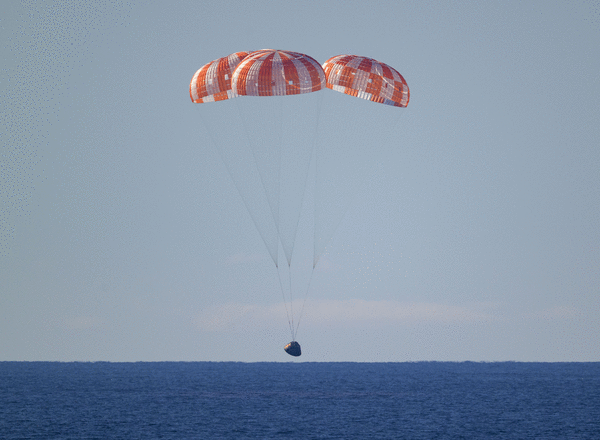
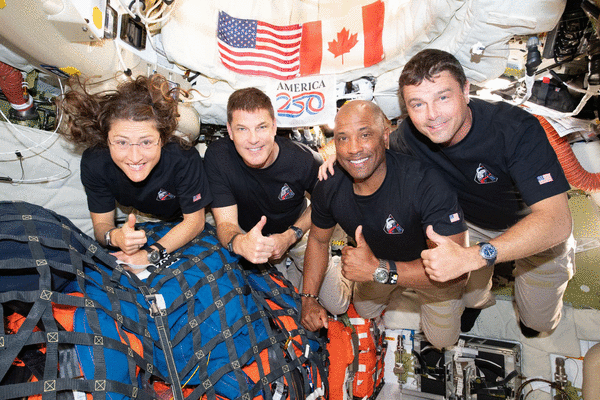


The Artemis II astronauts safely splashed down off the coast of San Diego at 5:07 p.m. Pacific time Friday after a historic 10-day mission around the moon, finally letting the crew and NASA officials breathe a sigh of relief.
NASA regarded the high-energy reentry — streaking through the atmosphere in a nearly 5,000-degree-Fahrenheit fireball at more than 30 times the speed of sound — as one of the riskiest moments of the mission.
Space agency officials' blood pressure was further elevated as experts closely watched the performance of the craft's heat shield — which astronauts rely on to slow them down and keep temperatures livable.
During the 2022 Artemis I test mission, which had no people aboard, the heat shield had unexpectedly chipped in more than 100 spots. NASA determined any astronauts aboard would have been unscathed, but noted the problem posed an increased risk to future crews. Instead of redesigning the heat shield — which NASA will do for future missions — the agency opted to bring the capsule in on a steeper trajectory intended to inflict less stress on the materials.
The Artemis Program, an international collaboration spearheaded by NASA, aims to put boots back on the moon for the first time in more than 50 years. The space agency hopes to establish a lunar base as a testing grounds for future missions to Mars.
Artemis II, a flyby mission around the moon that lifted off April 1, was focused on testing out life support systems and practice piloting the spacecraft to make the journey a smoother ride for future crews who will be focused on the complex challenge of actually landing on the lunar surface.
They worked out problems with the capsule's space toilet (multiple times), piloted the spacecraft by hand, and tested procedures such as sheltering from solar radiation in the cargo locker.
Yet Monday's flyby — the first time humans had reached the moon since 1972 — held an emotional significance for the crew and space enthusiasts beyond the mission's technical objectives.
While in space, the crew spoke of the surreal sights of our dusty, rugged natural satellite, appearing about the size of a bowling ball at arm's length, suspended in the nothingness. The astronauts couldn't help but feel a renewed appreciation for our home planet.
"Maybe the distance we are from you makes you think what we're doing is special," Artemis II pilot Victor Glover said on Easter while on his way to the moon. "But we're the same distance from you, and — I'm trying to tell you, just trust me — you are special. In all of this emptiness — this is a whole bunch of nothing, this thing we call the universe — you have this oasis, this beautiful place that we get to exist together."
About 25 minutes before the crew splashed back down on our oasis, Artemis II Cmdr. Reid Wiseman radioed Mission Control.
"We have a great view of the moon out window two," he said. "Looks a little smaller than yesterday."
"Guess we'll have to go back," Mission Control replied.
_____
©2026 Los Angeles Times. Visit at latimes.com. Distributed by Tribune Content Agency, LLC.






Comments