Detroit Mayor Sheffield, police chief lay out 6-point safety plan
Published in News & Features
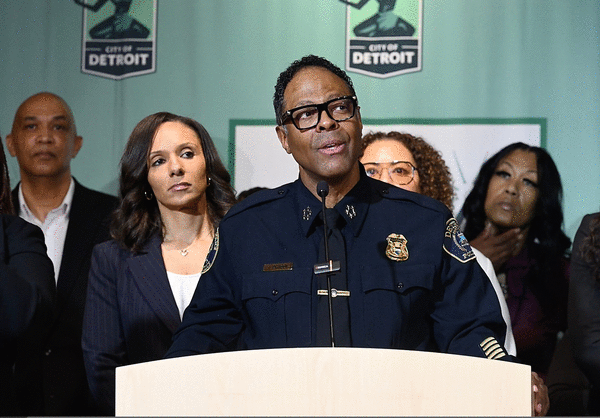
DETROIT — Detroit Mayor Mary Sheffield and Police Chief Todd Bettison on Thursday unveiled a six-point "community safety plan" that stresses working with the community and employing strategies to reduce accidental gun deaths.
The plan of the first-term mayor is heavily focused on fostering relationships between the police and the city's young people, a continuation of the mayor's youth-oriented push since she took office in January. The city's homicides and violent crimes have been declining in recent years.
Two new initiatives included in the plan are the creation of Neighborhood Safety Action Teams to identify problems and a Conflict Resolution & Restorative Practices Task Force. The plan's other four components are a "DPD Safe Summer Strategy" that targets drag racing, drifting, block party compliance and crowd control; youth-centered activations; a gun storage and safety campaign; and after-hours engagement and enforcement.
"I've said many times that we can't arrest our way to a safe city," Sheffield said. "It is going to take a broad range of strategies that address not only criminal behavior but the circumstances that create the opportunity for it to occur."
The announcement at Detroit Public Safety Headquarters marked the sixth consecutive year that the city's mayor and police chief have held a press conference to unveil a multipoint crime-fighting strategy, a trend that began under former Mayor Mike Duggan.
Bettison said previous crime-fighting initiatives will be rolled into the new one.
"This is a holistic approach," the chief said. "We're including everything, including the kitchen sink. ... This activates proven initiatives that we have delivered in the past."
What gun safety campaign involves
One of the plan's six components, a "Gun Safety and Storage Campaign," will educate residents and make 2,000 gun locks available for free. The locks were provided by the Detroit Public Safety Foundation and the Henry Ford Child Safety Project, officials said.
Bettison said there will be increased enforcement of drag racing and drifting, and block parties, many of which have turned violent in the past.
"Our officers will be on the streets," Bettison said. "This is dangerous activity and will not be tolerated in Detroit. ... We will ensure that our Block Party Task Force addresses that. Quality of life for our residents is paramount."
The Neighborhood Safety Action Teams will be made up of representatives from multiple city agencies, citizens and organizations. City officials will walk through neighborhoods each week to see what problems need to be addressed, Sheffield said.
Thursday's press conference came as police and city officials brace for an influx of teens downtown for a third consecutive weekend. During the last two weekends, hundreds of young people flooded downtown, with multiple issues reported, including an attempted robbery, vandalism, brawls and one incident of shots fired.
Sheffield and Bettison have been praised and criticized for their reaction to the first weekend of chaos, a "teen takeover" that coincided with the Detroit Tigers' April 3 home opener at Comerica Park. Following the takeover, the mayor and police chief held a press conference with the organizers of the event and vowed to provide more constructive activities for the city's young people.
Sheffield Thursday revealed details of that strategy.
The initiative announced Thursday is the latest multipoint plan that aims to address crime in Detroit, which in 2025 recorded 165 homicides, the lowest since 1964, and a 19% decrease from 2024.
As of Tuesday, according to the latest Detroit Police Department statistics available, there were 37 homicides in the city in 2026, down from 42 during the same period last year, while aggravated assaults were up to 2,209 from 2,138 in 2025. Total Part 1 violent crimes fell 7.7% from last year during the same period, according to police figures.
What prior crime-fighting plans targeted
In 2025, police and city officials released a five-point crime-fighting plan that involved levying higher fines against parents whose kids violate the city's curfew; authorizing overtime to extend the hours of the Mobile Field Force, which responds to problems in large crowds; and elevating reports of groups of juveniles to Priority 1 status.
In the aftermath of a July 2024 block party shooting that involved 21 victims — the most people wounded in a mass shooting in Michigan history — former Detroit Mayor Mike Duggan and former Detroit Police Chief James White unveiled a plan to deploy "Neighborhood Response Teams" citywide and prioritizing 911 calls about block parties.
White in 2023 unveiled a 12-point plan to combat violence, following multiple shootings and two homicides in the Greektown neighborhood and the Riverwalk, both near downtown. The plan's provisions included using "Casper Units" ― undercover officers who hide in crowds looking for arguments that could escalate ― along with closing some streets, enforcing noise, open-alcohol and curfew ordinances, and increasing deployment, including adding more "eyes in the sky" with helicopter patrols and officers on rooftops.
White released a five-point "Community Safety Strategy" in 2022. The 244-page plan included increasing the presence of officers in neighborhoods, quashing raucous parties, weeding out bad cops and addressing blight. In 2021, shortly after White was named interim chief, he and Duggan announced a five-point plan to crack down on the "party atmosphere" in neighborhoods and parks that often leads to violence. The plan involved officers working overtime, crackdowns on parking lot owners who allowed tailgating parties, and strong drag racing enforcement.
Multipoint crime-fighting plans also were initiated by former Wayne County Sheriffs Benny Napoleon and Warren Evans, in 2013 and 2009, respectively; and by former Detroit Mayor Coleman Young, who in 1974 revealed a 10-point plan to improve police-community relations, and Mayor Kwame Kilpatrick, whose five-point plan in 2004 focused on banning new liquor stores and increasing Detroit Police sting operations. Kilpatrick in 2002 also released a 10-point security plan as well as a nine-point plan to make the police department "agile, attentive, accountable, accessible, problem-solving."
_____
©2026 www.detroitnews.com. Visit at detroitnews.com. Distributed by Tribune Content Agency, LLC.





Comments