Mesa Verde National Park to return thousands of Native American artifacts and Indigenous remains to tribes
Published in News & Features
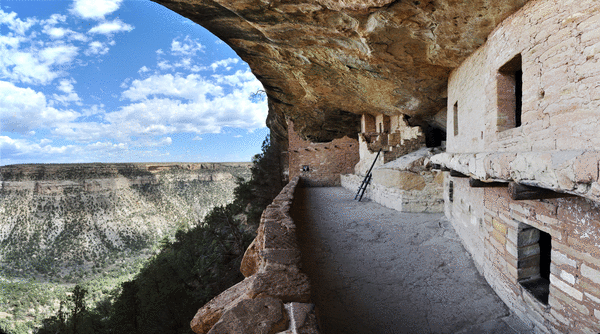
DENVER — Mesa Verde National Park plans to return more than 4,000 sacred Native American objects and the remains of 85 Indigenous people in its possession, marking the largest potential repatriation in the park’s recorded history.
Park officials told The Denver Post last week that they have been conducting a thorough inventory of human remains and culturally significant objects in Mesa Verde’s collection over the past two years, as required by a 1990 federal law designed to return Native American remains and artifacts to tribes.
In its review, the National Park Service found 4,304 objects that were likely associated with death rites or ceremonies, the agency said in a July 31 federal notice. These items, along with the remains of the 85 individuals, may be connected to tribes in Arizona, New Mexico and Colorado, officials wrote.
Federal records reviewed by The Post showed Mesa Verde National Park, renowned for its Ancestral Puebloan cliff dwellings, has never marked for return this many items.
The park service declined an interview request for this story.
The Native American Graves Protection and Repatriation Act, known as NAGPRA, requires federal agencies and institutions that receive federal funds — including museums, universities, state agencies and local governments — to return Native American human remains and other cultural items to tribal nations.
The law came in response to the historic genocide against Indigenous peoples, the forcible removal from their ancestral lands and widespread plunder of Indian grave sites by European settlers, the American government and zealous archaeologists.
But despite NAGPRA’s intentions, many of the most prestigious museums and universities in the country continue to hold Indigenous human remains and sacred objects.
The objects identified by Mesa Verde National Park include ceramic bowls and jars, sandals, mattings, ropes made of human hair and animal bones. Park officials found feather boxes, crystals, turquoise and buckskin bags.
Many of these cultural items — along with human remains — were found during University of Colorado excavations and other archaeological projects in the park during the 1950s and ’60s. The remains of one individual found there had been collected by an unknown person prior to 1916, and ended up in the New York University College of Dentistry.
In numerous instances, private citizens found items or bones and donated them to the national park.
Now that the park has completed its inventory, tribal members or tribes can submit repatriation requests.
Mesa Verde sits in the far southwest corner of Colorado, nearly 400 miles from Denver. President Theodore Roosevelt established the park in 1906, making it the first to be preserved specifically for cultural heritage reasons.
The area is home to nearly 5,000 ancestral sites from the Pueblo people, who built cliff dwellings on the mesas that have been remarkably maintained for hundreds of years.
Other Colorado institutions have been active this year in returning sacred items.
History Colorado on Wednesday said it intends to repatriate 20 cultural objects — including an eagle bone whistle, pipe stem, beaded pipe bags, leggings and moccasins — to the Cheyenne River Sioux Tribe in South Dakota.
The museum’s notice to federal authorities said these items were part of the collection of a physician and ethnographer from South Dakota named James R. Walker. Walker, who documented Lakota society, religion and culture in the late 19th and early 20th centuries, collected numerous materials from the tribe.
History Colorado also intends to return a beaded cradleboard to the Northern Cheyenne Tribe that was removed from a grave in Montana.
Chance Ward, the museum’s NAGPRA collections specialist, said the institution regularly opens up its collection to tribes so leaders can review its holdings.
Everything is based on a tribe’s timeline, Ward said. The museum never pushes delegations to come on any particular day. It’s all part of building and maintaining relationships with Indigenous communities, he said.
“To me, this is the standard way of complying with NAGPRA,” said Ward, who is a member of the Lakota tribe. “You’re working with tribes and talking to them and reviewing the objects and returning them as the law requires. We’re doing what we’re supposed to.”
Western Colorado University in Gunnison earlier this year announced that it plans to return the remains of 43 Native Americans, along with 155 funerary objects that have been in the school’s possession for decades.
University officials told The Post in 2023 that the school attempted to repatriate these items in the 1990s, but a procedural error stymied their efforts. With no paid staff, the school admitted that being proactive on NAGPRA was a luxury it couldn’t afford.
Later that year, though, Western Colorado received a federal grant to carry out the disposition process. The school ultimately hosted several Western tribes, including the Ute Mountain Ute and Southern Ute, for consultations on campus. After a three-decade odyssey, the remains and artifacts will soon be headed home.
“It feels amazing to know that these ancestors and different objects are going to go home and be buried, that they get to finish their journey finally,” said David Hyde, the university museum’s volunteer curator and collections manager. “There’s no reason for Native American ancestral remains to be in museums, cabinets or campuses. This is a long time coming.”
The Denver Art Museum, which has been accused by tribes and foreign governments of being intransigent on repatriations, last month said it would return a beaded umbilical cord amulet that the museum had purchased in 1969. Another five objects, a series of ceramic vessels, will be made available for repatriation as well.
“The museum is prepared to return the items as soon as an affiliated tribe is ready to receive them,” Andy Sinclair, a museum spokesperson, said in an email.
Colorado has long been viewed as a national leader in complying with NAGPRA, with the Denver Museum of Nature & Science and the University of Colorado’s Museum of Natural History two of the first institutions in the country to repatriate their entire Native American collections.
Institutions in the state reported making 88% of the more than 4,100 Native American remains taken from Colorado available for return, according to 2025 data compiled by ProPublica.
©2026 MediaNews Group, Inc. Visit at denverpost.com. Distributed by Tribune Content Agency, LLC.





Comments