Texas changes what students learn about 9/11, Islam, Christianity. What to know
Published in News & Features
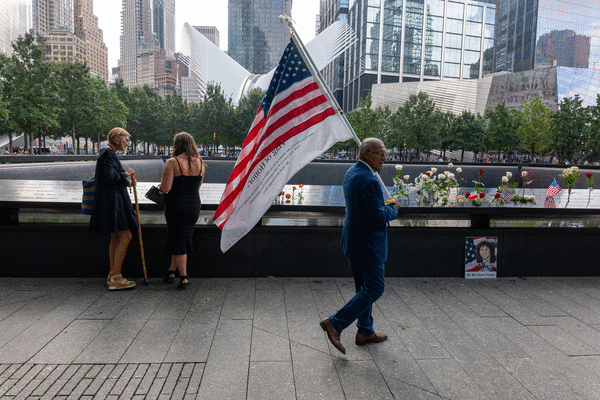
DALLAS — The Sept. 11 terrorist attacks happened 25 years ago, but how Texas students learn about that day is still evolving.
Just days before this year’s anniversary, the State Board of Education approved new social studies standards that will change what high school students learn about 9/11, religion and other parts of history.
Some of the changes have already drawn controversy, raising questions about how certain topics will be presented to students.
So what do the new standards actually require Texas students to learn, and when will the changes reach classrooms?
What will Texas students learn about 9/11 under the new standards?
Texas high school students already study the Sept. 11 attacks, but the new standards require them to learn more about what led to the attacks and their aftermath.
Students will be expected to learn that the attacks were “motivated by radical Islam,” a phrase that is now explicitly included in the standards.
In world history, 9/11 will also be taught as part of the “rise of radical Islam,” alongside lessons on terrorism, al-Qaeda, the Muslim Brotherhood and ISIS.
In U.S. history, lessons will cover the roles of former President George W. Bush, former Secretary of State Colin Powell and former National Security Advisor Condoleezza Rice following the attacks.
Students will also examine the Global War on Terror in Afghanistan and Iraq and what the standards describe as the “decline of civil liberties due to the PATRIOT Act.”
Texas schools will begin phasing in the newly adopted social studies standards during the 2030-31 school year.
What else will Texas students learn under the new social studies standards?
The beginnings of Islam and the Prophet Muhammad are among the topics covered in world history.
The standards call for lessons on what they describe as his “brutal military campaigns against Jewish and Christian tribes,” the normalization and regulation of slavery and the taking of female captives as harem slaves.
Lessons on Christianity will cover the life and teachings of Jesus, the spread of the religion and its influence on Western civilization and American history.
The standards also connect Christianity to U.S. history, requiring students to examine how biblical imagery and ideas about equality and justice from the Declaration of Independence appear in Martin Luther King Jr.’s “I Have a Dream” speech. Other changes reach different periods of history. One requirement covers the creation of the modern state of Israel in 1948 in what the standards describe as the ancestral homeland of the Jewish people.
Another focuses on the Aztec Empire, including how it collected goods and payments from conquered people and practiced human sacrifice.
President Lyndon B. Johnson’s Great Society is another topic students will study. The programs were launched in the 1960s to fight poverty and racial inequality.
The standards require students to learn about arguments over the “negative effects” of the modern welfare state that grew as those programs expanded.
Why are the new Texas social studies standards controversial?
Much of the debate has focused on how Islam is portrayed in the new standards.
Muslim students who spoke before the State Board of Education said the standards focus too heavily on violence when teaching about Islam.
“I feel attacked, as if my religion doesn’t belong,” 15-year-old Habiiba Quresh told board members, according to the Texas Tribune. “I shouldn’t have to defend my religion in the middle of history class because of one sentence someone on this board wrote.”
Some of the board’s own appointed experts also raised concerns about the historical basis for parts of the standards involving the Prophet Muhammad.
“I would warn us about including things that are not based on well-established secular sources,” University of Texas at Austin philosophy professor Robert Koons said in the Texas Tribune.
Critics also questioned the board’s decision to remove an earlier requirement for students to learn about Muslim contributions to algebra and astronomy.
“The board has turned our classrooms into a place where prejudice is taught as fact and entire communities are written out of their own history,” the Texas chapter of the Council on American-Islamic Relations said in a statement. “This is not only a Muslim issue, a Black issue, or a Palestinian issue — it is a Texas issue, because a board willing to do this to one community can do it to any community next.”
Board members who supported the standards pushed back against the criticism.
“There’s been a lot said out of this room, particularly to sensationalize all these topics and to make them seem more divisive than they actually are,” State Board of Education Chair Aaron Kinsey told the Texas Tribune.
“Fifteen people sat in the room, and we worked through, democratically, how to make those choices on behalf of our constituents. So I don’t think we shortchanged anything. I think that we did an exceptional job overall.”
Kinsey also said the board had to reduce the number of things students would be expected to learn after Texas Education Agency officials warned that earlier versions included too much content.
“The intention is not to shortchange anything,” Kinsey told board members. “But we have to determine what is essential.”
_____
©2026 Fort Worth Star-Telegram. Visit star-telegram.com. Distributed by Tribune Content Agency, LLC.





Comments