San Diego County reports persistent delays in tuberculosis reporting at Otay Mesa Detention Center
Published in News & Features
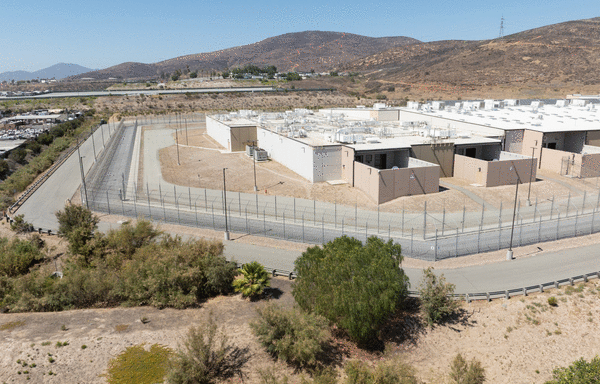
SAN DIEGO — San Diego County warned doctors at the Otay Mesa Detention Center this week that continued weeks-long delays in reporting suspected tuberculosis cases “may subject health care providers to professional licensing actions.”
The letter, dated Tuesday and signed by Dr. Sayone Thihalolipavan, the county’s public health officer, cites a three-week notification delay for a suspected TB case. Although the patient began treatment on Aug. 5, the county public health department did not receive a report on the suspected case until Aug. 27.
State law demands that all suspected cases be communicated to local public health authorities within one working day.
While it is now owned by the federal government, the immigration detention center is operated by private contractor CoreCivic. The organization did not immediately respond to a request for comment Thursday morning.
It is not the first instance of delayed TB reporting from the U.S. Immigration and Customs Enforcement facility. On Aug. 10, the county published an inspection report following a visit on June 12 which, while generally finding compliance with state health standards, noted that two suspected TB cases were not communicated directly by the center’s medical staff and that “the facility was unresponsive for several weeks before the facility finally cooperated with the communicable disease investigation.”
Public health policy seeks quick notification of new cases so that investigators can begin identifying those potentially exposed as quickly as possible. Delays in timely action, Thihalolipavan said Thursday morning, reduce the chances that new cases can be detected and treated.
“There are many things that we need to do to prevent further spread, especially in an indoor facility,” Thihalolipavan said.
He said CoreCivic is equipped to screen for TB, isolate patients and treat their symptoms.
“They’re dealing with a population that probably has a higher burden of tuberculosis exposures and rates, and they have all the tools to recognize, isolate, treat and prevent the spread of tuberculosis in their facility,” Thihalilipavan said.
California law requires every healthcare provider to report more than 40 different diseases and conditions to local health authorities with varying degrees of urgency. Anthrax, for example, requires an immediate call to public health officials, while HIV cases must be relayed within a week.
The nature of tuberculosis makes delayed reporting more likely.
Commercial labs routinely and automatically report positive test results for more than 40 mandated diseases and conditions directly to public health departments. However, because the bacterium that causes tuberculosis requires culturing — the process of growing bacteria from a sample — it can be weeks before a result is available.
This is why public health departments want to know when screening methods such as chest X-rays and blood tests indicate that a person is likely infected. Notification at the point of suspicion, rather than waiting for confirmation, provides a multi-week head start in identifying additional cases.
As the Medical Board of California noted in a 2017 newsletter to all California physicians, failure to report has been an ongoing issue that can “result in discipline for physicians.”
State law, the board adds, makes failure to report a misdemeanor punishable by a fine of $50 to $1,000 and/or up to 90 days in jail. Failing to meet reporting timelines can also affect doctors’ licenses. In 2021, the medical board publicly reprimanded a Riverside doctor for several “negligent acts,” including her failure to report a patient’s condition to her local health officer.
Thihalolipavan said that, while his department has already worked to educate detention center medical staff on reporting, and will continue to do so, it will be necessary to refer the matter to the medical board if late reports continue to arrive.
“Ideally, we want to work it out with them in a non-punitive pathway but, of course, if we need to go there we absolutely will,” Thihalolipavan said. “We want to see how they respond to this letter.”
As of Thursday morning, he said, no response has been forthcoming.
Terra Lawson-Remer, chair of the San Diego County Board of Supervisors, released a statement early Thursday morning with Supervisor Paloma Aguirre, whose South County district includes Otay Mesa, decrying the slow pace of public health notification.
“The guards, nurses and cooks who work there live in Chula Vista, San Ysidro and Imperial Beach, and they went home to their families every night for three weeks while this facility sat on a tuberculosis case,” Aguirre said in the statement.
San Diego County sued the federal government in March after Lawson-Remer demanded that the U.S. Department of Homeland Security and ICE allow public health officials full access to the detention center.
“When we fought for this law and took the case to court, we were establishing a basic principle: detention facilities must be subject to public health oversight,” Lawson-Remer said. “As Otay Mesa continues to fail to report a communicable disease on time, it proves why those principles matter and why regular inspections must continue.”
©2026 The San Diego Union-Tribune. Visit sandiegouniontribune.com. Distributed by Tribune Content Agency, LLC.






Comments