Moscow refinery hit as Russia reports largest drone attack this year
Published in News & Features
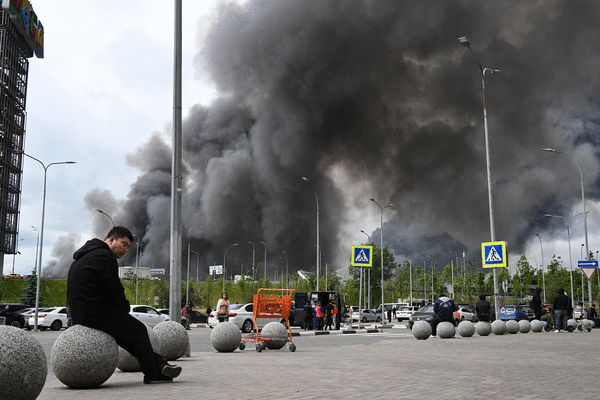
The Moscow Oil Refinery was hit during drone attacks that were part of the largest overnight Ukrainian barrage this year, as Russia entered the final day of voting in its parliamentary elections.
Russia’s Defense Ministry said it downed 1,110 Ukrainian drones across 19 regions of Russia as well as in Crimea, which the Kremlin annexed in 2014. That’s the largest overnight total reported so far this year, eclipsing the previous high of 822 in August.
The ministry said its air defenses brought down eight Ukrainian Flamingo missiles and 1,951 drones over the past day, the Interfax news service reported.
Several drones struck the territory of the Moscow refinery, damaging a facility at the site, Mayor Sergei Sobyanin said, without elaborating. Nobody was hurt and emergency services were working at the scene, he said in a post on Telegram.
Oil producer Gazprom Neft PJSC owns the refinery, located about 25 kilometers (16 miles) from the Kremlin. It has a processing capacity of about 245,000 barrels a day and is one of the key fuel suppliers for the capital region.
The refinery’s AVT-6 primary crude oil distillation unit, the integrated crude oil processing unit and the isomerization unit were hit during the attack, and large fires were recorded at the facility, the Ukrainian General Staff said in a post on Facebook.
Gazprom Neft’s press service didn’t immediately respond to a request for comment.
Two people died and 20 were injured in drone strikes in the Moscow region, Governor Andrey Vorobyev said on Telegram.
Ukrainian President Volodymyr Zelenskyy said that a Pelican ballistic missile was involved in the attacks, the first publicly confirmed combat use of the system. Its manufacturer Fire Point puts the missile’s range at only 200 kilometers on its website, though, and it was unclear from Zelenskyy’s post what part it played and where.
The strikes on the Moscow area, including on the refinery and a logistics center, had “very significant impact,” Zelenskyy said on X.
The attacks took place as Russia holds the third and final day of voting in its first parliamentary elections since President Vladimir Putin ordered the full-scale invasion of Ukraine in February 2022.
Sobyanin said 152 drones targeted Moscow overnight in what he called an “unprecedented” assault involving more than 1,600 unmanned aerial vehicles over the past day aimed at the capital. Most were downed by air defenses, he said.
The attack “was clearly planned with the aim of disrupting the elections,” Sobyanin said.
Turnout had reached 47.95% shortly before noon in Moscow on Sunday, state-run Tass news service reported, citing Russia’s central election commission.
The refinery strike was the latest indication that neither Ukraine nor Russia has signed up to an energy truce that U.S. President Donald Trump claimed on Sept. 14 had been agreed with the warring sides as global diesel prices surge.
The Moscow refinery was previously damaged in June during a record drone attack on the capital, sending plumes of black smoke across the region and contributing to fuel shortages in Russia.
While Moscow is protected by some of Russia’s most advanced air-defense systems, recent large-scale drone attacks have exposed the limits of even layered defenses. Most are intercepted, though some still manage to strike targets.
Ukraine’s Air Forces said Russia carried out attacks overnight with 138 drones, half of them jet-powered. Air defenses destroyed 101 drones, it said Sunday in a Telegram post.
The Russian Defense Ministry said on Telegram that it struck a warehouse outside Kyiv storing components for drones made by Fire Point, as well as a Nova Poshta logistics center near the Black Sea port of Odesa, and a cargo ship used to deliver military goods.
_____
(With assistance from Olesia Safronova.)
_____
©2026 Bloomberg L.P. Visit bloomberg.com. Distributed by Tribune Content Agency, LLC.






Comments