Merz says he has backing to stay on as Germany's chancellor
Published in News & Features
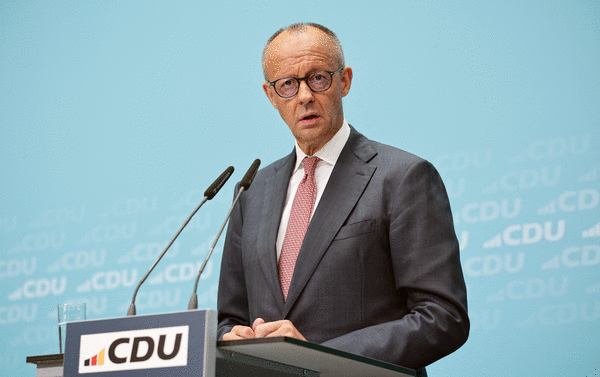
Chancellor Friedrich Merz reinforced his message that he’ll see through his reform agenda as Germany’s leader after his Christian Democratic Union crashed out of a regional parliament for the first time in the country’s post-World War II history.
The election debacle in the Baltic coast state of Mecklenburg-Western Pomerania — where the CDU took less than 5% of the vote on Sunday — caps a month of losses at the hands of the far-right Alternative for Germany. The setbacks have stoked calls within the conservative party for Merz to step aside.
Merz said he secured his party’s backing to stay on after he gathered the CDU’s leadership in Berlin to gauge his position. He also extended an offer to the Social Democrats to continue their 16-month coalition as it seeks to implement an overhaul of Germany’s pension, health and tax systems.
“We want to move the reform process forward, but we want to offer answers for people and their concerns,” Merz told reporters on Monday, adding that his party will weigh the consequences of the defeats “for a long time.” No members brought up a change in leadership in the closed-door gathering, he said.
The 70-year-old chancellor has been on a rapid downward spiral, the least-popular German leader in little more than a year in office. Though he kicked off his tenure with a spending splurge on defense and infrastructure, he’s struggled to pass reforms to boost the economy, which has suffered from years of stagnation. During the campaign, he’s largely been kept away from voters, reinforcing the view that he’s out of touch with citizens.
Germany’s political establishment was shaken when the CDU suffered a stunning defeat to the AfD two weeks ago in Saxony-Anhalt, another eastern state, where it could lead the first far-right government in the country since its foundation in 1949. In a separate election in Berlin on Sunday, the CDU, which has led a government in the German capital since 2023, was defeated by the anti-capitalist Left party.
Merz said the turmoil has prompted questions outside of Germany about political stability.
“These doubts are reaching me from colleagues in the European Union, from many investors who have been asking me for weeks: What is actually going on in Germany?” he told reporters, citing a rise in incidents of antisemitism. He cited a federal effort to stop the expropriation of property owners after the Left promised to introduce legislation to make it possible.
Eight CDU premiers last week sought to defuse any standoff with a declaration that they stood behind the chancellor, but many party officials are convinced that his stewardship can only do more harm. Whether he remains in power for now, his departure may come sooner rather than later, people within the party have said.
The chancellor took open criticism from his coalition partner, the SPD. Manuela Schwesig, the Mecklenburg-Western Pomerania premier who is poised to form a new government in the northeast, said Merz’s post-election comments indicate he’s out of touch.
“The chancellor’s remarks show that he is misjudging the situation,” Schwesig said on Monday in Berlin. “He is misjudging how local citizens feel, at least in my state. He is also misjudging the situation within his own party.”
The party’s co-leader, Lars Klingbeil, who serves as Merz’s finance minister and vice chancellor, said the party will have to take a look at the government’s landmark pension reform, particularly a plan to abolish a main early-retirement option.
“If citizens perceive reforms as something that threatens their lives, that only leads to a deterioration of their situation — then it’s not just our communication that needs to improve, but in some cases it’s also about the substance of the reforms themselves,” Klingbeil told reporters at party headquarters.
Marcel Fratzscher, who heads the Berlin-based German Institute for Economic Research, said the dynamic risks producing policy paralysis in the coalition.
“The approach so far has been, let’s not rock the boat, let’s try to preserve industry, let’s give them as many subsidies as necessary to keep them afloat,” he told Bloomberg Television in an interview. “And that strategy no longer works.”
The election in Mecklenburg-Western Pomerania was the latest demonstration of the AfD’s appeal, with the far right more than doubling its support and winning the state for the first time with calls to deport migrants and oppose military support for Ukraine and its attacks on the political establishment.
Even if the AfD is unlikely to be able to cobble a governing majority in the northeastern state, party leaders made clear that their ultimate aim is to displace the CDU as the country’s political party on the right.
“It’s clear that the AfD is the new civic-conservative party, because the CDU has not fulfilled that role for years, ever since Merkel hollowed out the party and pushed it further to the left,” Leif-Erik Holm, the AfD leader in the Baltic coast state, told Bloomberg, referring to ex-Chancellor Angela Merkel’s legacy of moderating the party’s conservative stances.
—With assistance from Michael Nienaber and Kamil Kowalcze.
©2026 Bloomberg L.P. Visit bloomberg.com. Distributed by Tribune Content Agency, LLC.





Comments