Trump pivots to foreign policy amid political, legal battles at home
Published in News & Features
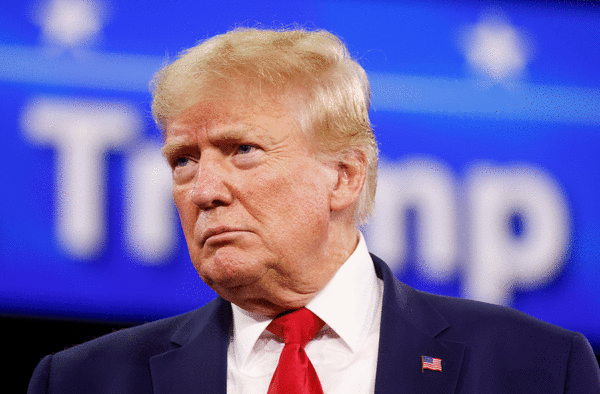
WASHINGTON — After dishing out more domestic discord this month, President Donald Trump this week will pivot hard to foreign affairs, putting his controversial artificial intelligence and Iran policies in the spotlight as the Senate looks to pass a college sports bill he has backed.
The president heads to New York City on Monday for meetings with world leaders and a much-anticipated Tuesday address before the U.N. Security Council. On Wednesday, he will personally greet Chinese President Xi Jinping at Joint Base Andrews outside Washington, D.C., at the start of a state visit as the economic superpowers engage in an AI arms race.
Trump’s address to the General Assembly, slated for Tuesday morning, is expected to amount to a defense of his second-term global moves and a preview of his intentions for his final two years as commander in chief.
Mike Waltz, U.S. ambassador to the United Nations and a former Florida Republican congressman, told reporters on Friday evening that Trump will use the speech to “highlight how he has, and his administration (has), confronted complex problems head-on around the world.”
“He’ll include many of the issues, frankly, neglected by past administrations that he’s not going to kick the can on,” Waltz said on a briefing call that was delayed several hours after Trump announced he would ban CNN, MS Now and Politico from the White House grounds over what he called “fake” reporting. (Those outlets announced a legal challenge on Monday morning.)
Along with kicking out journalists, Trump has further angered Democrats in recent weeks with his moves related to the Kennedy Center, resistance to new regulations for AI, full embrace of data centers, shrugging off Americans’ economic concerns and a public offer to voters to send them $5,000 if they keep the House and Senate in GOP control in November’s midterm elections.
Those matters will be on pause for two days as he heads to the Big Apple with all eyes on how foreign leaders address the ongoing U.S.-Israeli standoff with Iran, which continues to keep gas and other prices elevated 43 days out from an election that could hand House Democrats investigatory and subpoena powers to pry open closely guarded details about his second-term moves.
Waltz told reporters that his boss’s General Assembly address won’t usher in a kinder and gentler Trump foreign policy.
“He’s not going to leave them for another day or another administration,” Waltz said of a spate of global challenges. “He will touch on the importance of ensuring that Iran never has a nuclear weapon, which is not only demanded by the United States, (but) has been demanded by the U.N. Security Council in repeated resolutions. And he’ll talk about some of the United States accomplishments … over the past year.”
Trump has made clear since he opted to join Israeli Prime Minister Benjamin Netanayhu in striking targets inside Iran on Feb. 28 that he has been frustrated with other world leaders — including a list of traditional U.S. allies — for refusing to lend a hand. But he has mostly sidestepped questions from reporters about reports that China has not done enough to try convincing remaining leaders in Tehran to strike a deal to end the conflict.
Trump administration officials, on the same Friday evening call with journalists, said Iran and AI, along with a number of economic and trade matters, would be atop the agenda once Xi arrives for three days of meetings and a state dinner at the White House on Thursday evening.
But when pressed for specifics about just what AI-related topics Trump wants to discuss with his counterpart, the officials repeatedly said they did not want to “get ahead of” the coming one-on-one talks between the two leaders.
Ahead of the Trump-Xi summit, Democratic lawmakers called on the U.S. president to secure some kind of agreement with Xi to put the brakes on AI development.
Democrats on the House Select Committee on the Chinese Communist Party have scheduled a virtual hearing Wednesday on AI and China. Its top Democrat, California Rep. Ro Khanna, said in a Sept. 17 statement that “the American people are deeply concerned about the future of AI and the potential risks.”
“We urgently need an agreement with China on basic inspections and safety standards. We have convened the world’s leading experts to testify on what agreement is possible,” he said. “After multiple requests to OpenAI and Anthropic, they haven’t committed to testifying. Going forward, we will use all options to compel their appearance once we are in the majority.”
Sen. Chris Coons, a Delaware Democrat who sits on the Foreign Policy and Judiciary committees, last week told Bloomberg Television that AI development “is as much a threat to China as it is to the United States.” He added that during the Cold War, the U.S. and Soviet Union “were able to negotiate arms control agreements to reduce the risk we would destroy humanity.”
“This moment requires us to do the same, to look up from our domestic concerns or our partisan concerns and work to find a way that we can come up with some minimal, reasonable guardrails to slow the rapidly accelerating pace of AI development and deployment,” Coons said.
But in a Monday midday social media post, Trump wrote he would not agree to or enact anything on AI that he determined would “stifle Growth.”
‘Not been up to par’
Meanwhile, administration officials expressed frustration heading into the talks about China’s actions on issues like rare earth minerals — long a source of tension between Xi’s government and all recent American administrations, regardless of political party.
One administration official drew a diplomatic line on Friday evening, pushing back on a reporter’s question about whether the U.S. side would relax its trade policies in order to try changing Beijing’s behavior.
“There’s not going to be any exchange of export controls to get something that, in our view, we’ve already negotiated for, and that’s, you know, the proper flow of rare earths,” the official said. “China’s performance, in that respect, has not been up to par of what we would expect, and that I’m sure will be a topic of discussion.”
The same official confirmed the economic rivals have been discussing lowering what he described as “certain tariffs in non-strategic sectors.” If an agreement is struck this week, it would cover “a narrow band of goods…that are non-sensitive and non-strategic.”
Still, the administration official said Trump “is not interested in compromising on our national security, and so some of the rules and regulations that … present hurdles would still have to be met for some of these types of investments to occur.”
As Trump fetes Xi, the Senate is expected to look for a time agreement on a college sports bill that Trump has backed. Without such a pact, the chamber could be forced to wait until Friday to wrap up work on the “Protect College Sports Act.”
He has left most of the public relations campaign on the bill to its primary authors, Senate Commerce Chair Ted Cruz, R-Texas, ranking member Maria Cantwell, D-Wash., panel member Eric Schmitt, R-Mo., and Coons.
“If Congress didn’t act,” Cruz said in a Sept. 17 X post, “there was a threat of the SEC and Big 10 joining forces to create a super league.”
Such a move, bill advocates and officials from other collegiate conferences have said, would inject even more chaos into the name, image and likeness era.
_____
©2026 CQ-Roll Call, Inc., All Rights Reserved. Visit cqrollcall.com. Distributed by Tribune Content Agency, LLC.




Comments