Free state parks admission, new hurdles for offshore oil drilling among environmental bills Newsom signs
Published in News & Features
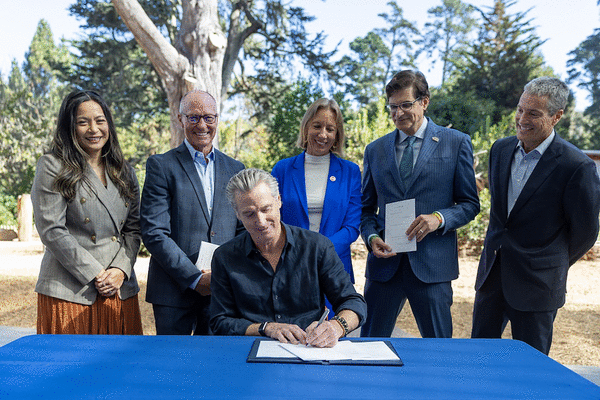
With less than 100 days left in his final term as governor, Gavin Newsom on Tuesday signed a bill that makes it more difficult for President Donald Trump to open California’s coast to new offshore oil drilling.
California already bans all new offshore drilling in state waters out to 3 miles offshore, under a law signed by former Republican Gov. Pete Wilson in the early 1990s after the Exxon Valdez oil spill in Alaska. Tuesday’s law would go farther, prohibiting the use of existing pipelines and other infrastructure in state waters to support new offshore oil drilling in federal waters.
Newsom also signed other environmental bills Tuesday to expand “non-lethal strategies” for wolves and ranchers to co-exist, and make a program permanent that provides free admission to state parks by allowing people to check out parks passes from public libraries.
At a conference at the California Academy of Sciences in San Francisco, Newsom said California has worked to hold the line, particularly on climate change issues, as Trump has rolled back dozens of federal environmental rules and laws.
“If we are just waiting for Donald Trump or the guy or gal on the white horse to come save the day,” Newsom said, “we are going to be left wanting, frustrated, angry and in despair. This movement has to be at this moment bottom up.”
The oil drilling bill, AB 1448 by Assemblyman Gregg Hart, D-Santa Barbara, was strongly supported by dozens of environmental organizations, from the Surfrider Foundation to the Monterey Bay Aquarium. It was opposed by business groups like Long Beach Area Chamber of Commerce and some unions, such as the State Building and Trades Council.
California is the nation’s eighth-largest oil-producing state. Most of its oil is produced from inland wells, but there are 27 offshore platforms and artificial islands where oil is produced, all located in Southern California off the coasts of Santa Barbara, Ventura, Los Angeles and Orange counties. They date back to the 1950s. No new ones have been constructed since 1983 because of opposition from political leaders, conservation groups and the tourism and fishing industries.
Trump attempted to open new areas off California and the West Coast during his first term, but opponents sued and when President Biden won election in 2020, he killed the plan.
Last year, Trump tried again, announcing that his administration was beginning efforts to open broad stretches of federal waters beyond 12 miles off the California coastline to new oil and gas drilling. So far, the Department of Interior has not issued specific maps showing where it will seek to allow oil companies to bid on new leases and potentially build offshore platforms. The agency is conducting environmental studies as required under federal law. If Democrats win control of Congress in November, they are virtually certain to work to block any new drilling by stripping funding for studies, as they did when President Reagan attempted new drilling in the 1980s, along with using other tactics.
“On the heels of several recent policy decisions that have led to the announced closures of two additional refineries in California,” the Building and Trades Council wrote in opposition, “this bill seeks to cut off yet another source of domestic crude oil for our in-state refineries. Simply put, California and every Californian cannot afford this bill or policies like it.”
Environmental groups noted California’s coast supports tourism, fishing and recreation industries valued at more than $51 billion a year, which are at risk of offshore spills like the 1969 Santa Barbara oil spill or the 2010 Deepwater Horizon spill in the Gulf of Mexico. A poll in July by the Public Policy Institute of California found that 63% of likely California voters oppose new offshore oil drilling in the state with only 34% in support.
“California just stepped up in the face of Trump’s deranged offshore drilling plan,” said Brady Bradshaw, California advocate at the Center for Biological Diversity Action Fund. “This administration’s shameless attempt to industrialize the ocean has made it clear that we have to defend our wildlife and natural spaces with everything we’ve got.”
Tuesday’s event came days after Newsom vetoed several significant environmental bills.
On Sept. 18, Newsom vetoed SB 954, a top priority this year in the state Capitol for many environmental groups. The bill by Sen. Catherine Blakespear, D-Encinitas, would have scaled back a landmark law Newsom signed last year to streamline the California Environmental Quality Act to encourage faster construction of housing, solar and wind farms, water systems and other projects.
Blakespear’s bill sought to restore full environmental studies for new advanced manufacturing plants that were given relief by Newsom last year. The Sierra Club and other groups called those provisions a loophole that would allow battery recycling and other potentially polluting plants to be built without proper oversight. But the California Chamber of Commerce and other business groups staunchly opposed the reversal, saying it would undermine the state’s manufacturing competitiveness as it seeks private funding and federal grants to build everything from new semiconductor facilities to electric vehicle factories.
“Protecting communities and strengthening California’s advanced manufacturing economy are not mutually exclusive goals,” Newsom said in his veto message. “The exemption was designed to advance both and should be given a meaningful opportunity to work.”
Also Tuesday, Newsom signed another of Hart’s bills, AB 1804, to make permanent a pilot program Newsom and his wife, Jennifer Siebel Newsom, started in 2021 to provide free day-use passes to 200 of California’s state parks that people can check out from more than 1,100 public libraries.
He also signed the “California Wildlife Coexistence Act,” a bill that requires the state Department of Fish and Wildlife to set up an umbrella program to pay ranchers when wolves kill their cattle, to better track such attacks and to offer more assistance in non-lethal ways to keep wolves from herds. The bill, SB 1135, by Blakespear, comes as ranchers in Lassen, Shasta and other rural counties report increasing attacks on their livestock by endangered wolves that have returned to California after being wiped out in the state.
Defenders of Wildlife, the Nature Conservancy and other environmental groups supported the measure. The Shasta County Board of Supervisors opposed it, saying it was “well intentioned,” but local control was better because the measure depends on future state funding.
Finally, Newsom also signed SB 1250 by Sen. Dave Cortese, D-San Jose, to require Caltrans to publish a list every two years of the wildlife overcrossings, under crossings and other projects it builds to better streamline planning to reduce collisions between vehicles and deer, mountain lions and other wildlife.
©2026 MediaNews Group, Inc. Visit at mercurynews.com. Distributed by Tribune Content Agency, LLC.





Comments