Trump tariffs will add $1 billion to cost of new NYC subways, trains and buses, MTA says
Published in News & Features
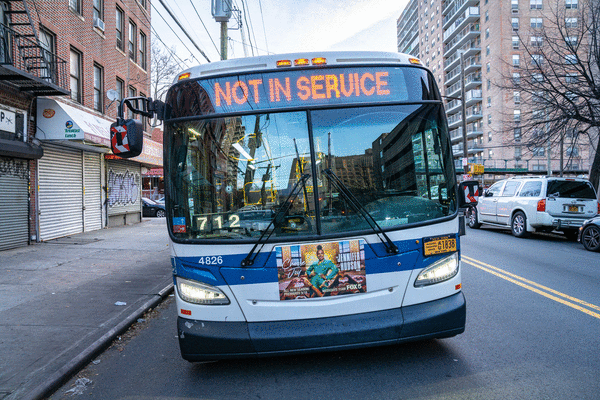
NEW YORK — The Trump administration’s controversial tariffs on imported goods will add $1 billion to the cost of modernizing the MTA’s bus and rail fleet, according to an estimate by the transit agency shared Wednesday — and Gov. Kathy Hochul has written to Washington asking for an exemption.
Trump’s “high and unpredictable tariff rates” on specialized components that have to be imported to the U.S. have driven up the cost of building a subway car by 27.9% since August 2025, according to Jesse Lazarus, head of the MTA’s rolling stock program.
“All-in, we are forecasting tariffs alone will increase costs for trains and buses by $1 billion into 2030,” the transit agency’s car-czar said Wednesday. “That’s a billion dollars to pay the federal government, not the American workers making our trains and buses.”
“Some of the components required to make a subway car are so specialized, we cannot avoid importing them — we need to source them from very specific places,” she added.
Prior to the Trump tariffs, the government already required any federally funded purchases of train cars or buses to be made in the United States, and 70% of their components must be sourced from the U.S.
And while the newest generation of subway cars on the lettered lines — the R211 built by Kawasaki in Lincoln, Nebraska — exceeds that requirement for American parts, the tariffs still end up adding significant cost, Lazarus said in a presentation to the MTA’s board.
Some of a train car’s high-carbon steels and wheel parts come from Japan, said Lazarus. Specialized fan motors and compressors are made in Italy. Critical components in a subway’s traction-power control circuits are sourced from Taiwan.
“Today’s tariffs on American-made rolling stock are diluting the American taxpayer’s investment by punishing manufacturers for sourcing components they cannot buy anywhere else,” Lazarus said.
“Of course, tariffs are not an entirely new thing, but it’s the nature of today’s tariffs that present an unprecedented challenge to the MTA’s rolling stock (program),” she said. “If it is not contained, it will force us to make difficult decisions about upcoming investments.”
Within the next four years, the MTA plans to replace the aging M3 cars on the Long Island Rail Road, purchase a fleet of new buses, and develop a new class of subway car to replace the aging R62s that operate on the system’s numbered lines — part of a $23 billion program to upgrade rolling stock at NYC Transit and the commuter railways.
Any of those efforts could be impacted by the tariff price hike, Lazarus said.
Presently, the MTA is offering to take on 90% of the tariff risk in upcoming contracts, on the assumption that the ultimate cost to the agency will be lower than if a manufacturer were to assume the total tariff on its own.
But in the longer term, officials said Wednesday, the MTA hopes to secure an exception to the tariffs for goods going into American-made train cars and buses that are funded by taxpayer dollars.
In a letter sent Wednesday to Trump’s commerce secretary, Howard Lutnick, Gov. Hochul called the tariffs a “tax on transit,” and pushed for an exemption.
“Higher tariffs on rolling stock will not result in a railcar manufacturing boom,” Hochul wrote. “(I)t will only raise costs for transit agencies at a time when other construction costs are skyrocketing.”
_____
©2026 New York Daily News. Visit nydailynews.com. Distributed by Tribune Content Agency, LLC.




Comments