Foiled mall plot reveals how Minnesota's terror threat has evolved
Published in News & Features
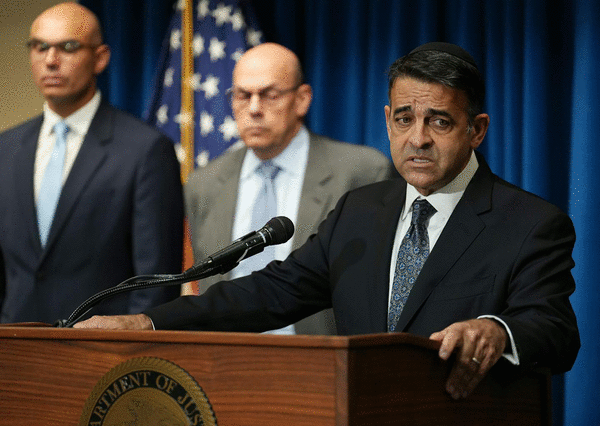
MINNEAPOLIS — Messages between a young man and a confidential informant. Talks about joining al-Shabaab. Plans for a mass casualty attack.
The federal criminal case filed against a young Minnesota man Wednesday echoed a series of cases that made headlines a decade ago, when a wave of young men were lured by terrorist organizations to travel thousands of miles.
But this time, the destination wasn’t just the Middle East or eastern Africa.
It was the Mall of America.
Sheikhdoon Abdullahi Mohamud, 18, is charged with obtaining a firearm to carry out an act of terrorism later this month at the largest mall in the United States. His alleged radicalization shows some of the same signs as the terrorism cases seen in Minnesota more than a decade ago: Engaging in pro-terrorist messages online, pledging allegiance to a designated group and progressing toward a plan of criminal action.
His case raises the question of whether any similar cases are imminent, or if it’s an outlier.
The kinds of terrorism prosecutions Minnesota saw a decade ago have diminished after the collapse of the Islamic State’s territorial control, according to academics and terrorism experts. But the threat of homegrown violent extremism never went away completely.
The National Counterterrorism Innovation, Technology and Education Center counts 282 people, including Mohamud, who have been charged for ISIS-related activity since 2014.
Austin Doctor, director of strategic initiatives for the center, said homegrown violent extremism still presents a problem within the United States even if the number of cases have dwindled. The defendants accused in terrorism cases now have a growing emphasis on carrying out attacks that will result in higher casualties, he said.
He pointed to the case of the man with an Islamic State flag who killed 14 people when he drove into a crowd on New Year’s Day in New Orleans last year as an example.
“That threat hasn’t gone away; it continues to persist,” Doctor said.
‘I will do attack here’
The complaint against Mohamud alleges he repeatedly messaged a confidential source that he wanted to travel to Somalia to fight on behalf of a terrorist organization. He later told the source that he didn’t have enough money to travel there, and had changed plans.
“I will do attack here,” he wrote, according to the complaint.
The complaint said Mohamud, a U.S. citizen raised by Somali parents, discussed wanting to commit shootings at various locations in the Twin Cities. He pondered an attack at Valleyfair around Christmas before fixating on the Hmong Arts Celebration at the Mall of America on Oct. 24.
By that point, he had pledged allegiance to ISIS through a selfie-style video, investigators said in his complaint.
The FBI arrested Mohamud before he followed through on the attack. He was taken into custody Oct. 6 at a parking lot in Richfield after he bought an AK-47 rifle, four magazines and 200 rounds of ammunition from an undercover agent who he thought was a member of ISIS.
The charges against Mohamud recalled similar counterterrorism investigations that gripped Minnesota more than a decade ago, when groups of Somali-Americans faced charges for leaving the United States to fight alongside Islamic extremist groups.
The Justice Department brought terrorism charges following an investigation into the disappearance of up to 20 local men who left the Minneapolis area and traveled to Somalia to train or fight with the terrorist group al-Shabaab.
Another major counterterrorism investigation in 2015 led to indictments against 11 Minnesotans charged in a conspiracy to provide material support to the Islamic State of Iraq and the Levant.
To Doctor, the foiled Mall of America attack reflects the lingering threat of violent extremism and U.S. Homeland Security’s attention to the issue.
“Cases like this show that the messaging of the Islamic State is continuing to take root in at least portions of persons living within the United States,” he said.
Oren Gross, a professor at the University of Minnesota Law School, said there’s a growing amount of data showing both that the people drawn to terrorist organizations are becoming younger and some young people are seeking such propaganda on their own. In the past, he said, defendants were lured by centralized terrorism organizations that most commonly offered them financing or training.
The allegations against Mohamud appear to fit that trend, Gross said, while noting that it’s “too early to tell” whether the case reflects a resurgence of terrorism threats overall.
The complaint outlining the case against Mohamud largely focuses on his conversations with the confidential source dating to December 2024. He frequently communicated about the attack through social media apps like TikTok, Telegram and Discord, and pondered whether to join al-Shabaab or ISIS.
“I wanna get martyred inshallah,” one of his messages to a confidential informant said. He also expressed a growing exasperation with the direction of his life in America.
Gross said it’s unclear to what extent Mohamud’s case is a one-off, but the evidence at hand does not indicate a resurgence of co-conspirators fleeing Minnesota to join forces with terrorism groups.
“So panic? Unnecessary. Vigilance? Yes.” he said.
©2026 The Minnesota Star Tribune. Visit startribune.com. Distributed by Tribune Content Agency, LLC






Comments