US becomes main fuel supplier to Cuba amid surge in exports to private sector
Published in News & Features
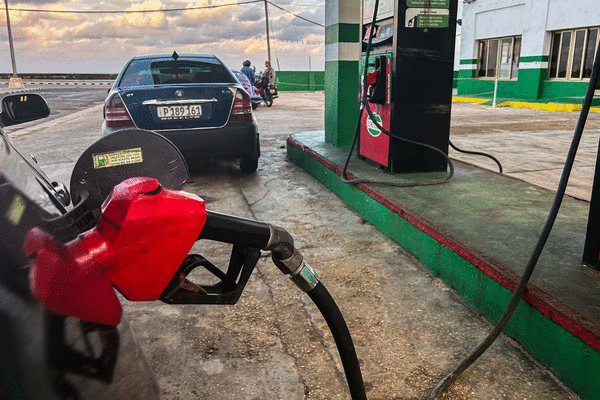
U.S. companies exported $231.7 million in fuel to private companies in Cuba from January through August 2026, making the United States the main fuel supplier to Cuba as the Trump administration continues to block oil shipments to the island’s government.
The Trump administration cut off Cuba’s oil supply this year, stopping shipments from Venezuela after the capture of Nicolás Maduro in January and pressing Mexico to halt deliveries.
Fuel sales to Cuba were minimal until February this year, when the Trump administration allowed U.S. fuel sales to Cuba’s private sector. They have grown so rapidly that, in August, fuel exports outpaced food exports to the island, according to data the New York-based U.S.-Cuba Trade and Economic Council released last week. That month, food and agricultural exports totaled $60.1 million, compared with $74.8 million in fuels.
The U.S. Department of Energy also recently reported a large increase in exports of petroleum products to Cuba, mainly diesel and gasoline. However, the figure, a record 3..2 million barrels in July, does not align with the Council’s reported dollar value or with how the fuel is moved, loaded into special containers known as ISO tanks. Jorge Piñón, an energy researcher at the University of Texas at Austin, is skeptical of the data and noted that only sanctioned Cuban state energy company CUPET has the capacity to store such a large quantity of fuel in one month.
Last week, federal agents in Miami announced the seizure of more than 600,000 gallons of biodiesel at Port Everglades and Port Houston heading to Cuba. Officials valued the cargo at about $2.8 million and said it was bound for a sanctioned Cuban state company, Enetec. However, Enetec is an intermediary agency and does not take ownership of the shipments, according to a person linked to one of the companies selling the fuel.
In an interview with Reuters in Havana, Cuban Minister of Energy and Mines Vicente de la O Levy said he had no knowledge of the shipments intercepted by the U.S. Department of Homeland Security.
“We can assure you that there was no contract of any kind with ENETEC S.A.,” De la O Levy told Reuters. “No Cuban state-owned company has managed to secure a fuel contract, whether for small or large quantities.”
At sea, the Coast Guard said it boarded the Grace in the Caribbean on Sept. 5 and escorted it to Progreso, Mexico, because it was hiding “illicit” fuel bound for Cuba in the ship’s ballast tanks and containers. The Coast Guard also said it had earlier detained the Jaira Provider, also carrying fuel to Cuba. Cuba’s deputy foreign minister, Carlos Fernández de Cossío, called the interdictions illegal.
Sales of U.S. fuels to Cuba state companies remains prohibited, but once on the island, anecdotal accounts and reports on Cuban independent media suggest some of the fuel might end up filling the tanks of government cars. Some private sellers have inked deals with CUPET and CIMEX, two sanctioned state companies, to lease gas stations to sell the fuel imported from the United States.
In the interview, De la O Levy said the Cuban government did not benefit from U.S. fuel sales. “We have the same blackouts, we have the same generation electricity deficits.”
While the cutoff of oil shipments to the Cuban government has strengthened the island’s private sector and pressured the government into announcing some reform to its centrally planned economy, it has also tipped Cuba to the brink of collapse, worsening a humanitarian crisis that has been raging for years, mostly due to government’s mismanagement and the lack of production.
Shift toward private sector
The decades-old U.S. embargo does not block the sale of food, medicines and other basic goods to Cuba. Traditionally, the Cuban government bought staples like chicken, vegetable oil, rice, soy and corn from the United States, along with many other products. But in recent years, trade between the two countries has changed significantly, as government spending decreased due to the country’s economic collapse, while micro, small and medium private enterprises filled the gap.
Total U.S. goods exports to Cuba reached $ 202.5 million in August and $876.5 million so far this year through August, according to the U.S. Census Bureau. The Council estimates that total U.S. exports to Cuba may surpass $1 billion in 2026.
Sales of cars and other types of vehicles to private entities in Cuba are also significant. Since 2022, the council says, exports of vehicles, motorcycles, bicycles and parts to Cuba have exceeded $333 million, including $ 106.7 million in 2026 so far.
The council’s August report also highlights exports worth $10.5 million in solar cell modules, $7 million in gasoline vehicles, $3.7 million in motorcycles and $1.6 million in lithium-ion batteries.
_____
©2026 Miami Herald. Visit miamiherald.com. Distributed by Tribune Content Agency, LLC.






Comments