After tearful testimony by ICE agent, judge mulls jurisdiction of assault case
Published in News & Features
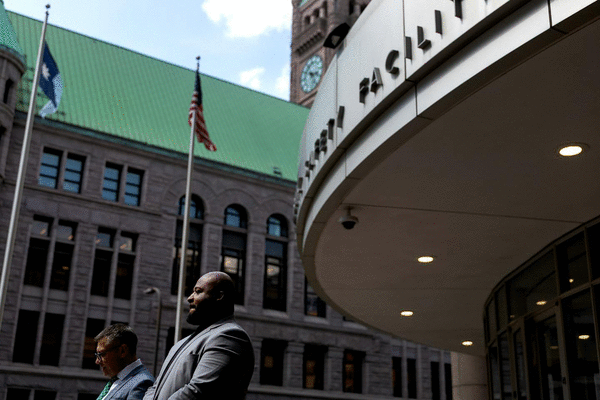
A judge is mulling an ICE agent’s attempt to stand trial in a federal courtroom instead of Hennepin County Court after hearing arguments spanning more than two days and tearful testimony from the defendant.
The ICE agent, Gregory Morgan Jr., is charged with two counts of second-degree assault for allegedly pointing his gun at two motorists who blocked him as he drove on the shoulder of Hwy. 62 during Operation Metro Surge. Hennepin County Attorney Mary Moriarty has argued the charges bring accountability for “extremely dangerous conduct” during the 10-week immigration enforcement action.
The proceedings included testimony from Morgan’s ICE agent partner, his ICE use of force trainer and Morgan himself to determine which jurisdiction his criminal case will proceed.
The motorists who reported Morgan, resulting in his charges, did not take the stand after their lawyer told the court they would invoke the Fifth Amendment rights during the hearing if called. U.S. District Judge Nancy Brasel allowed the move but said she may determine whether their testimony was needed later.
Morgan’s defense heavily relied on his perception of being under attack when he encountered the motorists’ Cadillac on the highway and that he was following his ICE training at the time of the incident. The state pressed Morgan on his driving that day and whether a gun is a proper way for law enforcement to identify themselves.
The case will test how the courts will determine who has jurisdiction when state prosecutors charge federal agents with crimes tied to their immigration enforcement duties. The state felony charges against Morgan were the first of their kind in the country to be levied over a federal agent’s actions while on duty.
The line of questioning from Morgan’s attorney Ryan Pacyga framed him as a single father and agent of less than a year who wanted nothing to do with the Operation Metro Surge assignment. Morgan testified that he didn’t want to go to Minnesota due to reports of unrest in the Twin Cities and his father’s cancer. Once he arrived, he said, he frequently encountered people throwing rocks and dildos at him and was called racial slurs.
“It was really overwhelming,” he said.
At one point during his testimony, Morgan abruptly stopped to hunch over and cry on the stand as he described the level of vitriol he faced from protesters and the personal toll it had taken on him and his family.
“I can’t live,” he said, his voice barely audible. “Because I was doing a job I was forced to do.”
Lawyers for the state pressed Morgan on whether his driving on the shoulder and fast speeds prompted the reaction from the Cadillac, as opposed to the defense’s claims that the driver was impeding federal immigration enforcement. They also questioned the defense’s argument that the Cadillac brake checked Morgan and his partner.
“It’s not within the realm of possibility that the Cadillac brake checked you to pull behind this car?” asked Julia Gegenheimer. Morgan emphasized he believed the car was impeding their vehicle.
Both Morgan and Myles Codner, Morgan’s law enforcement partner who was in the car at the time, testified that they felt under siege when they approached the swerving Cadillac on the highway. Codner said he believed the occupants were more protesters who were following them.
“I felt that we had been ambushed,” he said.
Morgan said he was concerned for the safety of himself, his partner and others on the road at the time when he flashed his gun near his chest for approximately five seconds as he yelled “police, back off.”
“That’s why I did what I did,” he said.
John Parodi, who trained Morgan when he became a federal agent, testified that merely pointing a firearm is not considered a use of force, according to ICE policy.
According to charging documents, the road rage encounter on Feb. 5 began as Morgan was driving east on Hwy. 62 in an unmarked Ford Expedition. His law enforcement partner was in the middle row, behind Morgan.
As Morgan drove on the right shoulder, a Cadillac with two occupants moved over to block his SUV in order to “cut him off a little bit,” one of the victims later told police, saying that they were not aware the occupants of the SUV were law enforcement. Morgan then drove alongside the Cadillac, pulled out his gun and pointed it at the people inside the vehicle. One of the occupants called 911 and told emergency dispatch:” A guy just aimed his gun at me … he just aimed a Glock at my face.”
If Morgan’s case is moved to federal court it will create a historic legal scenario in Minnesota. The case would be overseen by a federal judge under federal court rules, but it would still be a state prosecution for violation of state laws.
Brasel did not give a timing on when she may make a decision.
©2026 The Minnesota Star Tribune. Visit at startribune.com. Distributed by Tribune Content Agency, LLC.



Comments