US lifts sanctions on Delcy Rodríguez's brother amid Venezuela controversy
Published in News & Features
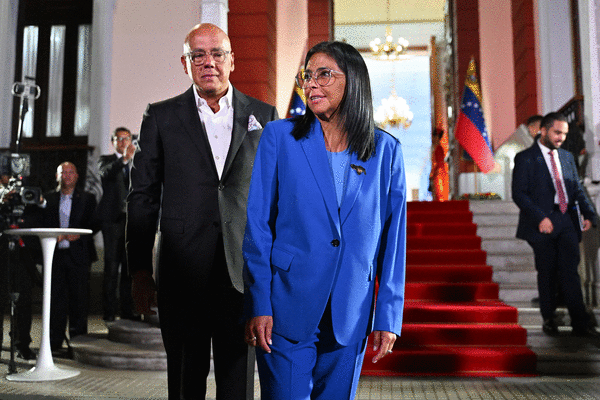
The Trump administration has removed Jorge Rodríguez, the brother of Venezuela’s acting President Delcy Rodríguez and one of the country’s most powerful political figures, from a U.S. Treasury Department sanctions list, further intensifying an already controversial relationship between Washington and the Venezuelan government that succeeded ousted President Nicolás Maduro.
The Treasury Department’s Office of Foreign Assets Control announced the removal of Jorge Jesús Rodríguez Gómez from its Specially Designated Nationals List, reversing sanctions imposed in September 2018 when the United States accused him and other members of Maduro’s inner circle of helping the Venezuelan leader consolidate his grip on power.
The action comes amid growing cooperation between Washington and the government headed by Rodríguez’s sister, which has reportedly facilitated the transfer of prominent businessmen wanted by U.S. prosecutors, including Alex Saab in May and his longtime business partner Álvaro Pulido earlier this week.
The Treasury notice does not explain why Rodríguez was removed from the sanctions list or indicate whether the decision was connected to Venezuela’s recent cooperation with U.S. authorities.
The decision marks another significant development in the Trump administration’s increasingly controversial relationship with the Venezuelan government that emerged after Maduro was removed from power in January.
Many Venezuelans, particularly opponents of the former president, view Rodríguez not as a departure from the authoritarian system they have long opposed, but as its continuation under new leadership.
As one of Maduro’s closest and most powerful allies, she remains closely associated with a regime widely blamed for political repression, economic devastation and the exodus of millions of Venezuelans. For those critics, Washington’s growing embrace of her administration raises concerns that the United States may be helping preserve the very political system it once sought to dismantle.
Jorge Rodríguez, a longtime Maduro ally who has held several senior government positions, has remained an influential figure in Venezuelan politics and a central member of the leadership surrounding his sister.
The Treasury announcement identifies Rodríguez by his full name, his date of birth, Nov. 9, 1965, and his Venezuelan identification number. Five entries appearing in the notice refer to variations of his name and identify the same individual.
His removal from the sanctions list generally lifts the asset-blocking restrictions associated with that designation and the prohibition on transactions with him by U.S. persons, although other applicable legal restrictions could remain in effect.
Rodríguez was sanctioned on Sept. 25, 2018, alongside his sister, Maduro’s wife, Cilia Flores, and Venezuelan Defense Minister Vladimir Padrino López.
At the time, the Treasury Department accused the Maduro government of systematically looting Venezuela’s riches while relying on a network of loyal officials to maintain political control.
“President Maduro relies on his inner circle to maintain his grip on power, as his regime systematically plunders what remains of Venezuela’s wealth,” then-Treasury Secretary Steven Mnuchin said in announcing the sanctions.
The 2018 statement specifically identified Delcy and Jorge Rodríguez as senior officials whom Maduro had placed in influential government positions to strengthen his hold on power.
Jorge Rodríguez had served as Venezuela’s vice president under Hugo Chávez in 2007 and later as mayor of Caracas’ Libertador municipality before becoming Maduro’s minister of communication and information in 2017.
His sister, meanwhile, served as foreign minister, president of the controversial National Constituent Assembly and executive vice president under Maduro before assuming the presidency following his removal earlier this year.
The original sanctions generally blocked any property or interests in property belonging to the designated individuals that came under U.S. jurisdiction and prohibited Americans from conducting transactions with them.
Treasury said at the time that sanctions against Venezuelan officials were not necessarily long term.
“U.S. sanctions need not be permanent; they are intended to change behavior,” the department stated in its September 2018 announcement.
It added that Washington would consider lifting sanctions against officials who took meaningful steps to restore democratic order, refused to participate in human rights abuses and helped combat corruption.
The latest removal does not specify whether the Trump administration concluded that Jorge Rodríguez has satisfied any of those conditions.
Inclusion on Treasury’s Specially Designated Nationals List generally prevents designated individuals from accessing assets under U.S. jurisdiction and prohibits U.S. citizens, companies and financial institutions from engaging in most transactions with them. Removal from the list can therefore have significant financial consequences, potentially restoring access to banking services and transactions previously prohibited under U.S. sanctions.
The decision does not, by itself, establish that Treasury has cleared Rodríguez of the allegations underlying his original designation or that every possible restriction involving him has been lifted.
It also does not establish a broader removal of sanctions against other Venezuelan officials, including his sister.
Earlier this week, Colombian businessman Álvaro Pulido, a longtime partner of Alex Saab, arrived in Miami to face federal charges stemming from alleged money laundering schemes involving nearly $2 billion in Venezuelan government funds.
Pulido had been imprisoned in Venezuela since 2023 in connection with the PDVSA-Cripto corruption investigation.
Colombia’s El Tiempo newspaper reported that agents from the U.S. Drug Enforcement Administration removed Pulido from a Venezuelan prison with the consent of Delcy Rodríguez’s government.
_____
©2026 Miami Herald. Visit miamiherald.com. Distributed by Tribune Content Agency, LLC.






Comments