Judge dismisses Maryland lawsuit over Baltimore ICE facility
Published in News & Features
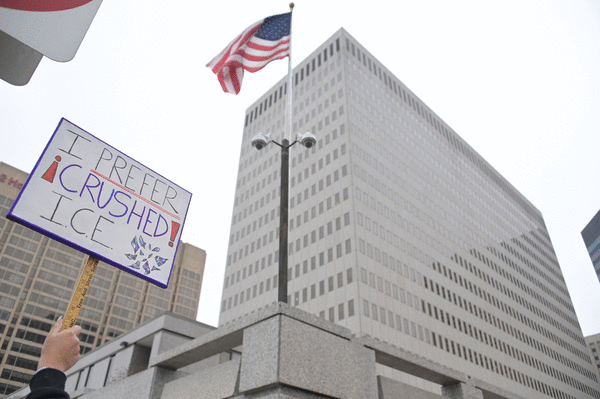
BALTIMORE — A federal judge dismissed Maryland’s lawsuit against federal immigration authorities this week over the agencies’ refusal to provide information about conditions of a downtown Baltimore facility where detainees have been held.
Maryland Attorney General Anthony G. Brown had sued Immigration and Customs Enforcement and the U.S. Department of Homeland Security in March, after the agencies refused to provide records related to holding rooms in the George H. Fallon Federal Building. The office alleged the facility’s conditions were inhumane.
U.S. District Judge Julie R. Rubin on Thursday dismissed Brown’s complaint, saying the subpoena exceeded the Office of the Attorney General’s legal authority under the state code it cited. “The OAG has no cognizable right to the information requested,” Rubin wrote, “there is no ‘actual harm.'”
Government attorneys refused to provide the records Brown subpoenaed, saying the request was overly broad and burdensome and that some documents could violate privacy protections.
A spokeswoman for Brown said the office is “reviewing the opinion.”
A Homeland Security spokesperson said in an email to The Baltimore Sun that the agency was pleased “this frivolous lawsuit” was dismissed.
“The ICE Baltimore field office is a processing facility, not a detention facility,” the spokesperson said, adding that those sent there “are quickly processed and transferred to permanent housing at a detention facility. These claims that there are subprime conditions or overcrowding are false.”
The statement added that food, water, blankets and hygiene products are distributed, and “each holding room is equipped with a phone where detainees can make phone calls to family members and lawyers.”
A viral January video showed detainees crowded on a floor under blankets, outraging state officials and members of the Maryland congressional delegation who made unannounced visits after reports that detainees were being held in cold, unsanitary conditions without adequate food or medical attention.
Brown previously said his office has monitored the holding facilities, which were not meant for long-term detention, since the summer of 2025, and conditions have since deteriorated. A related class action suit filed by immigrant rights groups on behalf of detainees in Baltimore, described as many as 40 to 50 people crowded into a room measuring just 15 feet by 15 feet, forcing them to sleep sitting up, without bedding and in “extremely cold” conditions, the office has said.
That case is also before Rubin, who was appointed by President Joe Biden. In March, Rubin found “ICE routinely exceeds” its own maximum capacities for the holding rooms, one day detaining more than 120 people, or more than twice the 56-person capacity, according to court documents. She also found detainees were kept for more than three days, during which they were unable to bathe and were subjected to unclean cells and toilets.
“The conditions,” Rubin wrote in a March 6 order, “demonstrate a sufficiently serious deprivation.
©2026 Baltimore Sun. Visit baltimoresun.com. Distributed by Tribune Content Agency, LLC.






Comments